

The open web is collapsing and the marketplace is responding with a next generation shift in strategic advantage, for those who can adapt, whether corporates or non-profits.
What we are witnessing is the web splitting into two tiers. A Synthetic Web that is mostly commodified, open, AI-dominated, highly forgettable, good enough for routine queries and creation, increasingly generic. And a Verified Web, one which is about partnering and is authenticated, governed, human-curated, connected to academic research and business practices, where the real strategic intelligence lives.
What’s happening… six collapses
For three decades the open web has powered knowledge discovery. It is so ubiquitous, we take it for granted. Now, in the wake of AI, the web is experiencing six separate collapses which, when combined, are degrading it as a knowledge source.
Each collapse feeds the others… Content collapse degrades AI training data. Trust collapse reduces engagement with publishers. Traffic collapse destroys publisher finances. Financial collapse and open access collapse removes expert knowledge from the open web. Knowledge quality collapse makes general-purpose AI less reliable, deepening the trust crisis.
1. The open web is drowning in slop
(Content Collapse)
In a period of just three years more than 74% of new web pages now contain AI-generated content. Over half of new articles are written or assisted by machines. Merriam-Webster named “slop” (low-quality AI content) its 2025 Word of the Year. Slop is arriving faster than anyone can sort the good from the bad, and the economics of it are brutal. Producing synthetic content costs next to nothing. Verifying it costs real time and money. The volume of unreliable content grows, while the resources to check it shrink.
As a moderator on Reddit commented
“I just feel like, the dead internet, there’s this sadness I feel of this one place on the internet that was so human is sort of eroding and becoming bogged up with artificial AI-driven content… I think that’s super depressing.”
Likewise, Facebook, Instagram, YouTube, and others are a tide of AI slop. The signal-to-noise ratio on the open web is breaking.
2. AI is eating itself
(Knowledge Quality Collapse)
When AI models are trained on content generated by previous AI models, they degrade, in the sense of narrowing. AI researchers call it “model collapse”. In the early stages, the model loses information from the tails of its data distribution. It loses the rare stuff, the unusual, the niche, the minority viewpoints, the specialised knowledge. It still looks like it’s working fine on common queries. But it’s gradually becoming blind to the edges.
In July 2024 a landmark paper in Nature demonstrated this, noting that by the ninth generation of recursive training, the model produced gibberish. A Leipzig University study (2025) confirmed this. Google search results are getting measurably worse. AI search results are making it into 50% of the new articles on-line. So, avoiding model collapse is a live issue for the model makers... at the same time as they're building 'generalised' skills.

The effect on people using AI is that AI outputs are becoming more homogeneous, converging toward the average across text, images, and decision-making, which is what researchers call algorithmic monoculture. Effectively we’re witnessing a ‘bland in, bland out’ problem, as observed by this Harvard/Wharton study. Whilst some debate minimised this problem during training by preserving pre-slop original data, it seems likely there will always be a skew towards generalisation as nuance vanishes.
Rice University researchers gave this a vivid name: Model Autophagy Disorder (MAD). The AI is eating itself, like a snake swallowing its own tail.
3. The distribution engine is broken
(Digital Traffic Collapse)
For 25 years, the deal was simple: people published knowledge and content on the web, search engines organised it, and anyone could find it. That deal is over. Google now answers your question directly on the results page using AI. Why click through?
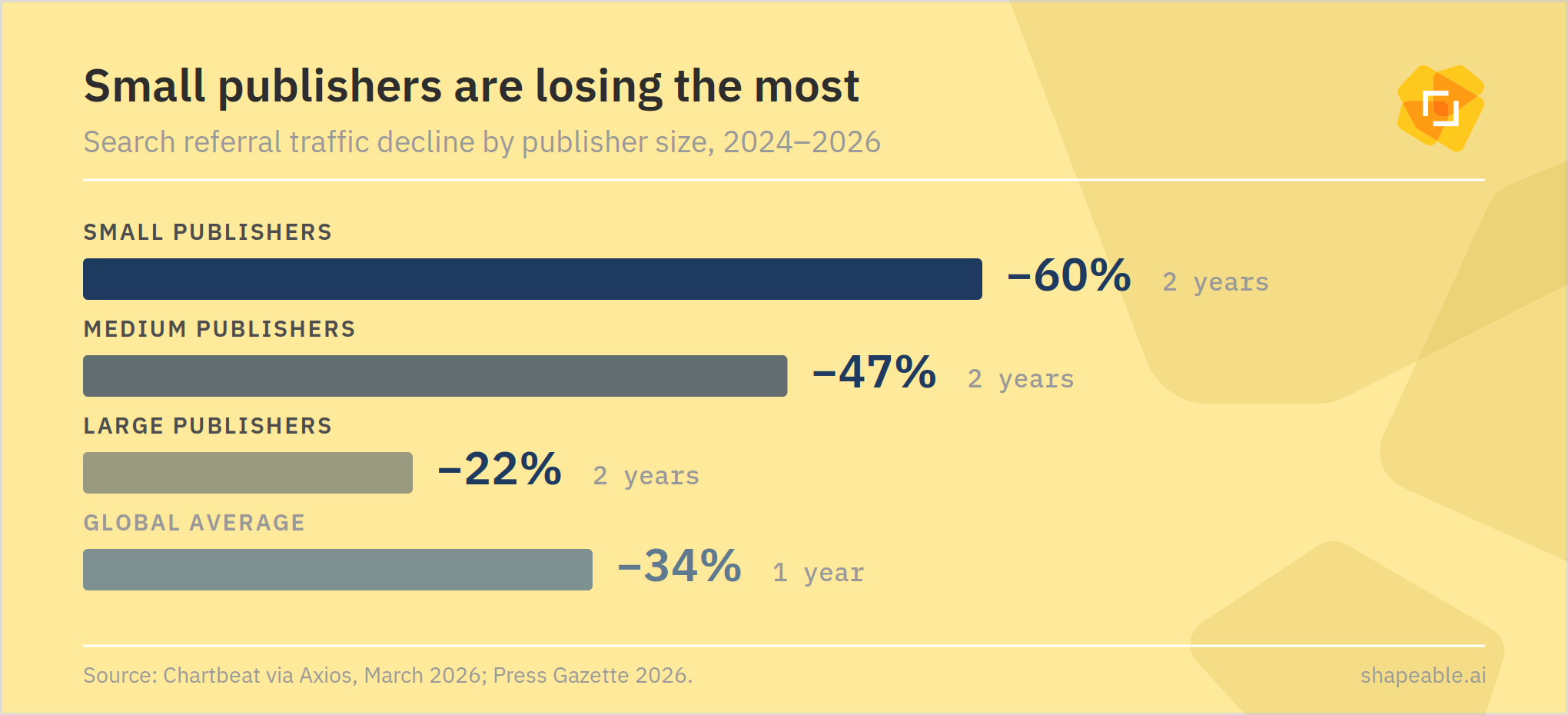
The result is that click-through rates have dropped 58% on queries where AI answers appear. Google search traffic to publishers fell 34% in a single year. Chartbeat data from the Reuters Institute 2026 report shows Google search referrals to 2,500+ news sites dropped 33% globally in the last twelve months. Niche experts, trade journals, and specialist blogs were the worst hit - some losing up to 89% of their traffic over two years. Press Gazette confirmed the pattern across hundreds of global publishers.
4. The business of knowing things is enclosing
(Financial Model Collapse)
Google now earns ninety-percent of its ad revenue from adverts shown on its own properties, not from ads placed on external publishers’ sites. Advertising is an important component of the business model for trade publications, industry analysts, technical knowledge bases, and specialist bloggers. But there is little incentive for Google to send users off their platforms and share that revenue, which leads to an existential pressure for content creators.
The damage isn’t just less revenue from fewer advert impressions, it’s the lost opportunity behind each missed visit, which includes newsletter subscriptions, buying reports, membership, or signing up for a conference. Google’s decision to answer questions instead of the publisher means the publisher loses the value of their whole offering, not just their website.
This affects the delivery of local news as well. News deserts are forming. In the USA 213 counties have no local news source at all. Unless other financial models replace advertising, the expertise and issues that publishers report on goes with them.

What stays free and public is also becoming machine-readable, and prepared for our AI-first world, so that both search and AI bots can ingest it easily. Cloudflare has already noted that in 2025 bot traffic exceeded human use of the internet.
“We want our marketing content to be findable and discoverable and optimized for agents. And then we obviously need to think deeply about how and what portions of our editorial content should also appear in those kinds of surfaces.”
Josh Muncke, VP of generative AI, The Economist Group, speaking at the PPA Festival, May 2026.
So whilst the long tail of niche independents has been shutting down, those who survive are rebuilding new ways to monetise and use AI. Their content is changing in format, volume, and access, into either lower quality and highly commodified short form social video and audio, or into higher-value material for its owned audiences behind logins.
5. Not believing what you read and see. A crisis of knowing.
(Trust Collapse)
The consequence of these collapses is a fog of understanding. Truth blurs into unverified and automated opinion, from both humans and machines. UNESCO has described the situation as a “crisis of knowing itself”. The mere existence of AI-generated content undermines confidence in all content, authentic or not. Researchers call this the “liar’s dividend”. It also supports the agendas of those who know how to manipulate the algorithm.
It’s not only about Instagram and Facebook being filled with deep fakes. A review in AI & Society across 24 studies concluded that exposure to AI-generated disinformation measurably reduces trust and alters decision-making. The World Economic Forum ranked AI-driven disinformation as the number one short-term global risk for the second consecutive year in 2025.
At the end of 2025, Deloitte submitted a AUD $440,000 Australian government report containing academic sources that didn’t exist. The report had been generated by AI. When even the major consultancies can’t verify fact from falsehood the trust problem is systemic.
And the impact on society? The Edelman Trust Barometer in 2025 found two-thirds of people cannot tell fact from disinformation. Seven in ten people think government officials, business leaders, and journalists deliberately mislead them. In 2026 they concluded the world is moving from grievance to insularity, noting:
“As economic anxiety, geopolitical tension, and technological disruption intensify, people are narrowing their world to smaller, familiar circles that reflect their views, and this hinders economic and societal progress.”
And not even academic papers are safe. Since the early 2010s there has been a rise in the use of academic paper mills by students competing for publication in prestigious journals. Nature magazine reported thousands of papers from across the world that contain sham science. Wiley publishing retracted 11,300 papers and closed 19 journals. Add AI to the paper mills, and no fact or innovation is safe from slop.
6. Locking the future behind access walls
(Open Access Collapse)
The sixth collapse predates the other five, but now has the AI-era twist of bot-blocking and content withdrawal from use by public AI. This may be the most consequential collapse of all. Large volumes of current and future insight are being removed from the web, either to protect Intellectual Property or to protect the business models that were formed to access it.
For decades now, the most structured source of innovation intelligence in the world has been locked behind paywalls. Five publishers - Elsevier, Springer Nature, Wiley, Taylor & Francis, and SAGE - control over 50% of all research output. Annually, $19 billion of knowledge is locked away in academic publishing. That is a punishing disincentive to fact checking.
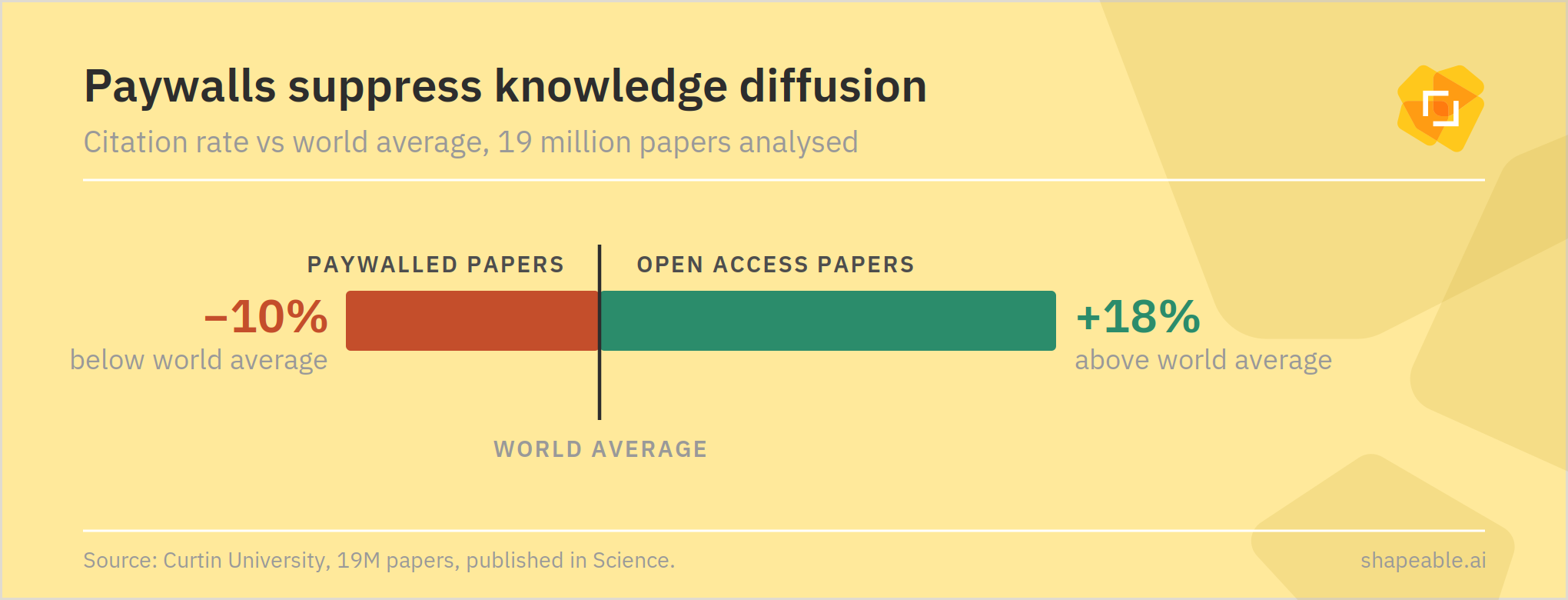
Research published in Science analysed 19 million papers and found that open-access papers attracted more citations from scholars across a wider range of locations, institutions, and fields. Paywalled papers were cited 10% below the world average, and open papers 18% above average.
Now, in the AI-era, knowledge creators and academic publishers are aggressively blocking AI crawlers and pursuing legal action against scraping. Researchers audited the web domains that AI companies had used to train their models like ChatGPT and Gemini. They found that in a single year (2023–2024) restrictions on AI training-use rose 500%. The top sources that had been used for training, news outlets and encyclopedias, closed down fastest. Under current Terms of Service, 45% of the original training corpus is now off-limits to AI. The researchers warned:
This is “rapidly biasing the diversity, freshness, and scaling laws for general-purpose AI systems.”
Cloudflare, which protects 20% of websites, has turned on bot blocking by default. This is to give control to publishers (academic or otherwise) who don’t want their material stolen. But what is worse? Not getting clicks or not being found at all?
What happens next? The Partnering Web.
If the six collapses are systematically widening the trust and foresight gap, they are also widening the advantage for those who build ‘trusted’ alternatives.
The World Economic Forum observed that the companies making fastest progress with AI are those building on shared knowledge assets through partnerships. Harvard Business Review shows how data-cooperatives can democratise AI. Stanford’s Collective Intelligence Project is developing frameworks for collective ownership of shared data. Horizon Europe is funding ‘Interconnected Innovation Ecosystems’ at up to €20 million per project.
The economics of collaboration are compelling. Building proprietary knowledge and AI infrastructure can be expensive. Building it collaboratively and spreading the costs across a consortium drops the individual outlay dramatically. At the same time, it creates a knowledge-base that exceeds anything a single member could build. There are other benefits: it is trusted and verified; academics get access to real-world operational data for their research; industry members get early, translated intelligence about relevant emerging research; fact-based, cited insights get delivered through trusted AIs.
A growth of publishing partnerships is forming for scientific papers, because UNESCO has pushed the concept of “diamond” open access. Preprint servers like arXiv (2.4 million papers, fully open) are growing rapidly. Governments are increasingly mandating open access to publicly funded research. In the US, Federally funded NIH research now has to be open source upon publication. For Intellectual Property, content crediting standards like the Coalition for Content Provenance and Authenticity (C2PA) now have 6,000+ members including Google, OpenAI, the BBC and Adobe.
Whilst AI’s are central to this Verified Web, they have trust and knowledge partnerships built into them, increasing their specific business value, connecting networks of organisations to each other. That offsets the characteristics of the open Synthetic Web which is inconsistent, more commodified… where sameness is the norm.
Get in touch
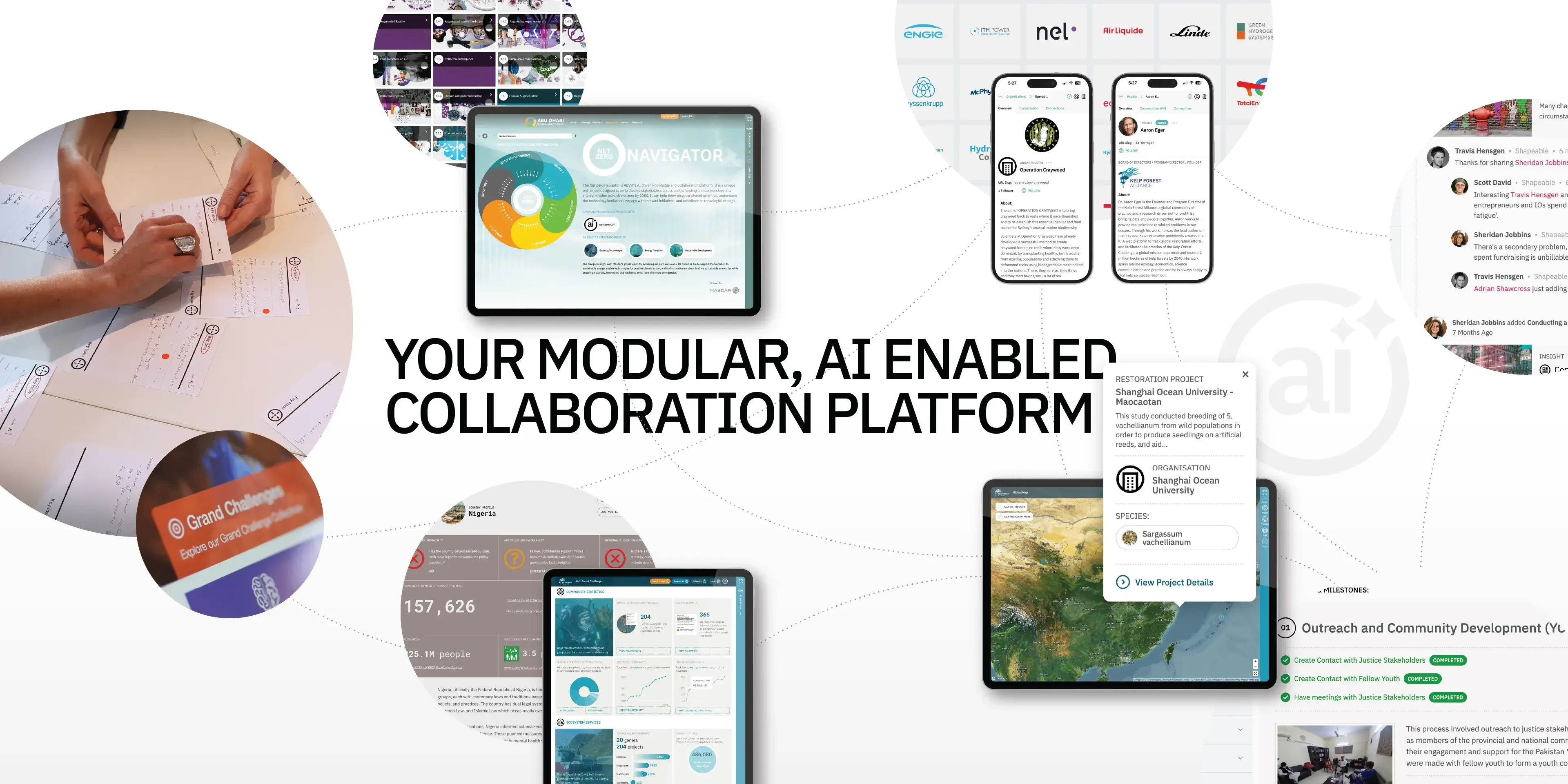
At Shapeable we’re pioneering: insight + partnering ecosystems trained on whole sector knowledge, with trusted AI and transparency at their core.
Let’s turn talk into action today. Contact us to arrange a discovery call.