{"data":{"platform":{"allPosts":[{"id":"65c416d2f2686ab70d310020","name":"Models will change the aging world","slug":"models-will-change-the-aging-world","typeLabel":"Thought Leadership","badge":null,"path":"/posts/models-will-change-the-aging-world","updated":"2024-03-15T02:28:38.66","__typename":"Platform_Post","_schema":{"label":"Post","pluralLabel":"Posts"},"openGraph":{"id":"openGraph_post/models-will-change-the-aging-world","title":null,"image":{"id":"image_shape-ecosystems/banner/models-for-aging_image__A2_GCs_h2e8px.jpg","url":"https://res.cloudinary.com/shapeable/image/upload/v1669361824/shape-ecosystems/banner/models-for-aging_image__A2_GCs_h2e8px.jpg.jpg","url2x":null,"thumbnails":{"id":"thumbnails-file_shape-ecosystems/banner/models-for-aging_image__A2_GCs_h2e8px.jpg","bubbleMedium":{"id":"thumbnails-bubble-medium-file_shape-ecosystems/banner/models-for-aging_image__A2_GCs_h2e8px.jpg","url":"https://res.cloudinary.com/shapeable/image/upload/c_limit,w_96/v1669361824/shape-ecosystems/banner/models-for-aging_image__A2_GCs_h2e8px.jpg.jpg","url2x":"https://res.cloudinary.com/shapeable/image/upload/c_limit,w_192/v1669361824/shape-ecosystems/banner/models-for-aging_image__A2_GCs_h2e8px.jpg.jpg"}}}},"published":"2021-11-10T00:00:00.00","content":{"id":"65c416d2f2686ab70d310020_content","text":"Aging has traditionally not been an area where you would look first for a global ‘hive mind’ or to see cutting edge innovation. Most of the sub-sectors - senior housing, home care, hospice and rehab, as well as medical devices and products and services for older consumers - are siloed, and many of them largely offline. Moreover, they certainly don’t share a common language for collaboration or shared benchmarks and metrics for what success looks like. This seems a world away from the whirling, beeping, humming, software-centric world of Amazon and Tencent (annual revenues of $250bn and $45bn respectively), which are building global behemoths, devouring competitors and picking up colossal momentum. However, maybe these worlds are not as different as they appear. In terms of economic opportunity, aging is the giant and Amazon the pygmy; the longevity market is [expected](https://www.marketwatch.com/story/longevity-is-the-economic-opportunity-of-our-lifetime-2017-02-16) to hit $15 trillion by 2020, around [three times the size](https://www.forbes.com/sites/jordanmckee/2018/09/11/global-digital-commerce-sales-to-near-6-trillion-by-2022/#3319910c4c5a) of the forecast global ecommerce market. \n\nThe most successful companies such as Amazon, Netflix and Tencent are run by ‘models’ - smart algorithms powered by data that constantly learn and improve the business. Great products attract more customer dollars that allow the company to make even better products, and so on. When done right, these turn into a [‘flywheel’](https://medium.com/swlh/the-amazing-flywheel-effect-80a0a21a5ea7) - creating unstoppable momentum, and delivering trillion dollar businesses. These models are powerful and of interest to future empire builders - as outlined in this article ['Models Will Run The World'](https://www.wsj.com/articles/models-will-run-the-world-1534716720) by hedge fund manager, Steve Cohen - subscription required, alas. (Sidenote: anyone with a social media account can vouch for the powerful, addictive behavior of some of these models at the individual level too). \n\nHow could social, mission-driven businesses co-opt some of these models to develop a flywheel for good? And more boldly, is it possible to orchestrate a massive global network of companies and individuals (rather than keep this all under the hood of one company), sharing common missions, through the power of an AI-driven platform technology?\n\nThese two meaty questions are ones that we’re working hard on, and will be starting to address with the development of our exciting new programme, The Collective, our new platform for collective intelligence and collaborative action. Developed over the past six months as a joint venture with [Shapeable](http://www.shapeable.ai/), a unique company formed of a group of ex-World Economic Forum designers and technologists, The Collective is helping us build a common platform to connect innovators and accelerate our mission. We shared the v0.2 version with existing [members](http://www.aging2.com/thecollective/members) at a workshop in San Francisco last week, and will be hosting a public webinar next week, [August 7th and we invite you all to join](https://www.eventbrite.com/e/the-aging20-collective-building-the-model-webinar-tickets-65281320186?mc_cid=99ed3e4f4e&mc_eid=af84a1877c). \n\nA model can be seen in four steps: framing the topic; generating the data; developing and deploying learning algorithms; and having an impact (the data about which can be measured, resulting in further improvements). Working with the Shapeable team, we’ve started building a model with The Collective that aims to deliver lasting, system-wide change in four steps:\n\n **1) Framing the topic.** Having been working with startups, corporates and older adults for 7 years we consistently see similar patterns and themes. As such in 2016 we created the [Grand Challenges](http://www.aging2.com/grandchallenges), which frame the topic of innovations in aging into 8 topics, from Brain Health to Mobility & Movement. \n\n **2) Generating the data**. We’re building The Collective around three types of connected data, Stakeholders (the organizations from all over the aging space and all over the world who are able to share their strategic priorities and success stories), Insights (articles and content with data and metadata that connect the space and highlight interesting ideas) and Impact Stories, case studies of success that have had a measurable impact. Building the data model for what ‘successful impact’ looks like is a further important project we’re working on. \n\n **3) Learning algorithms.** ‘Success’ in an ecosystem can take many forms - it can be about the impact that specific innovations have had on the older adult, caregiver, or bottom line, or it can be about the platform itself - are we able to connect the right stakeholders (investor and promising startup, say) at the right time that will benefit everyone? There are precedents for both, and at this stage we’re exploring all options. Our partnership, via Shapeable, with GraphAware, one of the world’s leading graph database and machine learning companies, will help us build the right models and learn what works. \n\n **4) Delivering changes.** We’ll only be able to build a model for the ecosystem if things happen, data is generated and the processes automatically get smarter, accelerating the creation of new markets. We’ll need a feedback loops in place - knowing when that introduction hit the mark, or was a dud. Or learning that the best practice for fall prevention championed in Albuquerque also works in Adelaide. And why. Impact will come when we can improve transparency about what works, reduce complexity and clutter, experiment with new forms of collaboration (such as social impact bonds and blended finance) and overall help build new markets and deliver products and services faster.\n\nThe first version of The Collective is just hinting at these answers. Scott David, founder of Shapeable, says we’re at v0.2, and can think of ourselves being at the “end of the beginning”. What that means is that we now have the fundamental building blocks in place - Insights, Stakeholders and Impact Stories, and on top of a layer of ‘relevance engineering’ that, when up and running, will help connect disparate players infinitely better than our small team can do manually (or that happens via serendipity at events). \n\nWhat we need next is YOU. And by that I mean your content and contributions for what should be on the platform. And also you as a corporate partner willing to pay a [modest fee](http://www.aging2.com/thecollective) to join as a member and help fund the further creation of this ambitious project that has been built on a very tight budget, fuelled by a passion for the mission and optimism about others sharing our journey. We have signed up 16 willing volunteers, [‘Super Connectors’](https://www.aging2.com/thecollective/superconnectors/), whose job it is to connect us with innovative content, organizations and ideas. They are acting as ‘content ambassadors’, the first line of insights and ideas helping us populate the content and ‘build the model’. They will be working alongside our other [Ambassadors](http://www.aging2.com/chapters) - the 90+ leaders of our local city chapters, to build this into a genuinely global community of insights and expertise. (We’re currently growing by one chapter a week so may well be at 100 by Labor Day).\n\nWe’re now actively looking for ‘Impact Stories’ where innovations have had a measurable impact - please email them to [thecollective@aging2.com](mailto:thecollective@aging2.com). And if you’re interested in joining us on the journey as a corporate member, check out our membership page at www.aging2.com and send me a note at [stephen@aging2.com](mailto:stephen@aging2.com)."},"authors":[{"id":"65f3b12320c8f920cc9c9335","name":"Stephen Johnston","slug":"stephen-johnston","typeLabel":"Person","badge":"","path":"/people/stephen-johnston","updated":"2024-03-15T02:23:31.84","__typename":"Platform_Person","_schema":{"label":"Person","pluralLabel":"People"},"openGraph":{"id":"openGraph_person/stephen-johnston","title":"Stephen Johnston","image":{"id":"image_shapeable-platform/person/stephen-johnston_photo__1669448693549_ty7tuo","url":"https://res.cloudinary.com/shapeable/image/upload/v1710469398/shapeable-platform/person/stephen-johnston_photo__1669448693549_ty7tuo.jpg","url2x":null,"thumbnails":{"id":"thumbnails-file_shapeable-platform/person/stephen-johnston_photo__1669448693549_ty7tuo","bubbleMedium":{"id":"thumbnails-bubble-medium-file_shapeable-platform/person/stephen-johnston_photo__1669448693549_ty7tuo","url":"https://res.cloudinary.com/shapeable/image/upload/c_limit,w_96/v1710469398/shapeable-platform/person/stephen-johnston_photo__1669448693549_ty7tuo.jpg","url2x":"https://res.cloudinary.com/shapeable/image/upload/c_limit,w_192/v1710469398/shapeable-platform/person/stephen-johnston_photo__1669448693549_ty7tuo.jpg"}}}}}],"types":[{"id":"65c416d3f2686ab70d310029","name":"Thought Leadership","slug":"thought-leadership","typeLabel":"Post Type","badge":null,"path":"/post-types/thought-leadership","updated":"2022-11-24T05:46:13.00","__typename":"Platform_PostType","_schema":{"label":"Post Type","pluralLabel":"Post Types"}}],"type":{"id":"65c416d3f2686ab70d310029","name":"Thought Leadership","slug":"thought-leadership","typeLabel":"Post Type","badge":null,"path":"/post-types/thought-leadership","updated":"2022-11-24T05:46:13.00","__typename":"Platform_PostType","_schema":{"label":"Post Type","pluralLabel":"Post Types"},"openGraph":{"id":"openGraph_post-type/thought-leadership","title":"Thought Leadership","image":null}}},{"id":"65c5b88d3f7729382a555e37","name":"A new multi-channel webcast experience for a Global Digital Davos","slug":"a-new-multi-channel-webcast-experience-for-a-global-digital-davos","typeLabel":"Post","badge":null,"path":"/posts/a-new-multi-channel-webcast-experience-for-a-global-digital-davos","updated":"2024-06-22T22:26:29.27","__typename":"Platform_Post","_schema":{"label":"Post","pluralLabel":"Posts"},"openGraph":{"id":"openGraph_post/a-new-multi-channel-webcast-experience-for-a-global-digital-davos","title":null,"image":{"id":"image_shapeable-platform/banner/webcasts_image__webcasts_image__webcasts-01_wi4fdh.jpg_sfeet6","url":"https://res.cloudinary.com/shapeable/image/upload/v1707456630/shapeable-platform/banner/webcasts_image__webcasts_image__webcasts-01_wi4fdh.jpg_sfeet6.jpg","url2x":null,"thumbnails":{"id":"thumbnails-file_shapeable-platform/banner/webcasts_image__webcasts_image__webcasts-01_wi4fdh.jpg_sfeet6","bubbleMedium":{"id":"thumbnails-bubble-medium-file_shapeable-platform/banner/webcasts_image__webcasts_image__webcasts-01_wi4fdh.jpg_sfeet6","url":"https://res.cloudinary.com/shapeable/image/upload/c_limit,w_96/v1707456630/shapeable-platform/banner/webcasts_image__webcasts_image__webcasts-01_wi4fdh.jpg_sfeet6.jpg","url2x":"https://res.cloudinary.com/shapeable/image/upload/c_limit,w_192/v1707456630/shapeable-platform/banner/webcasts_image__webcasts_image__webcasts-01_wi4fdh.jpg_sfeet6.jpg"}}}},"published":"2013-02-04T00:00:00.00","content":{"id":"65c5b88d3f7729382a555e37_content","text":"**The creative process and my role**\n\nThis new format is now being used for all our events – from Annual Meetings to Regional Meetings. I led the user experience, design, and product specifications, managed the development build done by an external supplier, and liaised with Livestream, YouTube and our streaming media team to make sure the usability and performance were reliable and exceptional.\n\nNeedless to say, some new feature development and testing was required at very short notice during Davos, as surprise Use Cases arose – such as sessions running into excessive over-time. I liaised with the overall team during Davos to make sure all of these exceptions were dealt with, releasing new and fully tested development builds each night of the meeting’s five days.\n\n\n\n**Development team and technologies**\n\nThe webcast widget and its calendar layout is fully modular. Parameters in its API code allow it to have different components, columns, configurations and sizes – from a video-only player to a full page searchable programme with topic tags.\n\nA team of 3 managed the Livestream schedule, encoding, and widget CMS. An external team of 4 built and tested the widget, its API, and CMS on Google App Engine. And several team members from both Livestream and YouTube were available to run their services and troubleshoot any issues.\n\n\n**About the author**\n\nThis post was written by Scott David whilst he was at the World Economic Forum, leading their User Experience strategy and design, across their digital platforms for data-driven knowledge and communities of global leadership."},"authors":[{"id":"65c416ccf2686ab70d30ff44","name":"Scott David","slug":"scott-david","typeLabel":"Person","badge":"","path":"/people/scott-david","updated":"2024-02-23T12:04:28.24","__typename":"Platform_Person","_schema":{"label":"Person","pluralLabel":"People"},"openGraph":{"id":"openGraph_person/scott-david","title":"Scott David","image":{"id":"image_shape-ecosystems/person/scott-david_photo__scott-profile-2019c_hgdzxg","url":"https://res.cloudinary.com/shapeable/image/upload/v1668517287/shape-ecosystems/person/scott-david_photo__scott-profile-2019c_hgdzxg.jpg","url2x":null,"thumbnails":{"id":"thumbnails-file_shape-ecosystems/person/scott-david_photo__scott-profile-2019c_hgdzxg","bubbleMedium":{"id":"thumbnails-bubble-medium-file_shape-ecosystems/person/scott-david_photo__scott-profile-2019c_hgdzxg","url":"https://res.cloudinary.com/shapeable/image/upload/c_limit,w_96/v1668517287/shape-ecosystems/person/scott-david_photo__scott-profile-2019c_hgdzxg.jpg","url2x":"https://res.cloudinary.com/shapeable/image/upload/c_limit,w_192/v1668517287/shape-ecosystems/person/scott-david_photo__scott-profile-2019c_hgdzxg.jpg"}}}}}],"types":[],"type":null},{"id":"65c77c6f7dd3b7e4a69089ef","name":"Connecting to Change the World","slug":"connecting-to-change-the-world","typeLabel":"Post","badge":null,"path":"/posts/connecting-to-change-the-world","updated":"2024-02-15T04:08:50.55","__typename":"Platform_Post","_schema":{"label":"Post","pluralLabel":"Posts"},"openGraph":{"id":"openGraph_post/connecting-to-change-the-world","title":null,"image":{"id":"image_shapeable-platform/banner/book-review-post-banner_image__book_ban_flezpm","url":"https://res.cloudinary.com/shapeable/image/upload/v1707572353/shapeable-platform/banner/book-review-post-banner_image__book_ban_flezpm.png","url2x":null,"thumbnails":{"id":"thumbnails-file_shapeable-platform/banner/book-review-post-banner_image__book_ban_flezpm","bubbleMedium":{"id":"thumbnails-bubble-medium-file_shapeable-platform/banner/book-review-post-banner_image__book_ban_flezpm","url":"https://res.cloudinary.com/shapeable/image/upload/c_limit,w_96/v1707572353/shapeable-platform/banner/book-review-post-banner_image__book_ban_flezpm.png","url2x":"https://res.cloudinary.com/shapeable/image/upload/c_limit,w_192/v1707572353/shapeable-platform/banner/book-review-post-banner_image__book_ban_flezpm.png"}}}},"published":"2023-03-27T00:00:00.00","content":{"id":"65c77c6f7dd3b7e4a69089ef_content","text":"[Connecting to Change the World: Harnessing the Power of Networks for Social Impact”](https://www.amazon.com/Connecting-Change-World-Harnessing-Networks-ebook/dp/B00NASJ4I8/) (2014)\n\n[Connect > Innovate > Scale Up: How Networks Create Systems Change](https://www.amazon.com/Connect-Innovate-Scale-Up-Networks-ebook/dp/B0B2X7F839/) (2022)\n\n- Pete Plastrik\n- Madeleine Taylor\n- John Cleveland\n\n------\n\nShapeable was first introduced to Pete Plastrik when working with the Biophilic Cities Network. The strategy outline he provided, working with their program manager JD Brown, was impressive in its clarity and extremely valuable to us - as the platform provider and consultancy tasked with implementing parts of its plan.\n\n------\n\n## Review\n\nThere’s a lot of talk about collaboration at scale these days - an ideal of like-minded people coming together to create meaningful impact - the reality of doing this is hard to achieve successfully.\n\n\n\nThis is why these books by Pete Plastrik, Madeline Taylor and John Cleveland are vital to network-building success. Written by seasoned practitioners, **they offer clear, actionable advice** about what you need to do and how to plan for it - because getting a group of like-minded people together is the easy part. The hard part is sustaining growth and momentum after the initial burst of enthusiasm. **There’s a value exchange which needs to be recognised and honoured. Everyone needs a ‘how-to’ framework and a precise schedule of stages for achieving their objectives. Otherwise, people become burnt by collaborations that don’t go anywhere or whose efforts get sold off for profit.** However, if you know what’s expected of you when you start, you also know this process takes time. You can pace yourself and manage the expectations of organisers and contributors for the long haul.\n\nThe first book, *Connecting to Change the World: Harnessing the Power of Networks for Social Impact* (2014), introduced the model of “connect, align, produce” as the core steps for creating impact. \n\n- **Connect** asks, ‘Who’s in the network? What’s going on? Who’s available to start connecting with before you do anything together?’ \n- **Align** then says, ‘you have this in common’. ‘You want this outcome and that outcome.’ \n- **Produce** says, ‘Let’s work together because we’ve got these commonalities.’ \n\nThis breakdown particularly resonated with us at Shapeable, and tightly fits our own process.\n\n\n\nThe latest book, Connect > Innovate > Scale Up: How Networks Create Systems Change (2022), focuses on scaling up and expanding the original model. **Everyone talks about scale, but they don’t understand the dynamic.** This book is really saying, ‘observe the process and the pathway to scaling’.\n\nThey identify several considerations for success, including:\n\n- Strategy\n- Complexity\n- Timeframe expectations\n- Measurable goals\n- Membership criteria\n- Convening power of your organisation\n- Stakeholders to represent all the angles of understanding \n- Members’ abilities to act\n- Rightsizing the network \n\n## Summary:\n\n**These two books offer a roadmap for network activation and a theory of change via collaborative action.** As much as we all want to jump straight to the third step, you still have to do the groundwork in the first two steps; otherwise, you’ll shoot yourself in the foot of your opportunities to scale.\n\n**The optimal readers are network builders** (in their many forms) and the consultants who work with them.\n\nThe authors make their advice **plain, practical, understandable, usable, and, therefore, valuable.** You don’t feel lost at any point. And they bring examples and quotations from clients that back up their points.\n\n\n-----\n\nRead more articles like this on our [Shapeable Newsletter](https://bit.ly/ShapeSubscribe)https://bit.ly/ShapeSubscribe)"},"authors":[{"id":"65c416ccf2686ab70d30ff44","name":"Scott David","slug":"scott-david","typeLabel":"Person","badge":"","path":"/people/scott-david","updated":"2024-02-23T12:04:28.24","__typename":"Platform_Person","_schema":{"label":"Person","pluralLabel":"People"},"openGraph":{"id":"openGraph_person/scott-david","title":"Scott David","image":{"id":"image_shape-ecosystems/person/scott-david_photo__scott-profile-2019c_hgdzxg","url":"https://res.cloudinary.com/shapeable/image/upload/v1668517287/shape-ecosystems/person/scott-david_photo__scott-profile-2019c_hgdzxg.jpg","url2x":null,"thumbnails":{"id":"thumbnails-file_shape-ecosystems/person/scott-david_photo__scott-profile-2019c_hgdzxg","bubbleMedium":{"id":"thumbnails-bubble-medium-file_shape-ecosystems/person/scott-david_photo__scott-profile-2019c_hgdzxg","url":"https://res.cloudinary.com/shapeable/image/upload/c_limit,w_96/v1668517287/shape-ecosystems/person/scott-david_photo__scott-profile-2019c_hgdzxg.jpg","url2x":"https://res.cloudinary.com/shapeable/image/upload/c_limit,w_192/v1668517287/shape-ecosystems/person/scott-david_photo__scott-profile-2019c_hgdzxg.jpg"}}}}}],"types":[],"type":null},{"id":"65c5b83a3f7729382a555e2a","name":"A data platform for global issue indexes and competitiveness","slug":"a-data-platform-for-global-issue-indexes-and-competitiveness","typeLabel":"Post","badge":null,"path":"/posts/a-data-platform-for-global-issue-indexes-and-competitiveness","updated":"2024-06-22T22:27:54.41","__typename":"Platform_Post","_schema":{"label":"Post","pluralLabel":"Posts"},"openGraph":{"id":"openGraph_post/a-data-platform-for-global-issue-indexes-and-competitiveness","title":null,"image":{"id":"image_shapeable-platform/banner/gcr-banner_image__gcr-slide_image__gcr-slide_wv5wqw.jpg_ie7rsr","url":"https://res.cloudinary.com/shapeable/image/upload/v1707456551/shapeable-platform/banner/gcr-banner_image__gcr-slide_image__gcr-slide_wv5wqw.jpg_ie7rsr.jpg","url2x":null,"thumbnails":{"id":"thumbnails-file_shapeable-platform/banner/gcr-banner_image__gcr-slide_image__gcr-slide_wv5wqw.jpg_ie7rsr","bubbleMedium":{"id":"thumbnails-bubble-medium-file_shapeable-platform/banner/gcr-banner_image__gcr-slide_image__gcr-slide_wv5wqw.jpg_ie7rsr","url":"https://res.cloudinary.com/shapeable/image/upload/c_limit,w_96/v1707456551/shapeable-platform/banner/gcr-banner_image__gcr-slide_image__gcr-slide_wv5wqw.jpg_ie7rsr.jpg","url2x":"https://res.cloudinary.com/shapeable/image/upload/c_limit,w_192/v1707456551/shapeable-platform/banner/gcr-banner_image__gcr-slide_image__gcr-slide_wv5wqw.jpg_ie7rsr.jpg"}}}},"published":"2014-09-03T00:00:00.00","content":{"id":"65c5b83a3f7729382a555e2a_content","text":"The [Global Competitiveness Index](http://reports.weforum.org/global-competitiveness-report-2015-2016/) is the most significant. It measures economic productivity and ranks 140 economies. It is comprised of sub-indexes, topic driven pillars, and hundreds of individual indicators, as well as a year by year time series. It alone receives over 2.5 million page views per annum and the internal team reply to a constant stream of requests for its data and results.\n\nThe indicators are harvested by our economists, and processed and normalised to their analytical methodology from sources such as the OECD, the World Bank, and our Executive Opinion Survey.\n\nOur Global Indexes are: [Global Competitiveness](http://reports.weforum.org/global-competitiveness-report-2015-2016/); [Travel and Tourism Competitiveness](http://reports.weforum.org/travel-and-tourism-competitiveness-report-2015/); [Energy Architecture Performance](http://reports.weforum.org/global-energy-architecture-performance-index-report-2016/); the [Gender Gap](http://reports.weforum.org/global-gender-gap-report-2015); [Human Capital](http://reports.weforum.org/human-capital-report-2015); and [Information Technologies Networked Readiness](http://reports.weforum.org/global-information-technology-report-2015/).\n\n**The creative process and my role**\n\nThe project first began in 2012 when I led a visit to the World Bank – to share knowledge with their data evangelists and the development agency who had created their data catalogue. Following that visit I specified our product concept and its User Experience, sourced and managed the specialist talent to build it as a distributed global team, and defined its technical architecture.\n\nInitially the data platform, its tools and data visualisations, were released on our members extranet. From the outset, all charts, graphs and data tables were mobile responsive. And because I had specified an API to supply the data structure, we easily exposed this to our public-facing digital publishing platform. We have since iterated and improved the layout of the scorecard pages, their flow of content and opinion, and ways to interact with and share the data.\n\n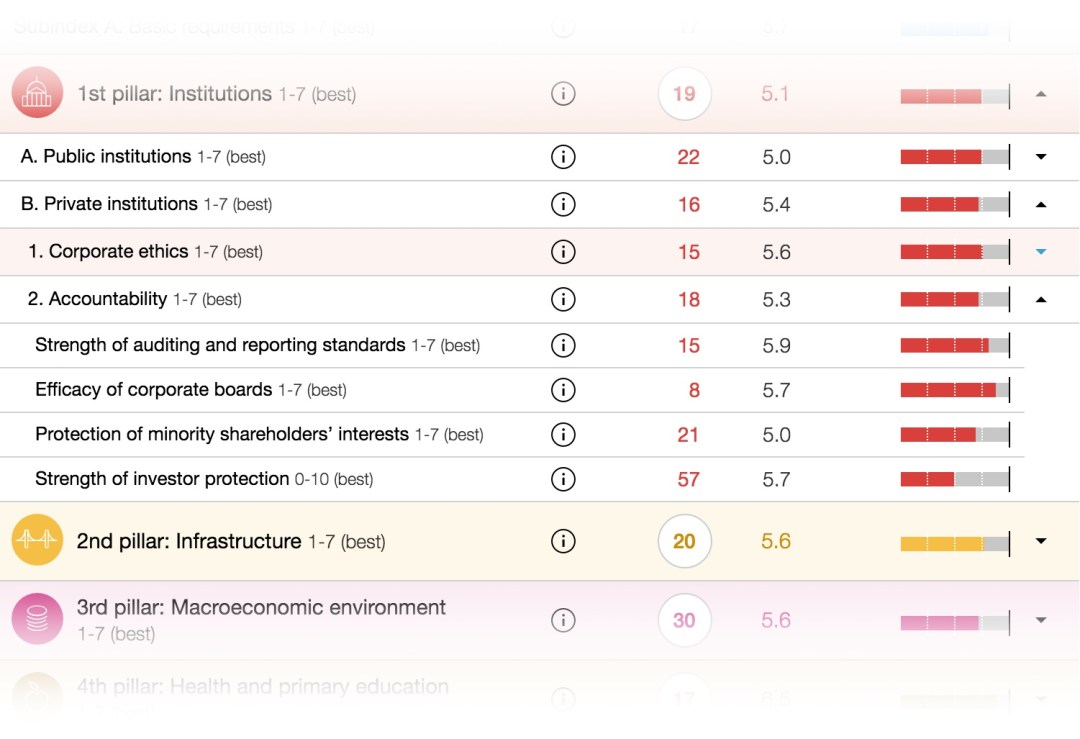\n\n**Development team and technologies**\n\nThe long term vision for the data platform is to store, interconnect, and reference all data that we use. With this in mind, I chose the hosted JSON based database, [CloudAnt](https://cloudant.com/), which is forked from [CouchDB](http://couchdb.apache.org/). By using a Database as a Service, this also outsourced our DevOps requirements. The API and Indicator Catalogue which powers the back-end of this product, with scorecard pages for each economy, is build with [node.js](https://nodejs.org/en/) and modularised code for all embeddable charts.\n\nThe team comprised one developer for the Node API, one for the mobile responsive data visualisations, one for the front end interface and publishing platform, myself and one of our lead economists as a key collaborator. The initial build was completed in 3 months, and integration into our public-facing platform took 2 weeks.\n\n**About the author and team**\n\nThis post was written by Scott David whilst he was at the World Economic Forum, leading their User Experience strategy and design, across their digital platforms for data-driven knowledge and communities of global leadership. What is now the Shapeable team, in particular Adrian Shawcross and Travis Hensgen, assisted with the design and build of this work.\n\n"},"authors":[{"id":"65c416ccf2686ab70d30ff44","name":"Scott David","slug":"scott-david","typeLabel":"Person","badge":"","path":"/people/scott-david","updated":"2024-02-23T12:04:28.24","__typename":"Platform_Person","_schema":{"label":"Person","pluralLabel":"People"},"openGraph":{"id":"openGraph_person/scott-david","title":"Scott David","image":{"id":"image_shape-ecosystems/person/scott-david_photo__scott-profile-2019c_hgdzxg","url":"https://res.cloudinary.com/shapeable/image/upload/v1668517287/shape-ecosystems/person/scott-david_photo__scott-profile-2019c_hgdzxg.jpg","url2x":null,"thumbnails":{"id":"thumbnails-file_shape-ecosystems/person/scott-david_photo__scott-profile-2019c_hgdzxg","bubbleMedium":{"id":"thumbnails-bubble-medium-file_shape-ecosystems/person/scott-david_photo__scott-profile-2019c_hgdzxg","url":"https://res.cloudinary.com/shapeable/image/upload/c_limit,w_96/v1668517287/shape-ecosystems/person/scott-david_photo__scott-profile-2019c_hgdzxg.jpg","url2x":"https://res.cloudinary.com/shapeable/image/upload/c_limit,w_192/v1668517287/shape-ecosystems/person/scott-david_photo__scott-profile-2019c_hgdzxg.jpg"}}}}}],"types":[],"type":null},{"id":"65c5bf3e3f7729382a555ebd","name":"A Net Zero Navigator to convert knowledge into funding for global action","slug":"a-net-zero-navigator-to-convert-knowledge-into-funding-for-global-action","typeLabel":"Post","badge":null,"path":"/posts/a-net-zero-navigator-to-convert-knowledge-into-funding-for-global-action","updated":"2024-02-15T04:07:18.76","__typename":"Platform_Post","_schema":{"label":"Post","pluralLabel":"Posts"},"openGraph":{"id":"openGraph_post/a-net-zero-navigator-to-convert-knowledge-into-funding-for-global-action","title":null,"image":{"id":"image_shapeable-platform/banner/nzn-banner_image__nzn_banner_iomexb","url":"https://res.cloudinary.com/shapeable/image/upload/v1707458343/shapeable-platform/banner/nzn-banner_image__nzn_banner_iomexb.png","url2x":null,"thumbnails":{"id":"thumbnails-file_shapeable-platform/banner/nzn-banner_image__nzn_banner_iomexb","bubbleMedium":{"id":"thumbnails-bubble-medium-file_shapeable-platform/banner/nzn-banner_image__nzn_banner_iomexb","url":"https://res.cloudinary.com/shapeable/image/upload/c_limit,w_96/v1707458343/shapeable-platform/banner/nzn-banner_image__nzn_banner_iomexb.png","url2x":"https://res.cloudinary.com/shapeable/image/upload/c_limit,w_192/v1707458343/shapeable-platform/banner/nzn-banner_image__nzn_banner_iomexb.png"}}}},"published":"2023-12-04T00:00:00.00","content":{"id":"65c5bf3e3f7729382a555ebd_content","text":"**Come and visit…** The one-day Abu Dhabi Sustainability Week Summit is taking place today, 4 December 2023, at the Connect Conference Centre in Expo City, Dubai. Look for [Thomas Philbeck](https://www.linkedin.com/article/edit/7137298269579218944/?author=urn%3Ali%3Acompany%3A19058443#) and [Curt Carbonell](https://www.linkedin.com/article/edit/7137298269579218944/?author=urn%3Ali%3Acompany%3A19058443#) in and around the ADSW Partnership Hub on the second floor of the Alif Pavilion. It's exciting and beneficial technology.\n\n\n\nThe Net Zero Navigator is a unique online platform and AI-driven interactive tool for [Abu Dhabi Sustainability Week - ADSW](https://www.linkedin.com/article/edit/7137298269579218944/?author=urn%3Ali%3Acompany%3A19058443#), an initiative of the United Arab Emirates and its clean energy company, [Masdar (Abu Dhabi Future Energy Company)](https://www.linkedin.com/article/edit/7137298269579218944/?author=urn%3Ali%3Acompany%3A19058443#), to accelerate the world's sustainable development and the SDGs. Created by ADSW, Masdar, Shapeable and Swift, it is designed to unite diverse stakeholders in their shared mission to achieve net zero by 2050. It analyzes the potential of key policy, funding, and partnership trends to help stakeholders unlock valuable ways to collaborate on priorities, engage with relevant initiatives, and contribute to meaningful change.\n\n\n\nThe systems change that the platforms tackles include:\n\n- Energy\n- Built Environment\n- Food & Agriculture\n- Mobility\n- Industry\n- Water\n\n"},"authors":[{"id":"65c416ccf2686ab70d30ff46","name":"Sheridan Jobbins","slug":"sheridan-jobbins","typeLabel":"Person","badge":"","path":"/people/sheridan-jobbins","updated":"2024-02-23T12:06:19.67","__typename":"Platform_Person","_schema":{"label":"Person","pluralLabel":"People"},"openGraph":{"id":"openGraph_person/sheridan-jobbins","title":"Sheridan Jobbins","image":{"id":"image_shape-ecosystems/person/sheridan-jobbins_photo__SheridanJobbinsbw1","url":"https://res.cloudinary.com/shapeable/image/upload/v1668517294/shape-ecosystems/person/sheridan-jobbins_photo__SheridanJobbinsbw1.jpg","url2x":null,"thumbnails":{"id":"thumbnails-file_shape-ecosystems/person/sheridan-jobbins_photo__SheridanJobbinsbw1","bubbleMedium":{"id":"thumbnails-bubble-medium-file_shape-ecosystems/person/sheridan-jobbins_photo__SheridanJobbinsbw1","url":"https://res.cloudinary.com/shapeable/image/upload/c_limit,w_96/v1668517294/shape-ecosystems/person/sheridan-jobbins_photo__SheridanJobbinsbw1.jpg","url2x":"https://res.cloudinary.com/shapeable/image/upload/c_limit,w_192/v1668517294/shape-ecosystems/person/sheridan-jobbins_photo__SheridanJobbinsbw1.jpg"}}}}}],"types":[],"type":null},{"id":"65c778067dd3b7e4a6908989","name":"From judgement to care. LifeLine International leads a global movement to decriminalise suicide worldwide.","slug":"from-judgement-to-care-life-line-international-leads-a-global-movement-to-decriminalise-suicide-worldwide","typeLabel":"Post","badge":null,"path":"/posts/from-judgement-to-care-life-line-international-leads-a-global-movement-to-decriminalise-suicide-worldwide","updated":"2024-02-15T04:09:38.65","__typename":"Platform_Post","_schema":{"label":"Post","pluralLabel":"Posts"},"openGraph":{"id":"openGraph_post/from-judgement-to-care-life-line-international-leads-a-global-movement-to-decriminalise-suicide-worldwide","title":null,"image":{"id":"image_shapeable-platform/banner/lli-post-banner_image__lli_link_oyc2tm","url":"https://res.cloudinary.com/shapeable/image/upload/v1707571396/shapeable-platform/banner/lli-post-banner_image__lli_link_oyc2tm.png","url2x":null,"thumbnails":{"id":"thumbnails-file_shapeable-platform/banner/lli-post-banner_image__lli_link_oyc2tm","bubbleMedium":{"id":"thumbnails-bubble-medium-file_shapeable-platform/banner/lli-post-banner_image__lli_link_oyc2tm","url":"https://res.cloudinary.com/shapeable/image/upload/c_limit,w_96/v1707571396/shapeable-platform/banner/lli-post-banner_image__lli_link_oyc2tm.png","url2x":"https://res.cloudinary.com/shapeable/image/upload/c_limit,w_192/v1707571396/shapeable-platform/banner/lli-post-banner_image__lli_link_oyc2tm.png"}}}},"published":"2024-02-15T04:09:38.65","content":{"id":"65c778067dd3b7e4a6908989_content","text":"LifeLine International is working across all 52 countries to remove the stigma of distress and accelerate the delivery of care to those in need by decriminalising suicide. Shapeable is proud to have built a [Country Change Platform](https://www.suicide-decrim.network/) for LifeLine International - with 52 publicly available [country profiles](https://www.suicide-decrim.network/countries) which show the state of play and use data to track progress.\n\n\n\n[**www.suicide-decrim.network**](http://www.suicide-decrim.network/)\n\nBehind the scenes, private microsites per country provide customisable resources to help implement local campaigns, and a guided process for systemic change. It is an online space where the Country Leads can store final documents, record activities and report on progress. Across the whole platform, countries can share best practices and lessons learned from successful decriminalisation campaigns.\n\nShapeable's data-driven approach helps each country adapt and refine their strategies whilst building authoritative data sets and sources. This leads to a trusted network of experts and insights, and impact reported at a global level, including against the UN's Sustainment Development Goal 3.4.2.\n\n\n\nThis is an on-going collaborative campaign with [Nick Stravs](https://www.linkedin.com/in/nicholas-stravs-76a04b2/) showing the way. As such we'd like to give a shout out to fellow agencies [Topham Guerin](https://www.linkedin.com/company/topham-guerin/) and [Decade of Change](https://www.linkedin.com/company/decade-of-action/) (DOA) who worked on the global awareness campaign, [25Crimes](http://25crimes.org/), and impact framing associated with it.\n\n\n\nDecriminalising suicide is not merely a matter of legal reform; it's about transforming societies and saving lives. If you have the skills, expertise or lived experience to contribute and participate in your own country program, please use the [Get Involved](https://www.suicide-decrim.network/get-involved) form to tell us more about you.\n\nIf you'd like to find out about Lifeline International, you can visit their [Media Centre](https://lifeline-international.com/campaign/)\n\nThis platform doesn't just inform; it empowers a global movement for change."},"authors":[{"id":"65c416ccf2686ab70d30ff46","name":"Sheridan Jobbins","slug":"sheridan-jobbins","typeLabel":"Person","badge":"","path":"/people/sheridan-jobbins","updated":"2024-02-23T12:06:19.67","__typename":"Platform_Person","_schema":{"label":"Person","pluralLabel":"People"},"openGraph":{"id":"openGraph_person/sheridan-jobbins","title":"Sheridan Jobbins","image":{"id":"image_shape-ecosystems/person/sheridan-jobbins_photo__SheridanJobbinsbw1","url":"https://res.cloudinary.com/shapeable/image/upload/v1668517294/shape-ecosystems/person/sheridan-jobbins_photo__SheridanJobbinsbw1.jpg","url2x":null,"thumbnails":{"id":"thumbnails-file_shape-ecosystems/person/sheridan-jobbins_photo__SheridanJobbinsbw1","bubbleMedium":{"id":"thumbnails-bubble-medium-file_shape-ecosystems/person/sheridan-jobbins_photo__SheridanJobbinsbw1","url":"https://res.cloudinary.com/shapeable/image/upload/c_limit,w_96/v1668517294/shape-ecosystems/person/sheridan-jobbins_photo__SheridanJobbinsbw1.jpg","url2x":"https://res.cloudinary.com/shapeable/image/upload/c_limit,w_192/v1668517294/shape-ecosystems/person/sheridan-jobbins_photo__SheridanJobbinsbw1.jpg"}}}}}],"types":[],"type":null},{"id":"65c779637dd3b7e4a69089ac","name":"Collaborative platforms are the new social networks","slug":"collaborative-platforms-are-the-new-social-networks","typeLabel":"Post","badge":null,"path":"/posts/collaborative-platforms-are-the-new-social-networks","updated":"2024-04-20T06:39:50.04","__typename":"Platform_Post","_schema":{"label":"Post","pluralLabel":"Posts"},"openGraph":{"id":"openGraph_post/collaborative-platforms-are-the-new-social-networks","title":null,"image":{"id":"image_shapeable-platform/banner/collab-impact-banner_image__collabban_lwjelb","url":"https://res.cloudinary.com/shapeable/image/upload/v1707571531/shapeable-platform/banner/collab-impact-banner_image__collabban_lwjelb.png","url2x":null,"thumbnails":{"id":"thumbnails-file_shapeable-platform/banner/collab-impact-banner_image__collabban_lwjelb","bubbleMedium":{"id":"thumbnails-bubble-medium-file_shapeable-platform/banner/collab-impact-banner_image__collabban_lwjelb","url":"https://res.cloudinary.com/shapeable/image/upload/c_limit,w_96/v1707571531/shapeable-platform/banner/collab-impact-banner_image__collabban_lwjelb.png","url2x":"https://res.cloudinary.com/shapeable/image/upload/c_limit,w_192/v1707571531/shapeable-platform/banner/collab-impact-banner_image__collabban_lwjelb.png"}}}},"published":"2023-03-29T00:00:00.00","content":{"id":"65c779637dd3b7e4a69089ac_content","text":"## TL;DR\n\n- Communicating in networks using online group chat, on social media or in a business context, has become utterly normal, familiar, and accelerated during the pandemic.\n- Community platforms mostly follow the same group chat paradigm of social or business networks, possibly due to their familiarity. So they can fall short of meaningfully turning talk into action.\n- Cross-sector, purpose-driven collaboration at scale is a different kind of problem to chat wall-based content-sharing. It requires an evolution of digital platforms to service this growing demand.\n- Big tech has a range of new ideas, from Business Ecosystems to DAOs (Distributed Autonomous Organisations) to Generative AI (such as ChatGPT), but they are in their early days.\n- Understanding knowledge architectures, complexity, human dynamics, incentives and processes, and converting that into software and consulting, is at the core of this next wave of platform evolution.\n\n## We all know group chat\n\nThe last few years have seen social networks, enabled by digital platforms, shifting dramatically… in [demographic profile](https://www.pewresearch.org/internet/2022/08/10/teens-social-media-and-technology-2022/), [content format](https://www.washingtonpost.com/technology/interactive/2022/tiktok-popularity/) and even [political persuasion](https://www.pewresearch.org/fact-tank/2022/11/18/key-facts-about-truth-social-as-donald-trump-runs-for-u-s-president-again/). At the same time, the idea of networks and group chat has solidified as a standard way of [communicating and doing business](https://slack.com/intl/en-au/blog/news/salesforce-completes-acquisition-of-slack), pushed to a new level by the COVID19 pandemic and Zoom.\n\n\nInevitably, because conversation at scale has become so normal, we’re seeing an increase in communities using platforms for purpose-driven collaboration. People want to participate in meaningful activity, and the world is a bit of a mess and needs fixing. So it’s a small step to use [Slack](https://slack.com/) to manage a community… instead of it just being used for software developers. And it’s quick to get chatting on [Mighty Networks](https://www.mightynetworks.com/) or [Discord](https://discord.com/) or [Circle](https://circle.so/) or [Hivebrite](https://hivebrite.com/) or [Facebook Groups](https://www.facebook.com/groups/explore/), which have better group management, events features, and simple interfaces. The ‘group chat’ paradigm is currently prevalent.\n\n\n## Solving cross-sector problems\n\nBut what happens when the chat settles, and the best ideas and content are lost deep in the threads? And what if you need to collaborate at a whole-industry level, or partner to address the Sustainable Development Goals, or bring multi-disciplinary and cross-sector groups together to work on systemic problems? These are very different kinds of problems to informal chat threads and exchanging files.\n\n\n\nSo, as the 2020’s progress, at Shapeable we’re expecting to see more platforms and networks breaking out of the chat paradigm and progressing towards the ‘collaborative action’ paradigm. That’s not just because our customers are doing that with us… it’s that the pieces of that future are here to be seen. Something is in the air.\n\n\n## Enter big money, big tech, and big ideas\n\nWithin the big tech and venture capital world it’s obvious that big ideas lead to the next unicorn company. And big ideas are innovation opportunities for the CEOs who attend Davos. We’re seeing many patterns coming together in this collaborative trend. They include, in no order of priority:\n\n- **Self-organising talent**. Smart contracts will create new types of companies as [DAOs](https://corpgov.law.harvard.edu/2022/09/17/a-primer-on-daos/) - [Distributed Autonomous Organizations](https://cointelegraph.com/daos-for-beginners/what-is-a-dao). Perhaps unsurprisingly, successful DAOs have talented teams. It’s the people not the blockchain. Yet, one day, the processes, practices, voting on what to do, and incentive mechanisms will become a platform protocol at scale, [beyond the hype](https://www.weforum.org/whitepapers/decentralized-autonomous-organizations-beyond-the-hype/).\n- **dApps and decentralised ownership**. It’s unlikely that the Web3 ideal of a [fully decentralised web](https://www.cmswire.com/information-management/how-is-web3-decentralized/) will materialise, complete with users owning their own data in their own vault. But progress will be made, and there will be Web3 platform corporates and [well-funded startups](https://www.alchemy.com/). Marc Andreesen’s [A16Z](https://a16z.com/web3-policy/) and Tim Berners Lee’s [Inrupt](https://www.inrupt.com/solid) (no Blockchain required) are just a couple of the key players.\n- **Collective Intelligence**. It’s not just the wisdom of the crowd. [Humans and machines](https://www.supermind.design/database) will [augment each other](https://radar.gesda.global/topics/collective-intelligence), at scale. Whilst the concept [started at MIT](https://cci.mit.edu/), it will change how we think about actionable knowledge infrastructure and the future of work.\n- **Business ecosystems**. New forms of value creation and [collaborative inter-dependency](https://www.bcg.com/publications/2022/what-is-your-business-ecosystem-strategy) are underway, to rethink [the company as a network](https://www.ey.com/en_au/alliances/what-business-ecosystem-means-and-why-it-matters), not just as a supply chain.\n- **Generative AI**. Whilst [ChatGPT](https://openai.com/blog/chatgpt) seems like magic, this kind of augmentation of human understanding and communication has only just begun. VCs are suggesting that startups get busy to [build Generative AI into their products](https://www.nfx.com/post/generative-tech).\n- **Narrative Markets**. Through Social Media we’re now used to campaigns, movements, missions, political persuasion, disinformation, or business trends at a global scale. At Shapeable we think of them as Narrative Markets… the competition for the real estate of ideas. Examples include Mariana Mazzucato pushing for UK industry-wide [missions that move markets](https://marianamazzucato.com/books/mission-economy), data-driven [behavioural economics](https://www.amazon.com/Narrative-Economics-Stories-Economic-Events-ebook/dp/B087YYKL79/) coming out of the Kahneman school of judgement and decision-making, and P&G repositioning [shame into intimacy](https://www.youtube.com/watch?v=0Yvbhincl40) for age care.\n- **Collaboration Jobs**. It’s not a coincidence that we’ve seen the arrival of a new C-suite role, the [Chief Community Officer](https://techcrunch.com/2021/02/20/chief-community-officer-is-the-new-cmo/) and others related to network analytics.\n- **Creator Economy**. Although opinion is now everywhere, and expertise is somewhat harder to spot, it’s undeniable that [microlearning is here to stay](https://www.forbes.com/sites/forbestechcouncil/2023/01/24/three-ways-the-creator-economy-is-changing-in-2023/), and niche educators will increasingly be in demand to help networks of collaborators to flourish.\n- **The Heterarchy**. There’s a movement away from siloed information and [hierarchical control](https://hbr.org/2014/12/understanding-new-power) to a [heterarchy](https://www.forbes.com/sites/stratfor/2016/02/04/heterarchy-an-idea-finally-ripe-for-its-time/?sh=2bdbc33347a7) of shared leadership with centralised knowledge. The [multi-stakeholder thesis](https://www.weforum.org/agenda/2021/01/klaus-schwab-on-what-is-stakeholder-capitalism-history-relevance/) popularised by the World Economic Forum is now commonplace, but it’s starting to take on a decentralised flavour.\n\n## Collaboration is the New Competition\n\nThe idea of [zero-sum competition](https://www.amazon.com/Zero-One-Notes-Startups-Future-ebook/dp/B00J6YBOFQ/) that has been prevalent for 40 years, and which has led to large-scale inequalities, seems to be entering a phase change. Competition increasingly seems to require collaboration, possibly changing its nature. Problem solving via multiple perspectives, distributed innovation, resource sharing, and time-to-market, all require a network… or [business ecosystem](https://www.ey.com/en_au/alliances/what-business-ecosystem-means-and-why-it-matters) with [orchestration strategy](https://www.bcg.com/publications/2022/what-is-your-business-ecosystem-strategy).\n\nA key truth is that maintaining the momentum of collaboration is really hard. That includes coordinating incentives, sharing knowledge and best practices, defining what to do and how, building in governance, measuring impact, and addressing ownership and credit for the outcomes. Beyond that, the complexity of aligning people with each other and compensating for their shortfalls are usually amongst the problems yet to be solved.\n\nAs this movement towards collaborative platforms makes progress, it’s good to see leading figures like Melinda French Gates at the forefront, advocating for [new forms of collaborative action](https://www.ft.com/content/a8fe8268-0660-43ab-bda4-0759b9ea7057).\n\n------\n\nRead more articles like this on our [Shapeable Newsletter](https://www.linkedin.com/build-relation/newsletter-follow?entityUrn=7052061887080894464)"},"authors":[{"id":"65c416ccf2686ab70d30ff44","name":"Scott David","slug":"scott-david","typeLabel":"Person","badge":"","path":"/people/scott-david","updated":"2024-02-23T12:04:28.24","__typename":"Platform_Person","_schema":{"label":"Person","pluralLabel":"People"},"openGraph":{"id":"openGraph_person/scott-david","title":"Scott David","image":{"id":"image_shape-ecosystems/person/scott-david_photo__scott-profile-2019c_hgdzxg","url":"https://res.cloudinary.com/shapeable/image/upload/v1668517287/shape-ecosystems/person/scott-david_photo__scott-profile-2019c_hgdzxg.jpg","url2x":null,"thumbnails":{"id":"thumbnails-file_shape-ecosystems/person/scott-david_photo__scott-profile-2019c_hgdzxg","bubbleMedium":{"id":"thumbnails-bubble-medium-file_shape-ecosystems/person/scott-david_photo__scott-profile-2019c_hgdzxg","url":"https://res.cloudinary.com/shapeable/image/upload/c_limit,w_96/v1668517287/shape-ecosystems/person/scott-david_photo__scott-profile-2019c_hgdzxg.jpg","url2x":"https://res.cloudinary.com/shapeable/image/upload/c_limit,w_192/v1668517287/shape-ecosystems/person/scott-david_photo__scott-profile-2019c_hgdzxg.jpg"}}}}}],"types":[],"type":null},{"id":"65c5b9e33f7729382a555e63","name":"Building a Global Issues Graph for world leaders","slug":"building-a-global-issues-graph-for-world-leaders","typeLabel":"Post","badge":null,"path":"/posts/building-a-global-issues-graph-for-world-leaders","updated":"2024-06-22T22:30:12.59","__typename":"Platform_Post","_schema":{"label":"Post","pluralLabel":"Posts"},"openGraph":{"id":"openGraph_post/building-a-global-issues-graph-for-world-leaders","title":null,"image":{"id":"image_shapeable-platform/banner/scott-graph-connect_image__scott-graph-connect_image__scott-graphconnect.jpg_rztxbn.jpg_t0wy4r","url":"https://res.cloudinary.com/shapeable/image/upload/v1707456955/shapeable-platform/banner/scott-graph-connect_image__scott-graph-connect_image__scott-graphconnect.jpg_rztxbn.jpg_t0wy4r.jpg","url2x":null,"thumbnails":{"id":"thumbnails-file_shapeable-platform/banner/scott-graph-connect_image__scott-graph-connect_image__scott-graphconnect.jpg_rztxbn.jpg_t0wy4r","bubbleMedium":{"id":"thumbnails-bubble-medium-file_shapeable-platform/banner/scott-graph-connect_image__scott-graph-connect_image__scott-graphconnect.jpg_rztxbn.jpg_t0wy4r","url":"https://res.cloudinary.com/shapeable/image/upload/c_limit,w_96/v1707456955/shapeable-platform/banner/scott-graph-connect_image__scott-graph-connect_image__scott-graphconnect.jpg_rztxbn.jpg_t0wy4r.jpg","url2x":"https://res.cloudinary.com/shapeable/image/upload/c_limit,w_192/v1707456955/shapeable-platform/banner/scott-graph-connect_image__scott-graph-connect_image__scott-graphconnect.jpg_rztxbn.jpg_t0wy4r.jpg"}}}},"published":"2015-11-22T00:00:00.00","content":{"id":"65c5b9e33f7729382a555e63_content","text":"This video of my talk and transcript below – Building a Global Issues Graph for world leaders – was delivered to a technically-focussed audience of Chief Technology Officers and lead developers, who were looking for ways to think about and enable these new opportunities.\n\nMy talk also features the projects that I have led, conceived, and have had built at the World Economic Forum over the past few years.\n\n https://youtu.be/jFJh1PnWSuM\n\n**An introduction**\n\nI’m Scott David from the World Economic Forum and I’d like to give you an overview of the way that we’re working with Graphs at the World Economic Forum and the journey that we’ve started.\n\nI’m sure you might be keen to see traversals through a billion nodes, or gigabits of analytics with community detection, but actually our graph is tiny. It is also incredibly powerful – despite being tiny. And it’s also under construction. Nevertheless there’s plenty to show. And what I would like to focus on sharing today is the thinking that led us to a Graph; the unique business opportunity that it presents to the World Economic Forum; and the kind of organization that the Forum is – which is, as you’ll come to realise, an extremely complicated one.\n\nIn the process I’ll describe two key projects – which are ‘Transformation Maps’ and ‘Graphs Search and Recommendations’. Both of them started their life with the recognition that leaders and experts need a more broad view of interconnected issues and how disruptive change is emerging.\n\n**Drivers of Change**\n\n3D printing is changing manufacturing and supply chains; self-driving cars are yet to disrupt; the hotel industry is threatened by the sharing economy; news is constantly under reinvention, chasing readership and profit; and diesel emissions scandals can impact the automotive industry over night. Many many organizations are going through change, including the Forum.\n\nBut the Forum is quite unique in that it is a meta-organisation – what we call a platform. Our role is to filter the noise around global issues, to find patterns in the data, and to indicate what is on the road ahead for other organisations. We bring together people from the public sector, business and civil society, who have the power to make change, who can achieve mutual understanding and agreement, and push action forwards. And as such, we are building technologies to facilitate high-level collaboration and knowledge exchange.\n\n**The World Economic Forum and Davos**\n\nBut first, The World Economic Forum is most well known for its Annual Meeting in Davos. It’s a tiny snow town on the eastern tip of Switzerland. It brings together two and a half thousand participants from our member base of the top 1000 global businesses, and other leaders from Government, NGO, Academia and Faith.\n\nAs a flavour of what happens there – in January 2015 John Kerry delivered a special address citing freedom, democracy and the rule of law; Bill and Melinda Gates spoke about sustainable development; Angela Merkel addressed global responsibilities in a digital age; will.i.am was interviewed in one of our smaller rooms; the future of military was debated; specialists talked about human vs artificial intelligence; and there were plenty of quotable moments.\n\nThat overview just skims the surface of the real complexity that is playing out in Davos. It is much more than a conference. For us, as the organiser, it is a solution of global complexity through networked thinking.\n\nLet’s remember that the people who come are in large part the leaders of the world – from Fortune 500 CEOs to Heads of State. Imagine the extraordinary logistics behind managing two and a half thousand high-profile participants, with the same number again of military and private security, and then multiply that complexity by the fact that we have one and a half thousand speaking roles in the Programme.\n\nWe have to manage the expectations and requirements of people like Sheryl Sandberg, Eric Schmidt and Satya Nadella. What do they want to talk about? What key messages to they wish to deliver? Are they seen to be speaking to the most important issues of the time, alongside the people they wish to appear with? All that is thanks to our Programme team who work year-round to identify the most important issues to discuss and who needs to come together to discuss them. It’s a marathon of matchmaking and diplomacy.\n\nAnd why do people come? Well, they have more meetings with influential people in those few days than they do during the rest of the year. They can meet experts to discuss emerging issues and problems that they’re struggling with. So it is also about the unknown, and the emerging, as well. These days deep interconnections can conspire to explode – as we saw with environmental regulations leading to the downfall of VW’s CEO and share price.\n\nSo our meeting in Davos is not just a conference – it is a solutions space – where world leaders come to discover, understand, and discuss the most pressing combinations of global issues.\n\n**Our technology products and knowledge creation**\n\nHelping decision makers make informed decisions and take action also requires an integrated flow of content, analysis and opinion. So throughout the year, with our network of members and partners, we monitor and measure, we identify trends and we build an archive of valuable knowledge which navigates that complexity and change, and which feeds into our meetings.\n\nSo let me give you a rapid-fire overview of some of the products that we’ve built, before then looping back to the potential that they’re going to have when connected up to our Graph.\n\nThe Forum produced 73 reports and white papers last year. The most important of which were delivered in digital format. If you saw the World Bank’s announcement a year ago saying that most of their reports were unread you’ll realize that being findable and digital is incredibly important. Besides that, there is also knowledge and data structure locked away in PDFs which is waiting to be released and used. You can see the kinds of issues that we work with – infrastructure, trust, new technologies and finance, employment, education, skills, the eurozone, global trends.\n\nMany teams around the Forum have a need for a digital platform because they’re also creating data sets and data visualisations as part of their analysis. You can see here the Global Risks Report which produces between 30 and 50 issues each year, evaluating their impact and likelihood, connected risks, clusters, and centres of gravity. It is a graph analysis. And they invite experts to discuss the findings, and work with our partner organisations to perform the research.\n\nThis is all evidence-based data, the most significant of which are our Global Indexes of which there are eight, with rankings across a hundred and forty economies, comprised of sub-indexes, topic driven pillars, and hundreds of individual indicators, with editions over a time series.\n\nWe have a data API and an Indicator Catalogue which powers the back-end of this product, with scorecard pages for each economy. The indicators are harvested, processed and normalized by our analytical methodology from a number of sources such as the OECD, the World Bank, as well as from our Executive Opinion Survey.\n\nOur Global Indexes, just to list them off for you are: Global Competitiveness; Travel and Tourism Competitiveness; Energy Architecture Performance; the Gender Gap; Human Capital; Information Technologies Networked Readiness; and most recently the Inclusive Growth Report, which is a new index and is important for the Forum, which aims to facilitate a deeper debate and change around sustainable policy recommendations.\n\nDuring all of our Events, a team from Livestream turns up to film, to stream the video to the world, and archive it on their platform. We built a video API and a configurable player that we embed on our own website, and that other organisations embed on theirs.\n\nAll the photographs I showed at the beginning are from Sessions which were filmed, and for which we have Videos, Transcripts, Tagged Topics, Issues, and Speakers associated with them in the data model. And this archive of videos dealing with global issues is growing with every Event that we host, and it becomes a time series of global issue change and the responses that leaders are having to them.\n\nAlso at Davos we have what we call The Social Wall. This is an eight metre screen outside the plenary hall. We use it to track the way that the world is responding to our Event and the influence and reach that the issues and people are having with the world at that time. The Twitter API gives us details of which leader is the most socially active and the most retweeted; the imagery API supplies a moment by moment feed of the world leaders delivering their ideas; the news API finds the articles that are being written about our proceedings; custom D3-based data visualizations show them; and nine experience templates deliver them.\n\nAlso during our Events our member’s extranet and apps receive most of their traffic, as members plan their itineraries. It contains all the people, organizations and sessions associated with the forum. In between Events it’s a community space for discussions around common interests. It’s a planning space for action and global issues. And as you can imagine, requirements gathering or end-user testing is pretty tricky with that target audience.\n\nThey don’t use it like Facebook. It’s not that kind of a demand that they have. This is where we’re integrating the products that I mentioned above and also combining strategically valuable knowledge, awareness, discovery and collaboration tools, and its the platform that’s benefiting the most from the graph work that we’re doing.\n\nSo you can see there’s huge potential available to us. As you look across that project set just imagine how many entity-relationship sub-graphs could be possible. There’s quite a lot. And how many traversals could be there through issue identification, all the way to solutions.\n\nSo let’s recap what the Forum is doing. It’s a content channel; it’s a trend spotter; it’s a global issues analysis machine; it’s a matchmaking service for group collaboration; it’s a benchmark data set provider; and it’s a ‘recommender’ for knowledge about global transformations.\n\nNow, the problem with an unequal distribution of the future is that leaders don’t know the weak signals from the noise, and that means that we act as a filter for them, and we make sense for them, and we reframe the view for them. We find the patterns in the data, and that means that we help to identify and characterize the nature of the discourse and then we enable things to get done.\n\n**Transformation Maps**\n\nYou can understand the reasons why we need a graph. In many ways, it has been in build for over 40 years with paper and spreadsheets. But the complexity is growing massively these days and requires some kind of technological action to be able to control it.\n\nOur chairman, Klaus Schwab, requested a global issues mapping project as a response to the increasing knowledge gap amongst senior leaders of unforeseen impacts. This became known as Transformation Maps.\n\nWhilst we had a database, it had never connected issues between each other. We didn’t even have a taxonomy, to place a Global Issues layer on top of the People layer. And so, what have we started to do about it?\n\nI know this is what you expect a Graph to look like, and a fairly mess one at that. But actually, if the data model itself is part of the product, and what is actually interacted with directly, then you can potentially rethink the way that it is visualised. And when we released the Transformation Maps at Davos this year it was received exceptionally well. We had CEOs taking over the 82 inch touch screen you can see here to perform demos to their colleagues.\n\nYou can see the way that a key issue for an economy can be affected by a key issue for an industry and between one industry and another. And you can see that this is a graph traversal stepping through several degrees of separation and cause and effect between distant key issues.\n\nThis widescreen view that you see here comes to its own as a facilitation tool for group strategic planning, which is one of its primary usage scenarios. It came about thanks to some crucial User Experience time during our Industry Strategy Meeting watching how Chief Strategy Officers discussed and explored its data structure, moving from key issue to key issue and Insight Area to Insight Area.\n\nWhat if you want to find an expert from our network to talk to? What if you want to discover Sessions at the Event that you are attending, dealing with the subjects that you’re interested in? What if you want to join a Forum project – of which we have around about sixty, condensed into ten global challenge initiative areas?\n\nThis product surfaces the nature of our Graph as a knowledge infrastructure – in a way that allows members to discover interconnections between global issues and allows them to frame their strategic conversations within their own organisations.\n\nNow, our Graph work, as I mentioned, is on-going, so a lot of the stuff I’ve shown here is actually in the process of being wired together, and the older infrastructures are starting to give way to the new infrastructures as we go.\n\nTo talk briefly about how we went about this – we began with what we do best – which is experts and issue mapping. We drew upon our internal issue-focused teams and our communities and networks. Together we’ve mapped the key issues within a hundred and ten primary global issues, economies and industries, and the key drivers of change upon them, and between them.\n\nWe have teams to coordinate our regional meetings in Africa, Middle East, Latin America, and East Asia. We have 21 industry teams, from automotive to telecommunications, and we have over 30 communities. And notably we have the Network of Global Agenda Councils – the world’s biggest brainstorm, with one and a half thousand global experts in eighty councils, who get together in the United Arab Emirates once a year to discuss the main global trends within their knowledge domain.\n\nThis data structure is not magic – it just required a high amount of effort with access to a large number of experts. Over several months we built a prototype content-input environment and monitored the quality of what was coming in; verifying the number of key issues that were being defined in any particular issue area. And we also wrote tagging guidelines to make sure that we didn’t have over or under enthusiasm, confirmation biases and filter bubbles.\n\nYou could call this ‘wisdom of the experts’ or ‘massively human in the loop’ or ‘data structure by gigantic think tank’. It’s like a speed-dating data structure of global expertise. If you could get everybody to talk to everybody else, and then capture those conversations in a graph, what would it actually look like? This is our first attempt at what that would look like.\n\nThat’s not to say that Machine Learning won’t have a huge role to play in this, for us to scale its data model and improve its tagging and build its taxonomy. It will. The human expertise will increasingly being augmented by machine intelligence.\n\nRight now this has become a year-round data model that represents the things that we and our members want and need to talk about. And it will become a definition in data structure of our engagement relationships with our members and their organisations. So, it’s awareness raising; it gives strategic focus; and it can evolve over time.\n\n**Graph Search and Recommendations**\n\nFrom all that I’ve shown, you can imagine that we needed some kind of powerful Search, which is why we embarked on a Graph Search project. Findability and Relevance are obviously essential with so much volume and separate products.\n\nAll the content objects in the examples I’ve shown need to be surfaced in the right place, to the right people, at the right time. But it should be more like a solutions architecture than just string retrieval. So whilst our Transformation Maps are our taxonomic glue, our Graph will become the central infrastructure that joins everything together as the Meta Store. And it seems obvious to me that Recommendations are just a type of personalised Search.\n\nAlso, a big reason that we did a Search project was that we’d had relevancy issues for many years. In 2012, after four months of trying to figure out Search weighting with SOLR, we realised that we would need five full-time staff continually classifying and weighting content to get it right. Clearly something was deeply wrong, and at that point we then just cut across to Google Search.\n\nThat was on our public site. But on a private platform you can’t rely on Pagerank and Google weighting algorithms to build relevancy. You’re forced to figure it out yourself, and we haven’t necessarily found it easy.\n\nThe first step we took was to move to Elasticsearch, and rebuild our index structures with some expertise at hand. And that’s thanks to both Neo in Europe and GraphAware in London. The evidence that SOLR was going to be difficult stacked up so we just moved on.\n\nThe second step was to engage in some relevance engineering – intersecting our search results with our graph traversals, supplying weightings and context dependencies that just don’t exist in a standard index. We wanted entity recognition as the entry point for Search relevance, and a hierarchy of assumed needs for the ranking of the top 10 results. We wanted Search and Recommendations as an API infrastructure as well – so that we could put a permissions layer into it and use it across different platforms.\n\nBut why the shoes? One of the first things we did was look at the way Recommender systems work. And a data model problem presented itself immediately – and that’s a reliance on similarity. So let me give you an example. I normally only buy work-related Kindle ebooks from Amazon, but last year I bought a pair of shoes. These shoes. The thing that surprised me was that for three months afterwards Amazon kept recommending exactly the same shoes, which seemed really kind of surprising for an organization so large. Perhaps it was because I bought two pairs of shoes – which I had? Perhaps as such a personal item they were an outlier – they knew it was significant but they didn’t know how to analyse it? Or perhaps everybody who bought leadership and User Experience books also brought Scarpa shoes? Who knows?\n\nSo traversals of person-to-person matchmaking similarity kinda reaps rewards. But we were curious about a way of thinking about how recommenders intersect with search.\n\nInstead we started thinking more about Recommendations like Matchmaking for multiple entities – which is what we do during our Meetings. We bring panels of people together in incredibly complex inter-relationships of talent and complementary nature. We figured that was something that we needed to think about within the Search space. Again, it’s more of a solutions engine approach that we’re taking with Search, and as I say, it’s Matchmaking rather than Recommendations.\n\nThat’s where we find ourselves on our journey at the moment. With a lot of really really interesting ideas and possibilities to unpack.\n\n**Organisational Readiness and next-generation technologies**\n\nThe last thing I’d like to briefly note before closing is organization technological readiness, and how that played out for us at the Forum. All things are evolving, and ideas flourish when the time is right. For us the time for new technologies was forced by the business changes we’re going through. We needed to fix Search as one of our primary issues. We also came to realize that standard databases would time-out if we started doing the kinds of traversals that we we’re wanting to perform.\n\nIt took from 2012 to 2014 to put an Issues taxonomy together that we could all agree upon. Our first Semantic Graph planning was done in 2011 – that’s long enough for the Graph world to get to a point of maturity. And long enough that Machine Learning as a service to arrive – which we’ve also started to apply, utilizing IBM BlueMix and AlchemyAPI and Aylien and others. And the hard librarianship that we would have had to do back in 2011 has basically been replaced with entity and concept extraction with Wikipedia-linked micro-services. And that’s going to help us to scale our Issues Taxonomy, supported by human-in-the-loop expertise.\n\nThis next generation of technologies will also bring us new opportunities, which we are exploring and evolving right now, and data augmentation to feed our Graph. It’s going to help us build more, as yet, unimagined products. Finding the right patterns in the data, to help our members focus their strategies on the global issues that matter to them.\n\nThank you.\n\n\n**About the author**\n\nThis post was written by Scott David whilst he was at the World Economic Forum, leading their User Experience strategy and design, across their digital platforms for data-driven knowledge and communities of global leadership."},"authors":[{"id":"65c416ccf2686ab70d30ff44","name":"Scott David","slug":"scott-david","typeLabel":"Person","badge":"","path":"/people/scott-david","updated":"2024-02-23T12:04:28.24","__typename":"Platform_Person","_schema":{"label":"Person","pluralLabel":"People"},"openGraph":{"id":"openGraph_person/scott-david","title":"Scott David","image":{"id":"image_shape-ecosystems/person/scott-david_photo__scott-profile-2019c_hgdzxg","url":"https://res.cloudinary.com/shapeable/image/upload/v1668517287/shape-ecosystems/person/scott-david_photo__scott-profile-2019c_hgdzxg.jpg","url2x":null,"thumbnails":{"id":"thumbnails-file_shape-ecosystems/person/scott-david_photo__scott-profile-2019c_hgdzxg","bubbleMedium":{"id":"thumbnails-bubble-medium-file_shape-ecosystems/person/scott-david_photo__scott-profile-2019c_hgdzxg","url":"https://res.cloudinary.com/shapeable/image/upload/c_limit,w_96/v1668517287/shape-ecosystems/person/scott-david_photo__scott-profile-2019c_hgdzxg.jpg","url2x":"https://res.cloudinary.com/shapeable/image/upload/c_limit,w_192/v1668517287/shape-ecosystems/person/scott-david_photo__scott-profile-2019c_hgdzxg.jpg"}}}}}],"types":[],"type":null},{"id":"65c5bae83f7729382a555e7d","name":"Creating a digital-first Reports and Initiatives platform (a retrospective)","slug":"creating-a-digital-first-reports-and-initiatives-platform-a-retrospective","typeLabel":"Post","badge":null,"path":"/posts/creating-a-digital-first-reports-and-initiatives-platform-a-retrospective","updated":"2024-02-15T04:09:02.43","__typename":"Platform_Post","_schema":{"label":"Post","pluralLabel":"Posts"},"openGraph":{"id":"openGraph_post/creating-a-digital-first-reports-and-initiatives-platform-a-retrospective","title":null,"image":{"id":"image_shapeable-platform/banner/graph-connect_image__graph-connect_image__GraphConnect-V3.014_gouph6.jpg_sqadhh","url":"https://res.cloudinary.com/shapeable/image/upload/v1707457229/shapeable-platform/banner/graph-connect_image__graph-connect_image__GraphConnect-V3.014_gouph6.jpg_sqadhh.jpg","url2x":null,"thumbnails":{"id":"thumbnails-file_shapeable-platform/banner/graph-connect_image__graph-connect_image__GraphConnect-V3.014_gouph6.jpg_sqadhh","bubbleMedium":{"id":"thumbnails-bubble-medium-file_shapeable-platform/banner/graph-connect_image__graph-connect_image__GraphConnect-V3.014_gouph6.jpg_sqadhh","url":"https://res.cloudinary.com/shapeable/image/upload/c_limit,w_96/v1707457229/shapeable-platform/banner/graph-connect_image__graph-connect_image__GraphConnect-V3.014_gouph6.jpg_sqadhh.jpg","url2x":"https://res.cloudinary.com/shapeable/image/upload/c_limit,w_192/v1707457229/shapeable-platform/banner/graph-connect_image__graph-connect_image__GraphConnect-V3.014_gouph6.jpg_sqadhh.jpg"}}}},"published":"2016-04-15T00:00:00.00","content":{"id":"65c5bae83f7729382a555e7d_content","text":"Five years ago The World Economic Forum launched its digital-first Reports platform. This was my first commissioned project for the Forum – a request from the Senior Director in charge of Communications – and it led to me becoming their Director of Information Interaction. It seems timely to revisit it, and evaluate its successes to see what we can learn from and improve upon.\n\nSince the launch, digital publishing has also evolved. My roadmap for the future product now contains a new content strategy in which we treat content like measurement data. By doing this, we’ll focus on content ‘usability’, re-usability, and user segmentation. Below are some highlights, observations, and the next steps for this new approach.\n\n**Uses of the Reports platform**\nThe World Economic Forum produces over 70 reports, benchmarking indexes, white papers, and project micro-sites each year. Together, they aim to provide a year-round flow of analysis, opinion and data. They help decision makers make more informed decisions, reveal future opportunities, and provide new ways of thinking. They’re produced in partnership with our members, and reflect their strategic and collaborative priorities. They also assist the World Economic Forum to define Global, Regional and Industry Agendas.\n\n**Readership growth**\nFrom modest readership numbers upon launch in 2011, the platform has grown to over 7.5 million page views per annum. The growth trend looks to double in the next year. The target audience is senior leadership and consultants within our member and partner organisations. It also includes governments, NGOs, business, and the general public who want to become informed and active.\n\nOur statistics show that over 170 countries visit this platform. Many of the most significant global companies and organisations also use it and reference its content.\n\n**Breaking out of the Print Paradigm**\nFrom the outset we aimed for digital format evolution. As with Marshall McLuhan’s observation “The Medium is the Message” the delivery format shapes the way we consume it.\n\nMany teams only know how to create a ‘Report’ with a Preface and Chapters and images. They replicate what they know from the world of print and paper. They seem unable to hold in their heads any model of multi-audience content and its usability, yet alone the vision to re-invent it. The result is that both the structure of this web platform and the structure of its content are susceptible to sub-optimal formats. Reports and micro-sites need consultants to read hundreds of pages, synthesise and condense the information, then redeliver the core insights and decision points to a leadership audience. This is time-consuming and cumbersome, and can reduce the freshness and value of the information.\n\n\n\nDespite these constraints, here are a few of the digital product and content innovations we’ve achieved:\n\n- We converted articles into data visualisation pages in the [Global Agenda Survey 2012](http://reports.weforum.org/global-agenda-survey-2012/). Readers can navigate pages using this visualisation. It also brought some data journalism to the global trend analysis.\n- We built a database of Indicators, API, and data visualisation to power the [Global Competitiveness Index 2014-15](http://reports.weforum.org/global-competitiveness-report-2014-2015/). This replaced hundreds of pages of PDF/paper and gave readers a tool to interact with instead.\n- An interactive data visualisation was the main feature of the [Global Risks Report from 2011-2015](http://reports.weforum.org/global-risks-2013/). It enabled exploration of its findings, impact and likelihood indicators. Such a tool significantly reduced the need for words, and allowed self-discovery of information.\n- We introduced non-linear journeys to our [Outlook on the Global Agenda](http://reports.weforum.org/outlook-14/). This added classification as metadata to all the content. It created groups of content for users to discover what’s most relevant to them. It personalised how they navigate and read the ‘Report’. This approach has become to central to other reports, including the [Digital Transformation of Industries Initiative](http://reports.weforum.org/digital-transformation-of-industries).\n- We removed manual design layout for PDFs and Print for the [Inclusive Growth Index’s](http://reports.weforum.org/inclusive-growth-report-2015/scorecard/#economy=AUS) scorecard pages. We created a server-side direct-to-print technology. On each scorecard page you can see a PDF link which was generated straight from the CMS. This technology will soon replace all manual page-layout work.\n- Mobile, social, and sharing tools have been added to the platform. For the [Outlook on the Global Agenda we added pre-filled tweets](http://reports.weforum.org/outlook-14/top-ten-trends-category-page/2-widening-income-disparities/) to help push key messaging onto social platforms.\n- In this way we have covered a huge number of subjects including industry perspectives on [infrastructure](http://reports.weforum.org/strategic-infrastructure-2015-r/), [trust](http://reports.weforum.org/white-paper-on-decoding-the-complexity-of-trust-industry-perspectives/), [new technologies in finance](http://reports.weforum.org/future-of-financial-services-2015/), [employment](http://reports.weforum.org/future-of-jobs-2016/), the [Eurozone](http://reports.weforum.org/euro-dollar-yuan-uncertainties-report-2012/), [Energy Architecture Performance](http://reports.weforum.org/global-energy-architecture-performance-index-report-2016/), [Education, skills and Human Capital](http://reports.weforum.org/human-capital-report-2016/), and [Strategic Foresight](http://reports.weforum.org/global-strategic-foresight/).\n\n**Development team and technologies**\nEvolving this content platform has been an exercise in finding and working with high-level external talent. It has been achieved with a modest budget of tens of thousands of Swiss Francs per annum. For that budget, I consider the results to be remarkable.\n\nThe main CMS is WordPress. In order to get the power, control and content granularity we required, our lead develop created a metaCMS – called [MasterPress](http://masterpressplugin.com/) – from the ground up. It supercharges our WordPress install. The structure it gives to our CMS admin and Post screens is mind-bendingly awesome.\n\nFor our data visualisation and Global Indexes and their Indicator catalogue, we have a dataAPI built upon node.js from data supplied by CloudAnt, with bespoke objects rendered using D3.js, using React for UI and PrinceXML for server-side CSS3-to-PDF.\n\n\n\n**What next? Content is becoming data and data is becoming content.**\nI’m shifting our Content Strategy and User Experience work to become Object Oriented driven by an Ontology. This is efficient for developer techniques and frameworks. It will also create a powerful re-usable content ecosystem. The current content model for Reports (based on ideas from Print) allows them fade into obsolescence. That observation has a lot to do with the format and delivery platform.\n\nThere is an emerging trend where content is becoming data and data is becoming content. As text is increasingly tagged, and as Machine Learning extracts concepts, entities and relationships from content, the metadata becomes as important as the text itself. The metadata is for the machines to reason upon and the text is for the humans to think about. This paves the way for statistical and predictive analysis through Machine Learning, and Conversational Interfaces.\n\nAs always, the future is here but unevenly distributed. I’ve added a few signals to indicate that my Content Strategy is headed in the right direction:\n\n- Circa created a news app based upon modular re-usable and re-combinable content – an archive of background material objects and new headline objects, as outlined by [Fast Company](http://www.fastcompany.com/3027634/how-the-next-stage-in-circas-modular-content-model-works) and [Lifehacker](http://lifehacker.com/behind-the-app-the-story-of-circa-1576284463). Unfortunately, they closed their doors despite the excellence of their idea.\n- [Vox cards](http://www.vox.com/cards) – A story is not seen as an isolated occurrence. The card stack idea represents the way that a story evolves over time, but gets aggregated in one place as a set.\n- [Washington Post Knowledge Map](http://www.niemanlab.org/2015/07/how-the-washington-post-built-and-will-be-building-on-its-knowledge-map-feature/) – Content is not just text with a date. It represents knowledge and facts which can be interconnected and converted into digital product infrastructure.\n- [BBC Semantic Publishing](http://www.bbc.co.uk/blogs/bbcinternet/2012/04/sports_dynamic_semantic.html) – For several years the BBC have been building semantic publishing. It is content with data structure. Algorithms and [ontologies](http://www.bbc.co.uk/ontologies) pull it to where it is needed.\n- [Our World in Data](http://ourworldindata.com/) – Telling the stories around the topics that matter most to human civilisation, always with associated subjects and data sets.\n- [Google Trends](https://www.google.com/trends/) uses the frequencies of searched-for terms as metadata. These effectively become live indicators, and can be used to track change over time, and extrapolate correlations or causes. [Google’s Flu Trends](https://research.googleblog.com/2015/08/the-next-chapter-for-flu-trends.html) was a strong example, but one where [correlation became inflated](http://www.wired.com/2015/10/can-learn-epic-failure-google-flu-trends/).\n\nThis fits perfectly with the Object-oriented Content Strategy I’m evolving. In this model, all content is an Object, with Core data and Metadata, and Relationships. It means that we’re rebuilding our Content Management System to become even more granular and Object Oriented. Content becomes re-combinable and re-usable in many contexts, for different target audiences.\n\n**Related Content**\n[The Inclusive Growth Index and Report\n\n](http://patternsinthedata.com/2015/09/the-inclusive-growth-and-development-index-and-a-digital-first-workflow/)[The Global Competitiveness Index and Report](http://patternsinthedata.com/2014/09/a-data-platform-for-global-issue-indexes-and-competitiveness/)\n[The Global Agenda Survey](http://patternsinthedata.com/2012/11/the-global-agenda-survey-2012/)\n\nYou can see more on the Reports platform and underlying knowledge modelling in my [Graph Connect conference talk](http://patternsinthedata.com/2015/11/building-a-global-issues-graph-for-world-leaders/).\n\n### *Related*\n\n[The Inclusive Growth and Development Index and a digital-first workflow](http://patternsinthedata.com/2015/09/the-inclusive-growth-and-development-index-and-a-digital-first-workflow/)September 7, 2015In “Content Strategy”\n\n[Launching a social platform for global leaders](http://patternsinthedata.com/2014/01/launching-a-social-platform-for-global-leaders/)January 13, 2014In “AI & Machine Learning”\n\n[A data platform for global issue indexes and competitiveness](http://patternsinthedata.com/2014/09/a-data-platform-for-global-issue-indexes-and-competitiveness/)September 3, 2014In “Content Strategy”"},"authors":[{"id":"65c416ccf2686ab70d30ff44","name":"Scott David","slug":"scott-david","typeLabel":"Person","badge":"","path":"/people/scott-david","updated":"2024-02-23T12:04:28.24","__typename":"Platform_Person","_schema":{"label":"Person","pluralLabel":"People"},"openGraph":{"id":"openGraph_person/scott-david","title":"Scott David","image":{"id":"image_shape-ecosystems/person/scott-david_photo__scott-profile-2019c_hgdzxg","url":"https://res.cloudinary.com/shapeable/image/upload/v1668517287/shape-ecosystems/person/scott-david_photo__scott-profile-2019c_hgdzxg.jpg","url2x":null,"thumbnails":{"id":"thumbnails-file_shape-ecosystems/person/scott-david_photo__scott-profile-2019c_hgdzxg","bubbleMedium":{"id":"thumbnails-bubble-medium-file_shape-ecosystems/person/scott-david_photo__scott-profile-2019c_hgdzxg","url":"https://res.cloudinary.com/shapeable/image/upload/c_limit,w_96/v1668517287/shape-ecosystems/person/scott-david_photo__scott-profile-2019c_hgdzxg.jpg","url2x":"https://res.cloudinary.com/shapeable/image/upload/c_limit,w_192/v1668517287/shape-ecosystems/person/scott-david_photo__scott-profile-2019c_hgdzxg.jpg"}}}}}],"types":[],"type":null},{"id":"65c5bb9c3f7729382a555e8a","name":"Interview with Stephen Johnston: The Power of Collective Intelligence and Collaborative Action.","slug":"interview-with-stephen-johnston-the-power-of-collective-intelligence-and-collaborative-action","typeLabel":"Thought Leadership","badge":null,"path":"/posts/interview-with-stephen-johnston-the-power-of-collective-intelligence-and-collaborative-action","updated":"2024-02-15T04:09:57.78","__typename":"Platform_Post","_schema":{"label":"Post","pluralLabel":"Posts"},"openGraph":{"id":"openGraph_post/interview-with-stephen-johnston-the-power-of-collective-intelligence-and-collaborative-action","title":null,"image":{"id":"image_shapeable-platform/banner/stephen-johnston-banner_image__stephen-johnston-header_image__Linkedin_Headers-03_mxw0s1.png_irqq6a","url":"https://res.cloudinary.com/shapeable/image/upload/v1707457397/shapeable-platform/banner/stephen-johnston-banner_image__stephen-johnston-header_image__Linkedin_Headers-03_mxw0s1.png_irqq6a.png","url2x":null,"thumbnails":{"id":"thumbnails-file_shapeable-platform/banner/stephen-johnston-banner_image__stephen-johnston-header_image__Linkedin_Headers-03_mxw0s1.png_irqq6a","bubbleMedium":{"id":"thumbnails-bubble-medium-file_shapeable-platform/banner/stephen-johnston-banner_image__stephen-johnston-header_image__Linkedin_Headers-03_mxw0s1.png_irqq6a","url":"https://res.cloudinary.com/shapeable/image/upload/c_limit,w_96/v1707457397/shapeable-platform/banner/stephen-johnston-banner_image__stephen-johnston-header_image__Linkedin_Headers-03_mxw0s1.png_irqq6a.png","url2x":"https://res.cloudinary.com/shapeable/image/upload/c_limit,w_192/v1707457397/shapeable-platform/banner/stephen-johnston-banner_image__stephen-johnston-header_image__Linkedin_Headers-03_mxw0s1.png_irqq6a.png"}}}},"published":"2023-03-29T00:00:00.00","content":{"id":"65c5bb9c3f7729382a555e8a_content","text":"His global consultancy, [Fordcastle](https://www.fordcastle.com/), has led him to a vision for healthy aging inspired by the Japanese concept of a ‘Pin Koro Society’, in which everyone lives long, purposeful lives until the very end - something which can only be achieved by a unique partnership of technology, governance and individual action.\n\nStephen was one of Shapeable’s first clients - one of the first people to recognize the power of collaborative problem-solving and the usefulness of our platform in creating a space for everyone to share their ideas, solutions and insights.\n\nTogether we have worked with clients as diverse and interesting as Stanford Distinguished Careers Institute, Pivotal Ventures, Orange County Strategic Plan for Aging, Sompo, Medline, Capita, and Nomura Research Institute - among many others.\n\n## Interview\nImage: Voiceprint graphic as per B21C?\n\n### Creating Systems Change\n**In 2012 I established Aging 2.0 as a global network for innovation in aging. At the time, I didn't really know that what I was doing was called “systems change”.**\n\nI was inspired by Tim O'Reilly’s Web2.0 Conferences, and went to my first one in 2004. Tim galvanised innovation and energy to define Web 2.0 - and that saw the rapid uptake and democratisation of the web. The transformation was from technical siloed approaches, to holistic, integrated systems. From business-first to user-centric. From national to global. **I used the frame they used with Web 2.0 for the 2.0 transformation of aging.**\n\nOver time, I became the centre of a growing global network and was bombarded with connection requests, and different stakeholders wanting to meet other stakeholders. **I started searching for a technology tool or platform to help bring multiple sides together.** I got interested in other organisations who were in the business of systems change. This led me to the World Economic Forum, and [Scott giving a presentation](https://www.youtube.com/watch?v=jFJh1PnWSuM&t=41s) about knowledge systems, data visualisation, and [graph databases](https://www.youtube.com/watch?v=dO1UHr-lzzw).\n\nImage: Aging2.0 Event\n\n### Collective Intelligence\n**Collective intelligence is the only way in which we’ll be able to tackle the challenges of global aging. The challenge is too big for any one individual, organization or country to tackle alone.**\n\nIn order to improve the system, we need to tie together individual experiences of older adults and their caregivers. What are the challenges they face? That's been one of the biggest pain points we've identified for older adult caregivers, 'What are other people going through? What innovative solutions have they come up with?\" **There's a real hunger for learning support and for building a knowledge base.**\n \nWhat happens is that somebody becomes a caregiver in five minutes. I**t takes nine months to have a baby, but it takes five minutes to realise that you are now a caregiver,** and that’s a massive learning curve. People get up to speed, become aged-care pros - and then that information goes into the ether when their loved one dies. One of the big challenges is: **how can you capture that? How can you allow other people to learn without going through the whole learning curve from the bottom?**\n \n**That's been my journey for the last 10 years - trying to build global insights.** We started that process with local chapter events where people would share their perspectives, share their best startup ideas, and get input from multiple sectors.\n\n**We built a framework around the content so that it could be mission-driven.** So rather than a traditional business model of organisational silos or country silos, we'd dive into a bold position of improving caregiving by closing the care gap, improving dementia care, or updating financial wellness, or end-of-life, daily living, mobility and movement - big themes that we were able to gather different stakeholders towards a common goal. By the time we started with Shapeable, we'd already built a framework around eight grand challenges, so the infrastructure was in place.\n\nImage: Grand Challenges\n \nThe result was, if I had a cognitive impairment innovation, or a startup, or some great insights from research in Colombia, or something that happened in Japan - it would be clear where it fitted. A critical piece of magic was the taxonomy. **How do you speak the same language as somebody working on something in the United States versus someone in Australia - when they don't even know they're working on the same topic?** If there is an open framework that is mutually agreed by all these different players that this is the topic - if they know 'this is the aspect of dementia that's relevant,' then **it's so much easier to share perspectives and have information laid to rest immediately.**\n\n### The Collective\n\n[The Collective was built as a grassroots](https://www.youtube.com/watch?v=qJUZMbrCuWU), ground-up marketplace for ideas. Businesses could see the value of that and were motivated. But government ‘will’ has been missing from the conversation. **There hasn't been a lot of overlap between the hard targets of innovation, technology-forward, big ideas versus the public programmes and government policy.**\n\nThere’s a lot of government investment in aging, and any number of lobbyists and public policy groups whose job is to put forward their members' interests. Half the budget, half of the dollars in aging, are spent by the government, federal and state - but the **spending is divorced from the cutting edge of innovation.** There are some impressive parts of the US government doing excellent work, but there’s still a lack of good public-private collaboration - it’s normally one or the other. We need some common frameworks to connect these worlds.\n\nImage: The Collective\n\n“Half the budget, half of the dollars in aging, are spent by the government, federal and state - but the spending is divorced from the cutting edge of innovation.”\n\n### Collaborative Action\nThinking about aging and brain health, in particular, has captured my attention.\n \nThere are several ways in which we can think differently about brain health and dementia. For example, one of the projects I'm working on is Brain Healthy Melbourne. Looking at what brain health and brain skills are necessary to compete and succeed in today's knowledge economy. And while recognising that dementia care is important, **the impact of brain health and brain skills actually creates an economic asset that politicians should be more aware of. They are potentially losing out as they build their cities that are fostering isolation and depression and lacking integration between the generations.**\n \nBut there are challenges in that, business models today aren't designed to implement things collaboratively. They are mostly designed for one vendor, a contract to deliver a product or service - like different business models and other types of reward mechanisms, funding outcomes and impact metrics of various interventions. 'Bundle interventions', is one area of interest we’re looking at, for example.\n \nThere are a lot of novel funding ideas out there, and the [Melinda Gates' article in the FT](https://www.ft.com/content/a8fe8268-0660-43ab-bda4-0759b9ea7057) is a good demonstration of that. She's talking about a new kind of collaborative network-building model where individual philanthropists and funders team up around missions. **Clearly, dementia and cognitive health is a huge, expensive topic, and no one organisation, however well-funded, will solve it**, especially as we haven't really got a treatment or drug on the horizon yet.\n \n**The most effective types of interventions require multiple collaborative solutions and collaborative funding.** This idea of a network of donors coming together to support a network of solutions is an interesting, relevant and timely approach for something that is bigger than any one individual or organisation. **Scott describes it nicely as a shift from collective intelligence to collaborative impact.**\n\nImage: Double-diamond from our reports together?\n \n**I think the more interesting area is starting to build multi-stakeholder groups, which include government, for-profit and indeed nonprofit, and research** - groups that are all interested in identifying the most promising models and the way that we think about it are influenced by conversations over the years with this mission-driven approach.\n\n### Economic rewards for problem-solving\nThere's growing recognition of the massive societal challenges we're facing. It's being driven by climate change - you just have to look at the [WEF's Global Risks Report](https://www.weforum.org/reports/global-risks-report-2023) to see the number of cataclysmic risks we're facing. And it's only going to get more critical. People understand the need to be collaborative in how we approach things, but this is difficult to do in the current economic system. So **while collaborative efforts are effectively the right model, they're only going to be superficial if you don't transform the economy into one that also rewards the right things. Currently, our entire economic infrastructure and systems reward GDP growth and profits. That needs to change to an economic system which rewards problem-solving.**\n\nImage: Voiceprint graphic as per B21C?\n\nTo read more about Stephen Johnston and his work in aging innovation, head over to Fordcastle or follow him on LinkedIn.\n"},"authors":[{"id":"65c416ccf2686ab70d30ff46","name":"Sheridan Jobbins","slug":"sheridan-jobbins","typeLabel":"Person","badge":"","path":"/people/sheridan-jobbins","updated":"2024-02-23T12:06:19.67","__typename":"Platform_Person","_schema":{"label":"Person","pluralLabel":"People"},"openGraph":{"id":"openGraph_person/sheridan-jobbins","title":"Sheridan Jobbins","image":{"id":"image_shape-ecosystems/person/sheridan-jobbins_photo__SheridanJobbinsbw1","url":"https://res.cloudinary.com/shapeable/image/upload/v1668517294/shape-ecosystems/person/sheridan-jobbins_photo__SheridanJobbinsbw1.jpg","url2x":null,"thumbnails":{"id":"thumbnails-file_shape-ecosystems/person/sheridan-jobbins_photo__SheridanJobbinsbw1","bubbleMedium":{"id":"thumbnails-bubble-medium-file_shape-ecosystems/person/sheridan-jobbins_photo__SheridanJobbinsbw1","url":"https://res.cloudinary.com/shapeable/image/upload/c_limit,w_96/v1668517294/shape-ecosystems/person/sheridan-jobbins_photo__SheridanJobbinsbw1.jpg","url2x":"https://res.cloudinary.com/shapeable/image/upload/c_limit,w_192/v1668517294/shape-ecosystems/person/sheridan-jobbins_photo__SheridanJobbinsbw1.jpg"}}}}}],"types":[{"id":"65c416d3f2686ab70d310029","name":"Thought Leadership","slug":"thought-leadership","typeLabel":"Post Type","badge":null,"path":"/post-types/thought-leadership","updated":"2022-11-24T05:46:13.00","__typename":"Platform_PostType","_schema":{"label":"Post Type","pluralLabel":"Post Types"}}],"type":{"id":"65c416d3f2686ab70d310029","name":"Thought Leadership","slug":"thought-leadership","typeLabel":"Post Type","badge":null,"path":"/post-types/thought-leadership","updated":"2022-11-24T05:46:13.00","__typename":"Platform_PostType","_schema":{"label":"Post Type","pluralLabel":"Post Types"},"openGraph":{"id":"openGraph_post-type/thought-leadership","title":"Thought Leadership","image":null}}},{"id":"65c5bc243f7729382a555e98","name":"Interview: Dr Aaron Eger, The Kelp Forest Alliance","slug":"interview-dr-aaron-eger-the-kelp-forest-alliance","typeLabel":"Thought Leadership","badge":null,"path":"/posts/interview-dr-aaron-eger-the-kelp-forest-alliance","updated":"2024-02-15T04:10:12.64","__typename":"Platform_Post","_schema":{"label":"Post","pluralLabel":"Posts"},"openGraph":{"id":"openGraph_post/interview-dr-aaron-eger-the-kelp-forest-alliance","title":null,"image":{"id":"image_shapeable-platform/banner/aaron-eger-banner_image__aaron-eger-header_image__Linkedin_Headers_V2-02_jwuvqh.png_yvn8cs","url":"https://res.cloudinary.com/shapeable/image/upload/v1707457524/shapeable-platform/banner/aaron-eger-banner_image__aaron-eger-header_image__Linkedin_Headers_V2-02_jwuvqh.png_yvn8cs.png","url2x":null,"thumbnails":{"id":"thumbnails-file_shapeable-platform/banner/aaron-eger-banner_image__aaron-eger-header_image__Linkedin_Headers_V2-02_jwuvqh.png_yvn8cs","bubbleMedium":{"id":"thumbnails-bubble-medium-file_shapeable-platform/banner/aaron-eger-banner_image__aaron-eger-header_image__Linkedin_Headers_V2-02_jwuvqh.png_yvn8cs","url":"https://res.cloudinary.com/shapeable/image/upload/c_limit,w_96/v1707457524/shapeable-platform/banner/aaron-eger-banner_image__aaron-eger-header_image__Linkedin_Headers_V2-02_jwuvqh.png_yvn8cs.png","url2x":"https://res.cloudinary.com/shapeable/image/upload/c_limit,w_192/v1707457524/shapeable-platform/banner/aaron-eger-banner_image__aaron-eger-header_image__Linkedin_Headers_V2-02_jwuvqh.png_yvn8cs.png"}}}},"published":"2023-06-01T00:00:00.00","content":{"id":"65c5bc243f7729382a555e98_content","text":"[Dr Aaron Eger](https://www.linkedin.com/in/aaron-eger-9b0b8468/?originalSubdomain=au) is a dedicated marine scientist and Founder and Program Director of the Kelp Forest Alliance, a global community of practice and research-driven not-for-profit.\n\nShapeable was introduced to Aaron in 2019 by Professor Adriana Vergés, his PhD supervisor at the University of New South Wales. Together we worked to create the Kelp Forest Alliance’s data and community platform. In this global hub, marine scientists and anyone working on kelp forests worldwide can cross-reference and track different restoration techniques while analysing project efficacy, comparing data and results, and seeing the aggregate impact of the whole community. [The Kelp Forest Alliance](https://kelpforestalliance.com/) connects the global community of scientists, artists, policy makers, community groups,and businesses\n\nIn his (2023) PhD thesis chapter on [*\"Global Kelp Forest Restoration: Past Lessons, Present Status, and Future Directions,\"*](https://onlinelibrary.wiley.com/doi/full/10.1111/brv.12850) Aaron delved into the rich history of kelp restoration, analysing an impressive dataset of 259 documented attempts spanning 60 years across 16 countries, various user groups, and multiple languages. This research and data set became the foundation for the platform, its scientific citations, members, and geo-mapping.\n\nScott wanted the video inserted here, but I couldn’t work out how to do it: so I’ve added the final cut to the shared Dropbox ShpContent>Newsletter>Interview Assets>02-Aaron Eger file\n\n\n\nI grew up on the west coast of Canada, which is about 50 degrees north on the Pacific Northwest. That was my marine home. When I was trying to figure out what I wanted to do in the world, **my mission to myself was somehow protecting that marine home and making sure that it would be able to sustain itself into the future.** All that beauty and splendour I experienced as a child was already diminished from the beauty and splendour my mom experienced growing up in the same spot on the ocean - either trying to protect that or even make it better so future generations could have that. It became a question I'm trying to figure out, ‘How do I actually get there? What do I need to do to make that successful?’ \n\n**We have** [**kelp forests on over a third of our coastline**](https://theconversation.com/whether-youre-a-snorkeller-or-ceo-you-can-help-save-our-vital-kelp-forests-202620)**. They are the largest biological marine ecosystem.** They are essential systems for sustaining our coastal oceans and marine ecosystems. Yet despite their importance, they're also understudied. So that was my motivation - to make a difference for the oceans, and this exceptionally important ecosystem that is threatened, degraded and hasn’t received the attention it is due.\n\n\n\nAs we set out on our research journey and eventually our organisational journey, **we wanted to raise the profile of kelp forests and give people and organisations working in those systems the tools and resources they need to save them.** \n\nIt’s not unique what we’re doing. There is terrestrial conservation - rainforests, grasslands, arboreal forests - or coral reefs and mangroves in the ocean. As we started, we tried to fit what had been done in other ecosystems in kelp forests. Through one-on-one conversations with people working in these other ecosystems, we benefited from their learned experiences. Then **we created a custom platform for working in kelp forests.** It’s similar to other ecosystems, but there are also specific kelp elements that have been interesting to pull together. It’s still a learning journey. All the information we want to collect, how we collect it, how we organise and communicate it to people. It’s a large task.\n\n\n\n## Guidebook and best practice\n\nThe idea behind our [guidebook](https://kelpforestalliance.com/TNC-KFA-Kelp-Guidebook-2022.pdf) was to bring together the best available information on planning and recording kelp forest restoration. **With about 50 co-authors doing restoration, we gathered the best advice** **for restoration****.** In doing that, we also got to see what was missing. Especially as we tried to compare projects because one project would record one thing one way, and the other would do it another way. **As we pulled that information together, we saw gaps in the data, and we were able to recommend new projects.** \n\nA lot of the learning has been qualitative - just on how the information was collected. It’s hard to quantitatively analyse or assess kelp reforestation with numbers and find a mathematical suggestion on what to do. **We need** [**standardised impact metrics and standardised data columns**](https://kelpforestalliance.com/kelp-forest-challenge) **to get that quantitative assessment. Information needs to be comparable across projects across the globe.** To do that, we analysed what works best and now track and see how we’re doing.\n\n**One key finding in early research was how far behind other ecosystems kelp is in terms of the area being restored**. This has also pointed out how little area is protected for kelp forests. The Kelp Forest Alliance aims to increase both those numbers - the size of protected forests and the restored area.\n\n## Measuring impact against global biodiversity pledges\n\nThe idea behind creating [pledges](https://forms.office.com/pages/responsepage.aspx?id=pM_2PxXn20i44Qhnufn7o4g01UsnWLNGv48SHZ9cem1UODY2QkFSQlcxRlk1QllDV1FXQzFDTUlURi4u) was to build a sense of community and commitment and create a movement for organisations doing restoration and conservation work for kelp forests. **We want to highlight the excellent work being done, incentivise new projects and ultimately get governments to make really big binding pledges for tens or hundreds of thousands of hectares.**\n\nThe pledges are there to inspire and track the outcomes of that activity. Pledges can be area-based for protection or restoration. They can be monetary-based to fund activities. In-kind pledges might be from dive shops loaning boats or scuba gear or from aquaculture facilities donating seed stock.\n\n\n\n**While we work towards protection and restoration, we're also working to increase awareness and understanding of kelp forests.** So we have pledges for people doing art or marketing campaigns, for general teaching expertise, physical space, and professional services to assist and amplify kelp forests into general conversation. \n\nWe’re contacting regional and federal politicians to get them to honour their ‘30 x 30’ commitments which was a call to protect 30% of habitats (marine and terrestrial) by 2030 and restore 30% of degraded habitats by that same year. We want to make sure kelp is getting its fair look.\n\n**It often happens in the marine realm that protected areas are just drawn over - large patches of relatively open ocean which don’t have a whole lot of biodiversity or activity.** Kelp forests need sunlight. They live right next to the coast in the first metres of depth. There’s a whole bustle of human activity in that zone, so it’s harder to create restored and protected areas because of competing interests. We want to ensure that the kelp forests and their ecosystems are adequately managed and that large open patches of empty ocean are not included in meeting international targets.\n\n## The value of kelp\n\n**Some people want to restore, protect and save kelp because they love it. Some want to do it because they interact with it. Some people want the votes, and some support us because it makes financial sense. Dollars are a graspable unit.** It's helpful to express that in dollars to give kelp forests an easy to understand value. Work that we started doing three or four years ago was published recently in [Nature Magazine](https://www.nature.com/articles/d41586-023-01307-3).\n\n\n\nAs a primary producer, kelp has minimal requirements for growth. In the right water temperature, with the right nutrients, and the right amount of sunlight, it just grows. **It doesn’t need fertilisers or insecticides, or any extra additives.** In this way it’s more beneficial than other food, pharmaceuticals or industrial materials.\n\nThe [International Seaweed Symposium](https://iss2023.net/) was held in Hobart in February 2023. It was the world’s largest international gathering of seaweed scientists, industry experts, and people working on policies related to seaweed. We took the opportunity to launch our latest initiative, The Kelp Forest Challenge. We hosted a series of online and in-person workshops that ended with a global call to protect and restore four million hectares of kelp forests.\n\nWe also used the conference to announce our initial pledges, including Korea, Washington State, and the Portuguese municipality. **We had 22 pledges across eight countries, about 40,000 hectares of area for kelp forest restoration. Since then, we’ve collected eight more from groups doing different activities around the world.** We continue to reach out to not-for-profits in Australia, California, and Canada. Artists, tech companies, and marketing campaign managers have all pledged to help kelp.\n\n## Working with Shapeable\n\n**Having the early connection to Shapeable helped us accelerate the idea of creating a global community with access to information, consolidating that information and making it accessible and user-friendly.** The platform has enabled us to build our community efficiently. I think we're up to about 530 people in the network, and about 150 people have created community accounts on the platform. I'm really happy with how that has turned out and how it’s developing. **We’ve received a lot of positive comments from the people using the platform and the website on how it looks and interacts.** It’s been a lovely relationship so far.\n\n"},"authors":[{"id":"65c416ccf2686ab70d30ff46","name":"Sheridan Jobbins","slug":"sheridan-jobbins","typeLabel":"Person","badge":"","path":"/people/sheridan-jobbins","updated":"2024-02-23T12:06:19.67","__typename":"Platform_Person","_schema":{"label":"Person","pluralLabel":"People"},"openGraph":{"id":"openGraph_person/sheridan-jobbins","title":"Sheridan Jobbins","image":{"id":"image_shape-ecosystems/person/sheridan-jobbins_photo__SheridanJobbinsbw1","url":"https://res.cloudinary.com/shapeable/image/upload/v1668517294/shape-ecosystems/person/sheridan-jobbins_photo__SheridanJobbinsbw1.jpg","url2x":null,"thumbnails":{"id":"thumbnails-file_shape-ecosystems/person/sheridan-jobbins_photo__SheridanJobbinsbw1","bubbleMedium":{"id":"thumbnails-bubble-medium-file_shape-ecosystems/person/sheridan-jobbins_photo__SheridanJobbinsbw1","url":"https://res.cloudinary.com/shapeable/image/upload/c_limit,w_96/v1668517294/shape-ecosystems/person/sheridan-jobbins_photo__SheridanJobbinsbw1.jpg","url2x":"https://res.cloudinary.com/shapeable/image/upload/c_limit,w_192/v1668517294/shape-ecosystems/person/sheridan-jobbins_photo__SheridanJobbinsbw1.jpg"}}}}}],"types":[{"id":"65c416d3f2686ab70d310029","name":"Thought Leadership","slug":"thought-leadership","typeLabel":"Post Type","badge":null,"path":"/post-types/thought-leadership","updated":"2022-11-24T05:46:13.00","__typename":"Platform_PostType","_schema":{"label":"Post Type","pluralLabel":"Post Types"}}],"type":{"id":"65c416d3f2686ab70d310029","name":"Thought Leadership","slug":"thought-leadership","typeLabel":"Post Type","badge":null,"path":"/post-types/thought-leadership","updated":"2022-11-24T05:46:13.00","__typename":"Platform_PostType","_schema":{"label":"Post Type","pluralLabel":"Post Types"},"openGraph":{"id":"openGraph_post-type/thought-leadership","title":"Thought Leadership","image":null}}},{"id":"67b2c23f36989e2b7f9f7416","name":"Building on 2024’s momentum","slug":"building-on-2024-s-momentum","typeLabel":"Activity Update","badge":null,"path":"/posts/building-on-2024-s-momentum","updated":"2025-02-18T07:09:31.07","__typename":"Platform_Post","_schema":{"label":"Post","pluralLabel":"Posts"},"openGraph":{"id":"openGraph_post/building-on-2024-s-momentum","title":null,"image":{"id":"image_shapeable-platform/banner/shaping-2025_image__elements-03_qjevfs","url":"https://res.cloudinary.com/shapeable/image/upload/v1739764759/shapeable-platform/banner/shaping-2025_image__elements-03_qjevfs.jpg","url2x":null,"thumbnails":{"id":"thumbnails-file_shapeable-platform/banner/shaping-2025_image__elements-03_qjevfs","bubbleMedium":{"id":"thumbnails-bubble-medium-file_shapeable-platform/banner/shaping-2025_image__elements-03_qjevfs","url":"https://res.cloudinary.com/shapeable/image/upload/c_limit,w_96/v1739764759/shapeable-platform/banner/shaping-2025_image__elements-03_qjevfs.jpg","url2x":"https://res.cloudinary.com/shapeable/image/upload/c_limit,w_192/v1739764759/shapeable-platform/banner/shaping-2025_image__elements-03_qjevfs.jpg"}}}},"published":"2025-01-29T00:00:00.00","content":{"id":"67b2c23f36989e2b7f9f7416_content","text":"## ShapeAI\nBut the biggest shift for Shapeable - and let’s be frank, for the rest of the world - has been the impact of LLM-based Artificial Intelligence. This revolutionary technology first launched by OpenAI in November 2022 officially entered its terrible twos! And 2024 saw many people and organisations battling back the Gartner Hype Cycle as we zoomed into this brave new world of fake news, generated content and copyright infringements.\n\nNo surprise then that our AI-driven Knowledge Explorer took centre stage in 2024, proving itself as a key tool across industries. Our tool can aggregate whole-sector knowledge, map stakeholders, connect innovation and organisations, intersect topics and make connections and new knowledge you can’t yet see. All while keeping trusted, proprietary knowledge ring fenced from the world’s training models.\n\n\n\nWe’ve also had fun making AI systems that synthesise survey responses, creating data via scoring methodologies, and generating entire country scorecards that benchmark their sustainability, innovation and investment potential.\n\nThe next 12 months will be an even bigger year of AI releases for us, with an increased focus on AI to improve collaboration, and assist with planning, through ‘Agentic AI’.\n\n\n## Notable Customer Releases\nOur innovative “[degrees of trust](/delivering-degrees-of-trust-in-ai-for-knowledge-and-collaboration)” framework caught the eye of sustainability experts at the World Future Energy Summit in Abu Dhabi when we launched the beta version of the Net Zero Navigator with SWIFT Partners Sàrl in January. Thomas Philbeck from [SWIFT Partners](https://www.linkedin.com/company/swift-partners-ch/?lipi=urn%3Ali%3Apage%3Ad_flagship3_pulse_read%3BycXlsKB4Tu6XxlZPQ8i%2F2g%3D%3D) put it best. “Shapeable's AI functionality showed how LLMs can be used to provide value to the entire spectrum of sustainability stakeholders.”\n\nConnectOre is exciting - it connects the knowledge and innovations of an entire industry, including technology companies, university researchers, and policymakers. John Fennell, the CEO of the [International Copper Association Australia](https://www.linkedin.com/company/international-copper-association-australia/?lipi=urn%3Ali%3Apage%3Ad_flagship3_pulse_read%3BycXlsKB4Tu6XxlZPQ8i%2F2g%3D%3D) delivered a talk about it at IMARC, gearing up for its March 2025 release. And Scott David was asked to speak on a panel at AusIMM to discuss the power of AI-driven knowledge systems for strategy and sustainability.\n\n\n\nOur partnership with GESDA - Geneva Science and Diplomacy Anticipator entered its fifth year, and we’re thrilled to see them gain traction among global scientists. We [launched a new explorer](https://www.linkedin.com/feed/update/urn:li:activity:7257271351088951298?lipi=urn%3Ali%3Apage%3Ad_flagship3_pulse_read%3BycXlsKB4Tu6XxlZPQ8i%2F2g%3D%3D) at the 2024 GESDA Summit, focusing on their community growth. It’s been amazing to see our work contribute to shaping the future of science and technology. And a remarkable resource in the war against fact-based information.\n\n2024 also saw us working with Mia Sturrock at PRF (the Paul Ramsay Foundation) as part of the team co-creating ‘A Framework for Systems Change’ in the for-purpose sector. One of Shapeable’s most powerful tools, as we’ve seen with the Kelp Forest Alliance, is the ability to provide simple processes and measurement tools to smaller grassroots organisations. Add to that our Knowledge Explorer, and Shapeable can become a tool to empower collaboration to greatest impact.\n\n\n## And Upwards\n2024 revealed the extraordinary potential of our “[Ecosystem as a Service](https://www.linkedin.com/pulse/what-solving-complex-challenges-could-scaled-like-software-bdkmc/?trackingId=gpgYvXCoRsJI2IYStCz%2B8A%3D%3D&lipi=urn%3Ali%3Apage%3Ad_flagship3_pulse_read%3BycXlsKB4Tu6XxlZPQ8i%2F2g%3D%3D)” (EaaS) concept. It proved that Shapeable can innovate entire business ecosystems with advanced technologies and systems thinking. We also saw that our self-service oriented architecture, with AI-enabled features, is a revolutionary tool for networks of organisations of all kinds.\n\nAs we enter 2025, we’re filled with gratitude for our amazing team, partners, and customers who are making this journey with us. We’re charging into 2025 with renewed energy, ready to push the boundaries of collaborative AI knowledge systems.\n\nHere’s to shaping the future together! Bring it on, 2025!\n\n\n*Are you mission-oriented, with a unique and complex challenge? Do you need systems thinking and a digital platform strategy to scale your impact? We're ready to [collaborate.](/contact)*"},"authors":[],"types":[{"id":"65c416d3f2686ab70d310026","name":"Activity Update","slug":"activity-update","typeLabel":"Post Type","badge":null,"path":"/post-types/activity-update","updated":"2022-11-24T05:30:35.00","__typename":"Platform_PostType","_schema":{"label":"Post Type","pluralLabel":"Post Types"}}],"type":{"id":"65c416d3f2686ab70d310026","name":"Activity Update","slug":"activity-update","typeLabel":"Post Type","badge":null,"path":"/post-types/activity-update","updated":"2022-11-24T05:30:35.00","__typename":"Platform_PostType","_schema":{"label":"Post Type","pluralLabel":"Post Types"},"openGraph":{"id":"openGraph_post-type/activity-update","title":"Activity Update","image":null}}},{"id":"67f74807dc9e88a242a4c102","name":"Shaping AI for business ecosystems","slug":"shaping-ai-for-business-ecosystems","typeLabel":"Activity Update","badge":null,"path":"/posts/shaping-ai-for-business-ecosystems","updated":"2025-04-29T01:45:15.41","__typename":"Platform_Post","_schema":{"label":"Post","pluralLabel":"Posts"},"openGraph":{"id":"openGraph_post/shaping-ai-for-business-ecosystems","title":null,"image":{"id":"image_shapeable-platform/banner/shaping-ai-for-business_image__AI_ARCHITECTURE_DIAGRAM_NO_TYPE_iu1eue","url":"https://res.cloudinary.com/shapeable/image/upload/v1744679944/shapeable-platform/banner/shaping-ai-for-business_image__AI_ARCHITECTURE_DIAGRAM_NO_TYPE_iu1eue.webp","url2x":null,"thumbnails":{"id":"thumbnails-file_shapeable-platform/banner/shaping-ai-for-business_image__AI_ARCHITECTURE_DIAGRAM_NO_TYPE_iu1eue","bubbleMedium":{"id":"thumbnails-bubble-medium-file_shapeable-platform/banner/shaping-ai-for-business_image__AI_ARCHITECTURE_DIAGRAM_NO_TYPE_iu1eue","url":"https://res.cloudinary.com/shapeable/image/upload/c_limit,w_96/v1744679944/shapeable-platform/banner/shaping-ai-for-business_image__AI_ARCHITECTURE_DIAGRAM_NO_TYPE_iu1eue.webp","url2x":"https://res.cloudinary.com/shapeable/image/upload/c_limit,w_192/v1744679944/shapeable-platform/banner/shaping-ai-for-business_image__AI_ARCHITECTURE_DIAGRAM_NO_TYPE_iu1eue.webp"}}}},"published":"2025-04-10T00:00:00.00","content":{"id":"67f74807dc9e88a242a4c102_content","text":"## Custom AI Architecture\nIt already seems a long time since OpenAI released ChatGPT and invoked the promises of productivity through Large Language Models (LLMs). At the time of the OpenAI release, Shapeable was already on the way to becoming an AI-focussed company. We opted to create our own custom AI architecture early on in our LLM R&D phase. This was due to overlapping requirements such as - business cases, international compliance, multi-language, content confidentiality and avoiding roadblocks on technical feature development.\n\n* Our AI technology stack now includes:\n* AI Server (written in Express)\n* Vector database (Pinecone)\n* Knowledge Graph (MongoDB)\n* LangChain with LangGraph\n* Data Ingestor with Web Scraper (with IP provenance)\n* Terraform and Docker, for geo-located instance creation\n* Foundation model routing\n* AgenticAI tool calling\n\n\n\nOur earliest R&D experiments used a third-party Retrieval Augmented Generation (RAG) SaaS solution, with its own vector database. We tested how users could explore large arrays of information and augment the responses using the customers’ proprietary data. Whilst we could generate more nuanced responses than via ChatGPT alone, we also realised this wasn’t capable of deep integration into our platform. We needed to take more control over information retrieval, access permissions, fallback models, and knowledge graph entities.\n\nAlso in the R&D stages of our AI development we tested most of the functionality using NodeJS scripts. From the very beginning we knew we wanted to support any LLM model by any provider, so we started building our prototypes using Langchain. This meant we could leverage the abstractions that the framework offered for the entire lifecycle of vendor-agnostic development. To keep the stack consistent, we chose JavaScript as the language. When our initial tests surfaced successful results, we started building the functionality into a NodeJS GraphQL server using TypeScript, to match our platform server.\n\nThe GraphQL server worked well in our initial tests, but it was complicated to stream the response text, and it took too long to generate the entire response before sending it back to the user interface. So, we decided to change the server into an Express App and leveraged [http server-sent](https://developer.mozilla.org/en-US/docs/Web/API/Server-sent_events/Using_server-sent_events#sending_events_from_the_server) events to stream the text directly from the LLM provider, via the AI server. This helped us stream the responses to an HTTP POST request without complicating things by using web sockets with GraphQL.\n\nWe also wanted to ensure that other platform server-related updates wouldn’t hinder the AI’s development, so we built the AI server as a micro-service. This has allowed us to keep our customer’s AI servers up to date with the latest AI advancements while having minimum overheads with other services.\n\n## Prompt Templates & Control Flow\nPrompt templates for LLMs are not a concept that we invented, but they strongly fit our users’ needs. Instead of staring at an empty question box, wondering what to ask, we also offer a choice of selections which generate specifically formatted outputs, along with citations, based on standardised use cases.\n\n\n\nThe simple front end interface never shows the detailed instructions and system prompt running in the background. Users can intersect Topics, generate Industry Briefings, get listings of innovative organisations for potential partnerships, output results in multiple languages, and with personalisation based on their user profile.\n\nThe architecture of our system ensures our customised AIs are friendly to newcomers and flexible to diverse customer requirements.\n\n\n\nWe specify each prompt template within a customer’s platform using variables that can be input via text or by drop-down selectors that show results from sets of taxonomies. The selections trigger queries to the vector-store to retrieve specific information, which then becomes the context for more informed AI responses. If a user is on a page that contains information related to a particular topic, the prompt template’s AI input variables will get auto-filled with that topic from the taxonomy in the frontend for the convenience of the user. Each prompt template also gets a set of system instructions that are set as rules for the AI to be aware of when generating a response.\n\nThe LLM provider and model can also be set per template. We’ve got to the point that as long as the provider’s API key has been set, we can instantiate any model in the backend. We have categorised foundation models from well-known providers in the backend so that if an API is down (you’d be surprised how often the OpenAI API goes down) a different provider with a similar model will respond to the user.\n\n\n\nThe architecture and implementation of our templating system has been well received by our customers and external stakeholders:\n\n> “I used the AI search across several topics and I found this brilliant. The synopsis provided, the topic summaries, potential partners and case studies were concise and an excellent read for all questions I asked.”\n\n## Knowledge Graph Entities and Vector Tagging\nOne of our key use cases is to identify organisations who are innovating on certain topics, to assist with partnership building. Another is to provide citations and links to sources across the platform, by topics and sub-topics, by country, and scientific papers. A drawback of a vector database is that it doesn’t recognise entities and relationships in the way knowledge graphs do. However, for any AI generated response we need to create a listing of entities it has referenced, by their type from the knowledge graph.\n\nTo achieve this we’ve introduced a knowledge graph tagging system during the ingestion of content and data. We've built the platform server on a knowledge graph. It tells the data ingestor which type of entities it is supplying, what connections they have to other entities, and other relational metadata which are then appended to the vectors via ingestion tagging. The AI Server is then able to deliver listings of knowledge graph entities to the front end interface, and link back to them on the platform.\n\nThis vector tagging methodology also lets us identify content ownership. We can ring-fence proprietary content, partner content, third party research and anything confidential. This enables us to connect content retrieval from the vector store with our permissions system. It means we can generate content within AI responses whilst citing ownership and IP attribution. We can also create ‘consulting namespaces’ for research-only purposes - or restrict the AI’s use of confidential material to those who have access rights. We call this our AI Degrees of Trust, and it’s also applied to the Prompt templates, per template.\n\n\n\nThe vector document IDs maintain this entity-graph relationship. The relationship allows the data ingestor to make granular updates to the ingested knowledge-base in the vector store. This ensures that the data in the vector database remains consistent with platform data.\n\n## Towards an Agentic Future\n\nThe flexibility of this system of prompt templates, knowledge graph tagging, degrees of trust, permissions, variables, and control over the structure of the AI’s outputs sets us up for Agentic workflows.\n\nMany of our Prompts will evolve into Agents. We have added an orchestration layer to our Prompt templates to enable on-demand tool-calling. So instead of creating Prompts that purely generate text outputs, the Prompts can instruct the model to invoke specific tools or functions that assist with reasoning, planning, delegating tasks and sharing information. These tools leverage the platform’s schema and taxonomy to enhance the quality of generated outputs. This will enable workflows that can handle complex tasks in real-world situations.\n\nWe have successfully tested this new Agentic AI approach to enhance the user experience and quality of generated outputs. With all the expertise and tools we’ve built along the way, we’re confident that it’ll become a valuable tool for planning and strategy development in the near future!\nGet in touch\n\nAre you a business ecosystem with a unique and complex challenge? Do you need a digital platform to scale your knowledge, collaboration, and impact? [We're ready to help.](/contact)\n"},"authors":[{"id":"65c44970ea098369f8d5b671","name":"Dinuka Piyadigama","slug":"dinuka-piyadigama","typeLabel":"Person","badge":"","path":"/people/dinuka-piyadigama","updated":"2025-10-28T05:19:09.77","__typename":"Platform_Person","_schema":{"label":"Person","pluralLabel":"People"},"openGraph":{"id":"openGraph_person/dinuka-piyadigama","title":"Dinuka Piyadigama","image":{"id":"image_shapeable-platform/person/dinuka-piyadigama_photo__professional_photo_1_it24wn","url":"https://res.cloudinary.com/shapeable/image/upload/v1743558829/shapeable-platform/person/dinuka-piyadigama_photo__professional_photo_1_it24wn.jpg","url2x":null,"thumbnails":{"id":"thumbnails-file_shapeable-platform/person/dinuka-piyadigama_photo__professional_photo_1_it24wn","bubbleMedium":{"id":"thumbnails-bubble-medium-file_shapeable-platform/person/dinuka-piyadigama_photo__professional_photo_1_it24wn","url":"https://res.cloudinary.com/shapeable/image/upload/c_limit,w_96/v1743558829/shapeable-platform/person/dinuka-piyadigama_photo__professional_photo_1_it24wn.jpg","url2x":"https://res.cloudinary.com/shapeable/image/upload/c_limit,w_192/v1743558829/shapeable-platform/person/dinuka-piyadigama_photo__professional_photo_1_it24wn.jpg"}}}}},{"id":"65c416ccf2686ab70d30ff44","name":"Scott David","slug":"scott-david","typeLabel":"Person","badge":"","path":"/people/scott-david","updated":"2024-02-23T12:04:28.24","__typename":"Platform_Person","_schema":{"label":"Person","pluralLabel":"People"},"openGraph":{"id":"openGraph_person/scott-david","title":"Scott David","image":{"id":"image_shape-ecosystems/person/scott-david_photo__scott-profile-2019c_hgdzxg","url":"https://res.cloudinary.com/shapeable/image/upload/v1668517287/shape-ecosystems/person/scott-david_photo__scott-profile-2019c_hgdzxg.jpg","url2x":null,"thumbnails":{"id":"thumbnails-file_shape-ecosystems/person/scott-david_photo__scott-profile-2019c_hgdzxg","bubbleMedium":{"id":"thumbnails-bubble-medium-file_shape-ecosystems/person/scott-david_photo__scott-profile-2019c_hgdzxg","url":"https://res.cloudinary.com/shapeable/image/upload/c_limit,w_96/v1668517287/shape-ecosystems/person/scott-david_photo__scott-profile-2019c_hgdzxg.jpg","url2x":"https://res.cloudinary.com/shapeable/image/upload/c_limit,w_192/v1668517287/shape-ecosystems/person/scott-david_photo__scott-profile-2019c_hgdzxg.jpg"}}}}}],"types":[{"id":"65c416d3f2686ab70d310026","name":"Activity Update","slug":"activity-update","typeLabel":"Post Type","badge":null,"path":"/post-types/activity-update","updated":"2022-11-24T05:30:35.00","__typename":"Platform_PostType","_schema":{"label":"Post Type","pluralLabel":"Post Types"}}],"type":{"id":"65c416d3f2686ab70d310026","name":"Activity Update","slug":"activity-update","typeLabel":"Post Type","badge":null,"path":"/post-types/activity-update","updated":"2022-11-24T05:30:35.00","__typename":"Platform_PostType","_schema":{"label":"Post Type","pluralLabel":"Post Types"},"openGraph":{"id":"openGraph_post-type/activity-update","title":"Activity Update","image":null}}},{"id":"65c416d2f2686ab70d31001c","name":"Can markets be moved with missions","slug":"can-markets-be-moved-with-missions","typeLabel":"Thought Leadership","badge":null,"path":"/posts/can-markets-be-moved-with-missions","updated":"2024-03-15T02:27:52.92","__typename":"Platform_Post","_schema":{"label":"Post","pluralLabel":"Posts"},"openGraph":{"id":"openGraph_post/can-markets-be-moved-with-missions","title":null,"image":{"id":"image_shape-ecosystems/banner/missions-move-markets_image__mariana-mazzucato_wqd6ob.jpg","url":"https://res.cloudinary.com/shapeable/image/upload/v1669361902/shape-ecosystems/banner/missions-move-markets_image__mariana-mazzucato_wqd6ob.jpg.jpg","url2x":null,"thumbnails":{"id":"thumbnails-file_shape-ecosystems/banner/missions-move-markets_image__mariana-mazzucato_wqd6ob.jpg","bubbleMedium":{"id":"thumbnails-bubble-medium-file_shape-ecosystems/banner/missions-move-markets_image__mariana-mazzucato_wqd6ob.jpg","url":"https://res.cloudinary.com/shapeable/image/upload/c_limit,w_96/v1669361902/shape-ecosystems/banner/missions-move-markets_image__mariana-mazzucato_wqd6ob.jpg.jpg","url2x":"https://res.cloudinary.com/shapeable/image/upload/c_limit,w_192/v1669361902/shape-ecosystems/banner/missions-move-markets_image__mariana-mazzucato_wqd6ob.jpg.jpg"}}}},"published":"2022-03-23T00:00:00.00","content":{"id":"65c416d2f2686ab70d31001c_content","text":"## The need for missions – to save the world\n\nA fascinating event last week by Collaborate CIC brought together UCL Professor Mariana Mazzucato, Grant Thornton UK CEO Sacha Romanovitch and CEO of Barking and Dagenham Council Chris Naylor, under the engaging moderation of Lord Adebowale to talk about “collaborative missions” – ways to harness public and private innovators behind a shared societal level goal. The classic example being JFK’s project to put a man on the moon, and bring him safely back. Today that looks innocent and almost quixotic. The urgent missions of today are existential – in a world being rocked simultaneously by the disruptive megatrends of globalization, ageing populations, urbanization and exponential technologies, our missions include preventing global climate catastrophe, reducing eye watering inequality, stemming massive immigrations, building an inclusive multigenerational society that works for 8 year olds and 108 year olds, and many more.\n\n## Mariana Mazzucato: This situation will not fix itself – so we need missions\n\nProf Mazzucato is well known for her work with Entrepreneurial State where she pricks the self important bubble of some of the tech entrepreneurs who are convinced of their own genius, laying out how much of the investment, risk bearing capital and intellectual work was from government programmes that brought us the Internet, GPS etc. In the Value of Everything she pricks the finance industry, who have convinced society that the more money they extract in their role of intermediaries (often just pushing money to each other rather than creating value in the real economy) the more valuable they are to society. Just months after the devastating financial carnage of 2008, the Goldman Sachs CEO was saying that we pay the biggest salaries so we make the most value to society. Instead Professor Mazzucato says high wages are economic ‘rent’ that doesn’t just fail to support the real economy but actively damages it. Her new mission-driven collaboration framework that she developed as part of work to support the €100bn European innovation program, provides a framework to think about how to identify and act on the big projects that political leaders, the financial sector and industry have failed to do.\n\n## Companies failing to invest in ‘real’ projects\n\nWe need missions because an over-financialized economy isn’t addressing new investments. David Ricardo pointed out back in 1817, that technology and automation will allow businesses to become more efficient and make significant profits, but that’s ok, as long as the profits are reinvested back into new projects. That‘s what happened during the previous industrial revolutions, when displaced farmers found jobs in newly built factories. That’s not happening today as profits are being dispersed to capital holders and shareholders in unprecedented amounts and the real income for the middle classes is stagnant and declining. Prof M. noted Steve Jobs Apple never did a share buy back, but Tim Cook’s spent over $100bn on its own stock. Meanwhile, there are big, gnarly challenges to address – for example, according to the latest IPC report, we have 12 years, if that, to act to prevent climate change disaster, yet it’s estimated that we’re only doing around one fifth of the investment necessary to make an impact.\n\n## The role of government – literally herding cats\n\nTodays typical approach suggested for governments is by and large rather boring – governments should ‘fix’ market failure. Government should level the playing field, set the rules of the game, be the lender of the last resort. All phrases smack of a very different age where governments were run by efficient, independent functionaries, who would keep crony capitalists in their place (e.g. breaking up the robber barons). It was not an age of regulatory capture and Citizens United – before corporations began writing their own rules.\n\nAs Peter Thiel points out in Zero to One, competition and capitalism are contradictory, though often conflated. A good capitalist, he points out, works very hard to build a monopoly and create a defendable moat. Adam Smith’s invisible hand metaphor has been widely misappropriated for political ends, somehow suggesting unfettered private selfishness will somehow deliver an optimal society. A more accurate representation was by Keynes – regulators should think of private companies as ‘domestic animals’ that needed a firm hand.\n\n## Missions that move markets\n\nGovernments as simply fixers of market failures are not going to get us to radical solutions. Markets are built, designed and created. Prof Mazzucato would like to see governments as investors of the first resort. Prof Mazzucato mentioned Charles Leadbetter’s article – movements with missions make markets, which traces the connections between social movements and concrete market outcomes, using the case of the birth control pill. This is an important contribution as it shows a path from a passionate, bottom up movement to significant market impact. It was very interesting that the pill succeeded because the broad mission united many different stakeholders, but their individual agendas were all quite different – the devout Catholics teaming up with the liberal sexual freedom fighters, both realizing that the pill could serve their different personal agenda.\n\n## Sacha Romanovich – we need a new operating system\nThe Grant Thornton UK’s MD called for three things to change in the context of our economy, which would be compatible with a new mission-driven approach:\n\n* **Redefining success; from short term finance –** Shifting from short term financial goals to longer term real ones. She noted the vulgar Sunday Times Rich List which shows who has hoarded the most wealth. “What we permit we promote” (similar to the famous Seattle Pike Place market’s mantra of what you walk by you accept) means that we all need to step up and ask for a new compact. Grant Thornton has pioneered the vibrant economy index which takes a more holistic and balanced approach to growth and ‘success’ of an economy than the famously broken measure of GDP.\n\n* **Changing the operating system: From competition to collaboration –** Ms Romanovich noted that her kids went from annoying to charming when she reframed their tennis game from beating the other person to ‘how long can you keep a rally going?’. This is in line with points Eric Beinhocker makes in his Origin of Wealth where he notes that Dutch companies are duty bound to survive for the long term, rather than just maximize quarterly profits. She also referenced Frederic Laloux’s Reinventing Organizations which talks about shifting from the economy as a machine to the economy as a forest – complex, and interconnected, in the style of evolutionary economics.\n\n* **Changing leaderships: from hierarchy to meritocracy –** Her final point was that, given we’re not machines the idea of top down dissemination of orders in a strict hierarchy just seems out of date. The time for ‘macho leadership’ is over – it’s done enough damage. One way to do this she suggested is to not focus too much on demanding answers, but instead work on developing brilliant questions.\n\n(Side note: I was as surprised and inspired by Ms Romanovich’s bold, visionary thinking as I was disappointed to learn that she’s announced her departure as CEO, due to it seems some insiders unhappy with her not focusing 100% on profit.)\n\n## CEO of Barking and Dagenham Council – stories from the front lines\n\nThe final speaker, Chris Naylor, shared some powerful stories from Barking and Dagenham – a London borough facing numerous challenges and some depressing stats, such as how 237 children from 71 women were removed from their mothers and placed into care upon delivery, female healthy life expectancy is 53, and when surveyed, 38% of teenagers thought it was ok to slap their partner if they ‘misbehaved’. At the same time there were clearly success stories and a dynamic and committed local council ready to engage with the bold thinking represented by these collaborative missions.\n\nOverall an excellent session – kudos to Collaborate CIC. However, I was left wanting more – in particular how does business get involved and what is the roadmap for action? How do we move from missionary zeal shared by the social sector to a new scalable way to run ethical businesses? I asked this to Prof Mazzucato and her response focused on the need to split between short and long term thinking, and benefits for individuals vs society. In the longer term, collaboration towards a societal end will lift all boats, whereas there may indeed be short term losers. What she didn’t say, but is the natural corollary, is that we need political leaders to step up and say things that are hard. Churchill talked of sacrifice, but few have since. RSA CEO Matthew Taylor notes in a podcast with Azeem Azhar that he regretted not telling people we couldn’t ‘have it all’ (e.g. strong growth, low taxes and social harmony) when he was head of policy under Tony Blair. More recently, the inability of UK politicians to be straight with the electorate about the false promises of the Brexit campaign has led us to today’s crisis point. Economics used to be called political economy, and perhaps it should be so renamed, to remind us that you can’t have one without the other.\n\nIn a world reeling with negative news and internal bickering about Brexit, picking big positive challenges is a welcome change of tone. The UK Industrial Strategy Grand Challenges is one of the more inspiring, bold examples here, and the new UCL Commission that Prof Mazzucato and David Willets are leading seems a promising start. Let’s hope it has the ear of the government and more attention is focused on this topic in general to turn a fascinating idea into a new way of doing business and running our society.\""},"authors":[{"id":"65f3b12320c8f920cc9c9335","name":"Stephen Johnston","slug":"stephen-johnston","typeLabel":"Person","badge":"","path":"/people/stephen-johnston","updated":"2024-03-15T02:23:31.84","__typename":"Platform_Person","_schema":{"label":"Person","pluralLabel":"People"},"openGraph":{"id":"openGraph_person/stephen-johnston","title":"Stephen Johnston","image":{"id":"image_shapeable-platform/person/stephen-johnston_photo__1669448693549_ty7tuo","url":"https://res.cloudinary.com/shapeable/image/upload/v1710469398/shapeable-platform/person/stephen-johnston_photo__1669448693549_ty7tuo.jpg","url2x":null,"thumbnails":{"id":"thumbnails-file_shapeable-platform/person/stephen-johnston_photo__1669448693549_ty7tuo","bubbleMedium":{"id":"thumbnails-bubble-medium-file_shapeable-platform/person/stephen-johnston_photo__1669448693549_ty7tuo","url":"https://res.cloudinary.com/shapeable/image/upload/c_limit,w_96/v1710469398/shapeable-platform/person/stephen-johnston_photo__1669448693549_ty7tuo.jpg","url2x":"https://res.cloudinary.com/shapeable/image/upload/c_limit,w_192/v1710469398/shapeable-platform/person/stephen-johnston_photo__1669448693549_ty7tuo.jpg"}}}}}],"types":[{"id":"65c416d3f2686ab70d310029","name":"Thought Leadership","slug":"thought-leadership","typeLabel":"Post Type","badge":null,"path":"/post-types/thought-leadership","updated":"2022-11-24T05:46:13.00","__typename":"Platform_PostType","_schema":{"label":"Post Type","pluralLabel":"Post Types"}}],"type":{"id":"65c416d3f2686ab70d310029","name":"Thought Leadership","slug":"thought-leadership","typeLabel":"Post Type","badge":null,"path":"/post-types/thought-leadership","updated":"2022-11-24T05:46:13.00","__typename":"Platform_PostType","_schema":{"label":"Post Type","pluralLabel":"Post Types"},"openGraph":{"id":"openGraph_post-type/thought-leadership","title":"Thought Leadership","image":null}}},{"id":"65c416d2f2686ab70d310024","name":"Why a Cognition Management Platform is the new, and smarter, CRM","slug":"why-a-cognition-management-platform-is-the-new-and-smarter-crm","typeLabel":"Post","badge":null,"path":"/posts/why-a-cognition-management-platform-is-the-new-and-smarter-crm","updated":"2024-04-20T06:41:11.19","__typename":"Platform_Post","_schema":{"label":"Post","pluralLabel":"Posts"},"openGraph":{"id":"openGraph_post/why-a-cognition-management-platform-is-the-new-and-smarter-crm","title":null,"image":{"id":"image_shape-ecosystems/banner/cognition-management_image__cognition-management_k8wp9r.jpg","url":"https://res.cloudinary.com/shapeable/image/upload/v1669361608/shape-ecosystems/banner/cognition-management_image__cognition-management_k8wp9r.jpg.jpg","url2x":null,"thumbnails":{"id":"thumbnails-file_shape-ecosystems/banner/cognition-management_image__cognition-management_k8wp9r.jpg","bubbleMedium":{"id":"thumbnails-bubble-medium-file_shape-ecosystems/banner/cognition-management_image__cognition-management_k8wp9r.jpg","url":"https://res.cloudinary.com/shapeable/image/upload/c_limit,w_96/v1669361608/shape-ecosystems/banner/cognition-management_image__cognition-management_k8wp9r.jpg.jpg","url2x":"https://res.cloudinary.com/shapeable/image/upload/c_limit,w_192/v1669361608/shape-ecosystems/banner/cognition-management_image__cognition-management_k8wp9r.jpg.jpg"}}}},"published":"2016-03-19T00:00:00.00","content":{"id":"65c416d2f2686ab70d310024_content","text":"## What is an Intelligent Application?\n\nThere are a few key changes to smart systems, rapid insight into customers’ behaviour, or the Semantic Web. The main difference is that we are starting to model thinking. We are making services that perform grunt-work thinking for us. This impacts how we imagine and build our products of the future. There are six key opportunities playing out, right now:\n\n1. Graph database technologies that model and query knowledge in a way that is closer to how we think\n2. Breakthroughs in engineering and delivery of Artificial Intelligence, including Cognition-as-a-Service as consumer products\n3. Performance-focused next-generation infrastructures for Business, Graph, and real-time Transactional Analytics\n4. Insight-to-action feedback which includes Human-in-the-Loop judgment as a process step for product and algorithm improvement\n5. Rich customer and User Experiences that deliver context and personalization via intuitive interfaces\n6. A Multi-Model approach to product and systems design, bringing new technologies together into a hybrid infrastructure\n\nAn Intelligent Application built upon these innovations creates a change of mindset. A whole new way of thinking. These technologies allow us to design systems that model how an organization thinks. They allow us to present more than just the data of the product, service or customer relationship.\n\n## Modelling the speed of thought\nThere has been a lot of talk about big data and the holy grail of harnessing the 4 Vs: Volume, Variety, Velocity and Veracity. In parallel there have been somewhat philosophical discussions about when big data ‘is’ big data, and big for whom. What’s important is not whether data is\nbig, or streaming in real time. It is whether Big Data is usable at the speed of your organisation’s thought.\n\nCapturing fraud within financial transactions requires real-time discovery of patterns in the data, with swift human-in-the-loop interception when a red flag requires a judgment call. At the other end of the scale, global trends analysis is often annual, as a gift to muse about over the Christmas period in the lead-up to a new year.\n\nBut as the world speeds up, this kind of ‘manual’ analysis will move into Intelligent Applications that provide insight to leaders at the speed of boardroom thought – perhaps for quarterly reporting or key strategy meetings. The insights will be delivered via next generation infrastructures, and the humans-in-the-loop are the analyst contributors and the members of the board.\n\n## The art of multi-model ricochet design\n\nMany organizations have, on the surface, similar problems. A standard way to solve technology requirements has been to buy to enterprise products. A features checklist manages expectations, and a team of consultants build something pragmatic.\n\nAs the pressure for competitive advantage rises, so will the need for bespoke systems. What will increase insight or efficiency if you smaller or niche companies? What will you build, and why? This tension is visible at high-level tech and big data conferences. There is a flurry of camera phones every time a diagram pops up on the Powerpoint. Heads of IT seek models for how to imagine this new opportunity, and how to discuss with the heads of other departments.\n\nAmong the first steps are lean development. Cloud services with reduced overheads for DevOps. Machine Learning micro-services. Learning by doing and prototyping. A credit card and a few willing accomplices will go a long way to start.\n\nOnce an Intelligent Application shows enough promise to influence change within an organization, it can then receive wider input before getting hardened into a secure and reliable infrastructure.\n\nAdd to that some personal thinking tools. Become a ‘Design Thinker’. Model and graph the way your organization thinks and classifies its knowledge. What taxonomy of entities and data relationships defines the flow of ideas, analysis, and production in your organization? How does\nsenior decision-making get represented?\n\nThen combine microservices into an ecosystem as a multi-model architecture. Companies like IBM are investing US$1 billion into their Watson division. They already have an incredible range of cloud services available to circumvent the talent shortage and the need for complex DevOps. There are many other suppliers with similar kinds of infrastructure offerings. The art is in defining which pre-created service, connected up to which other pre-created service, will deliver your desired results.\n\nThis is not only the design of a technology pipeline. It’s about picking, choosing, and joining together services from a variety of vendors. It’s also about building a ricochet of value between services in your multi-model architecture.\n\nImagine real-time streaming data using Spark, performing analysis to look for patterns in the data identified as relationships in your organizational Knowledge Graph. Then performing Machine Learning entity extraction to power a recommendations engine. The behavioral results are fed back and stored in the graph. This is augmentation between services. A 360-degree view of your customers’ needs evolves dramatically when you go bespoke in this way.\n\n## Rising to the Uber challenge\n\nMost organisations don’t have the luxury of a huge IT department, nor sufficient internal talent to innovate the next Airbnb or Uber, regardless of how often company Directors wheel out this ideal. But that’s no reason not to use the underlying principles. And it’s not only about rapid,disruptive innovation.\n\nUber and AirBnB have intuitive interfaces that deliver context and personalization via a rich customer and User Experience. The application has been perfectly simplified. The tasks being performed via the interface are streamlined. The focus of attention does not distract with irrelevant features or uncertainty over where to click next. Real-time features bring engaging, time-sensitive, or contextual information, such as a cab approaching. The mental model that users build up whilst interacting feels natural to the way they think without realizing it. Creating that takes time, and an attention to psychological detail.\n\nPart of the Uber challenge is about the ‘front end’ of the application, the tip of the customer-focused iceberg. And if you’re not thinking that way on the front end, chances are you’re not thinking that way on the back end either. Bad data models, poor infrastructure inter-operability,\nand terrible interfaces wreck productivity and analytical clarity.\n\nModeling how a user thinks on the front end is every bit as important as modeling how your organization thinks via the back end. How will your system do some thinking for you? The parity and complementary relationship between the two is itself a competitive advantage. It is an ethic that drives an organization. Intelligent Applications think like both the consumers and the underlying organization, together.\n\n## Cognition Management Platforms\n\nSo the biggest opportunity for creating Intelligent Applications is to imagine that you’re building a Cognition Management Platform that works across the entire organization, from front to backend.\n\nFor some time, processes have been modeled to enable efficiencies. Analysis can be modelled too. Think of each service as an outsourcing of grunt-work thinking, so that a team is liberated to perform at a higher level of value.\n\nIn the next wave of competitive advantage and Intelligent Applications, you will need more than data structure to create value. You need machines that can reason. You will have to describe to them what your view of the world looks like and what knowledge you have of it. You will need to teach computers to think and what to think about. You will need to tell them what conclusions they can draw for you, and when to hand the decisions over to a human.\n\nCognition Management Platforms will evolve beyond CRM to become an essential brain for your organization. One that may well have a dialogue with your clients, both with and without you.\n\n_This article was contributed to IDG Connect, on 14 March 2016, and has been edited for further clarity. Kamille Nixon commissioned it and collaborated on the themes, whilst at Neo technology the creators of the leading Graph Database Neo4j._"},"authors":[{"id":"65c416ccf2686ab70d30ff44","name":"Scott David","slug":"scott-david","typeLabel":"Person","badge":"","path":"/people/scott-david","updated":"2024-02-23T12:04:28.24","__typename":"Platform_Person","_schema":{"label":"Person","pluralLabel":"People"},"openGraph":{"id":"openGraph_person/scott-david","title":"Scott David","image":{"id":"image_shape-ecosystems/person/scott-david_photo__scott-profile-2019c_hgdzxg","url":"https://res.cloudinary.com/shapeable/image/upload/v1668517287/shape-ecosystems/person/scott-david_photo__scott-profile-2019c_hgdzxg.jpg","url2x":null,"thumbnails":{"id":"thumbnails-file_shape-ecosystems/person/scott-david_photo__scott-profile-2019c_hgdzxg","bubbleMedium":{"id":"thumbnails-bubble-medium-file_shape-ecosystems/person/scott-david_photo__scott-profile-2019c_hgdzxg","url":"https://res.cloudinary.com/shapeable/image/upload/c_limit,w_96/v1668517287/shape-ecosystems/person/scott-david_photo__scott-profile-2019c_hgdzxg.jpg","url2x":"https://res.cloudinary.com/shapeable/image/upload/c_limit,w_192/v1668517287/shape-ecosystems/person/scott-david_photo__scott-profile-2019c_hgdzxg.jpg"}}}}}],"types":[],"type":null},{"id":"65c416d2f2686ab70d31001e","name":"Lifelong Machine Learning","slug":"lifelong-machine-learning","typeLabel":"Thought Leadership","badge":null,"path":"/posts/lifelong-machine-learning","updated":"2024-02-15T04:10:35.97","__typename":"Platform_Post","_schema":{"label":"Post","pluralLabel":"Posts"},"openGraph":{"id":"openGraph_post/lifelong-machine-learning","title":null,"image":{"id":"image_shape-ecosystems/banner/lifelong-machine-learning_image__stanford_codeweb_1_3_nwcnzy.jpg","url":"https://res.cloudinary.com/shapeable/image/upload/v1669361774/shape-ecosystems/banner/lifelong-machine-learning_image__stanford_codeweb_1_3_nwcnzy.jpg.jpg","url2x":null,"thumbnails":{"id":"thumbnails-file_shape-ecosystems/banner/lifelong-machine-learning_image__stanford_codeweb_1_3_nwcnzy.jpg","bubbleMedium":{"id":"thumbnails-bubble-medium-file_shape-ecosystems/banner/lifelong-machine-learning_image__stanford_codeweb_1_3_nwcnzy.jpg","url":"https://res.cloudinary.com/shapeable/image/upload/c_limit,w_96/v1669361774/shape-ecosystems/banner/lifelong-machine-learning_image__stanford_codeweb_1_3_nwcnzy.jpg.jpg","url2x":"https://res.cloudinary.com/shapeable/image/upload/c_limit,w_192/v1669361774/shape-ecosystems/banner/lifelong-machine-learning_image__stanford_codeweb_1_3_nwcnzy.jpg.jpg"}}}},"published":"2015-01-01T00:00:00.00","content":{"id":"65c416d2f2686ab70d31001e_content","text":"We can fill gaps in our skills and knowledge through web searches, discussion with experts and like-minded people, reading books, working through an education curriculum, learning online with video tutorials, and absorbing a vast amount of content flowing through online news channels and aggregators. Some of this is structured learning, but a lot of it is being receptive to serendipity whilst stumbling around in the dark.\n\nMachine Learning is now moving in to help. It is absorbing and modeling what you know and don’t know, to enable more targeted information to help individuals learn. This is where platform companies—like Google, LinkedIn, and Amazon are headed – building algorithms that represent us and our needs in data. Lifelong learning will become powered by platform-driven matchmaking technologies, which will know enough about us to make recommendations, and adapt to our changing contexts. This is the connection point between human learning and machine learning.\n\n## Platform Matchmaking\n\nAt the heart of this opportunity is data, a lot of it, and algorithms which know how to convert it into a matrix of comparisons for matchmaking. Amazon has long used this approach to recommend products. “Customers who bought this item also bought…”. On Tinder, a matchmaking algorithm compares the data in one profile against others, to supply a list of opportunities. On Facebook, the matchmaking is used to target advertising. Effectively, your data is becoming a representation of you, with a specific purpose in mind. The algorithm needs to know enough about you and what you are looking for to be able to supply options in ranked order. This technique is simple, ubiquitous and surprisingly powerful. Yet, the utility of these algorithms is way beyond which book to read next, and it is only just beginning.\n\n[LinkedIn’s Economic Graph](https://www.linkedin.com/economic-graph) is “digitally mapping the global economy to connect talent with opportunity at massive scale.” It gives them great insight into the changing nature of work, the types of skills that comprise specific jobs, and the work-related behaviours that pre-signal a change of job. It can also recognise a skills gap that needs to be filled before being able to move forwards in a career. Recognising people’s skills gaps, and helping to fill them, makes perfect sense of their purchase of the content aggregation app [Pulse](https://en.wikipedia.org/wiki/Pulse_(app)) in 2013, of the online learning site [Lynda.com](https://www.lynda.com/) in 2015, and the launch of [LinkedIn Learning](https://learning.linkedin.com/product-overview) in September 2016.\n\nOne irony of the next few decades is that Machine Learning will increasingly take away knowledge jobs such as contract law and secretarial work, but it will also identify and recommend learning opportunities to help those people fill newly created gaps in their own knowledge in order to get new jobs.\n\n## From Personal Learning to Organisational Learning\n\nIn the coming years, the same technologies that power these innovations will become widespread for all sorts of companies. Data-driven companies and culture have been spoken about for some time, but in reality it is about becoming knowledge-driven. Departments and teams work in silos, with what they know locked away in their heads; internal processes are not optimised; staff training can be close to non-existent; the company’s board may have little insight into internal dynamics, and the CEO may not have learnt about disruptive threats hurtling towards the company’s bottom line.\nDiscontent, transparency break down, and sub-optimal use of talent within organisations can all benefit from the same kind of recommendation algorithms as those used to choose music. “Colleagues who solved this problem also spoke to…”; “CEOs who lacked this know-how also lacked …”; “Businesses that needed this service also needed…”. You can see where this is headed, even with a little tongue in cheek.\nDespite the current explosion of interest around machine learning and artificial intelligence, we are as far from understanding our personal learning journeys as we were from understanding that the Earth rotates around the Sun before Copernicus. A knowledge-based revolution, powered by machine learning, is going to hit the business world and bring with it a paradigm shift for how companies structure themselves and interoperate. Businesses will utilise new and commoditised technology-driven techniques to learn, optimise and evolve.\n\n## Biases in the Matrix\n\nWhilst machine-learning-based recommendations are driving revenue for web platforms and ecommerce websites, they are still far from sophisticated. They are surprisingly successful, even though they are mostly only using loose statistical methods to compare matrices of information that then supply a set of options. This is a grid, not a decision.\n\nThe weakest link in these machine learning systems can often be the coders and their companies, bringing bias through poor algorithm modeling and shortcut thinking. Buying a pair of shoes on Amazon can easily lead to the very same shoes being advertised for weeks. The algorithm seems not to know what has already been bought. There is also the problem of personal data pollution—which can occur if you buy a book for a parent or friend. Suddenly the algorithm thinks this is a preference of yours. Also, a filter bubble of popularity can keep articles at the top of a reading list through a self-confirming loop of people clicking the top of the list. Advertising funding elevates the priority of one item over another. Currently we are witnessing the issue of [fake news](http://www.buzzfeed.com/craigsilverman/viral-fake-election-news-outperformed-real-news-on-facebook?utm_term=.erx5Zw738#.lrM4WQD1x), undermining people’s perception during elections. Social velocity easily becomes a distorted signal in the recommendation algorithm, and many people have few checks-and-balances for how to sieve facts from falsehoods.\n\nThis represents an opportunity for relevance engineering. Our learning algorithms are under-evolved. We still mostly operate with principles of similarity—this is like that, so have some more. Skill dependencies and complementary relationships between knowledge domains will need to be modelled for the algorithms to meaningfully inform personal learning experiences.\n\n## Content is becoming data\n\nIn 2015, TED released [watson.ted.com](http://watson.ted.com) as a collaboration between them and IBM Watson. The full archive of TED talks has been catalogued and fed into Watson. The insights locked away inside thousands of hours of videos had been freed up for Machine Learning to analyse. Speech-to-text services converted the videos into the written word for Natural Language Processing to then extract concepts, people, places, and things, and classify them against topics.\n\nThis process is one of creating a knowledge structure from previously unstructured words in transcripts. Content has become data. This is equivalent to the Machine Learning having read every book that you have read, and all the books that you haven’t, and making a recommendation based on comparing all the content. That’s a big calculation. Log in to TED with your Facebook ID and it will perform a similar process on your history of social posts. It will come to know you and the people that you know quite intimately and it will be able to compile a highly tailored list of videos for your personal learning pleasure. This is way more powerful, useful, and potentially accurate.\n\nThe risk vs. reward of this kind of approach is clear. At a time when content channels try to maintain a competitive edge by flooding the market with volume, people are overwhelmed. A [survey by The Economist](http://tldisrupted.com/) verified that this phenomenon has caused confusion in three fifths of global executives, and that thought leadership content is so overcrowded that it has devalued itself. Knowledge flow is broken because volume no longer works. People need networked knowledge, personalised knowledge and learning filters. Currently, this can only be achieved via a highly select number of content channels to consume. In the future it will be enabled by a tailored algorithm that knows you. Give a little of yourself in data, and get a lot back in terms of personalisation—as long as trust is in place to use your data respectfully.\n\n## A New Knowledge Awareness\n\nThe World Economic Forum’s [Future of Jobs report](http://reports.weforum.org/future-of-jobs-2016/) highlights that, between 2015 and 2020, 35% of core skills will change. Likewise, a [Forrester report](http://blogs.forrester.com/jp_gownder/15-08-24-robots_wont_steal_all_the_jobs_but_theyll_transform_the_way_we_work) expects robots to replace 25% of automatable jobs within four years. This disruption will become increasingly visible. For example, the self-service check-out-free [Amazon Go store](http://www.youtube.com/watch?v=NrmMk1Myrxc) was launched in Seattle in December 2016; Uber has taxis on the streets of San Francisco, [ready to go fully driverless](http://www.recode.net/2016/12/16/13990352/uber-self-driving-cars-dmv-san-francisco-no-permit), but waiting for DMV approval. These are not necessarily humanoid-looking robots but are machines that can sense the world and work to the script of replicable processes.\n\nWith so much change around us, we will increasingly want learning to be baked into the rhythm of our lives, with machine learning acting as the connective glue for our topics of interest and comprehension levels. As we move further into an age where machine learning augments us, we will want our learning data to be multi-channelled and portable, with increasingly more sophisticated recommendation services, that matchmake us with our learning needs.\n\nWe will still want to meet experts at conferences to exchange niche ideas. We will still want our attention focused by a structured curriculum, with evaluation criteria and certification. And we will still want to share ideas within a group and feel that we are within a community of learners and teachers. The early signs of this are readily visible on [edX](http://www.edx.org/), [Coursera](http://www.coursera.org/), [Khan Academy](http://www.khanacademy.org/), [Lynda.com](http://www.lynda.com/) and other Massive Open Online Courses (MOOCs), with their peer review, discussion boards, auto-marking, interactive exercises, and learning analytics. [Udacity](http://www.udacity.com/) even offers corporate courses and Nanodegrees to get Silicon Valley Skills for the jobs of tomorrow.\n\nLifelong Machine Learning is our future. Through our personal data, we will have the opportunity to train our own teachers and become hybrid learners. The more bespoken this becomes, the more human-centred it becomes. Machines will discover what you don’t know and what you need to know to compete and succeed, through prompting and finding patterns in the data. Networked and interconnected knowledge will bring new insights, opportunities and, perhaps, even new ways to learn.\n\nScott David leads User Experience strategy and design at the World Economic Forum, across their digital platforms for data-driven knowledge and communities of global leadership.\n\n_The views expressed in this article are those of the author alone._\n\n_The header image is a visualization of a Stanford project, taken from the article [Semi-automatic method](http://radar.oreilly.com/2013/10/semi-automatic-method-for-grading-a-million-homework-assignments.html) for grading a million homework assignments at O’Reilly Radar. The overview of the method used to visualise ~40,000 student submissions to Coursera’s Machine Learning course is on [Jon Huang’s site](http://jonathan-huang.org/research/pubs/moocshop13/codeweb.html)._\n\n_This article was originally published on [E 180 Magazine](http://mag.e-180.com/2016/12/lifelong-machine-learning/)._\""},"authors":[{"id":"65c416ccf2686ab70d30ff44","name":"Scott David","slug":"scott-david","typeLabel":"Person","badge":"","path":"/people/scott-david","updated":"2024-02-23T12:04:28.24","__typename":"Platform_Person","_schema":{"label":"Person","pluralLabel":"People"},"openGraph":{"id":"openGraph_person/scott-david","title":"Scott David","image":{"id":"image_shape-ecosystems/person/scott-david_photo__scott-profile-2019c_hgdzxg","url":"https://res.cloudinary.com/shapeable/image/upload/v1668517287/shape-ecosystems/person/scott-david_photo__scott-profile-2019c_hgdzxg.jpg","url2x":null,"thumbnails":{"id":"thumbnails-file_shape-ecosystems/person/scott-david_photo__scott-profile-2019c_hgdzxg","bubbleMedium":{"id":"thumbnails-bubble-medium-file_shape-ecosystems/person/scott-david_photo__scott-profile-2019c_hgdzxg","url":"https://res.cloudinary.com/shapeable/image/upload/c_limit,w_96/v1668517287/shape-ecosystems/person/scott-david_photo__scott-profile-2019c_hgdzxg.jpg","url2x":"https://res.cloudinary.com/shapeable/image/upload/c_limit,w_192/v1668517287/shape-ecosystems/person/scott-david_photo__scott-profile-2019c_hgdzxg.jpg"}}}}}],"types":[{"id":"65c416d3f2686ab70d310029","name":"Thought Leadership","slug":"thought-leadership","typeLabel":"Post Type","badge":null,"path":"/post-types/thought-leadership","updated":"2022-11-24T05:46:13.00","__typename":"Platform_PostType","_schema":{"label":"Post Type","pluralLabel":"Post Types"}}],"type":{"id":"65c416d3f2686ab70d310029","name":"Thought Leadership","slug":"thought-leadership","typeLabel":"Post Type","badge":null,"path":"/post-types/thought-leadership","updated":"2022-11-24T05:46:13.00","__typename":"Platform_PostType","_schema":{"label":"Post Type","pluralLabel":"Post Types"},"openGraph":{"id":"openGraph_post-type/thought-leadership","title":"Thought Leadership","image":null}}},{"id":"65c416d2f2686ab70d30fff6","name":"Launch - A2 Collective","slug":"launch-a-2-collective","typeLabel":"Activity Update","badge":null,"path":"/posts/launch-a-2-collective","updated":"2024-04-20T06:40:42.12","__typename":"Platform_Post","_schema":{"label":"Post","pluralLabel":"Posts"},"openGraph":{"id":"openGraph_post/launch-a-2-collective","title":null,"image":{"id":"image_shape-ecosystems/banner/a-2-collective-launch_image__aging2-cities-optimised_jkpe1d.jpg","url":"https://res.cloudinary.com/shapeable/image/upload/v1669361995/shape-ecosystems/banner/a-2-collective-launch_image__aging2-cities-optimised_jkpe1d.jpg.jpg","url2x":null,"thumbnails":{"id":"thumbnails-file_shape-ecosystems/banner/a-2-collective-launch_image__aging2-cities-optimised_jkpe1d.jpg","bubbleMedium":{"id":"thumbnails-bubble-medium-file_shape-ecosystems/banner/a-2-collective-launch_image__aging2-cities-optimised_jkpe1d.jpg","url":"https://res.cloudinary.com/shapeable/image/upload/c_limit,w_96/v1669361995/shape-ecosystems/banner/a-2-collective-launch_image__aging2-cities-optimised_jkpe1d.jpg.jpg","url2x":"https://res.cloudinary.com/shapeable/image/upload/c_limit,w_192/v1669361995/shape-ecosystems/banner/a-2-collective-launch_image__aging2-cities-optimised_jkpe1d.jpg.jpg"}}}},"published":"2019-02-20T00:00:00.00","content":{"id":"65c416d2f2686ab70d30fff6_content","text":"\"SAN FRANCISCO & LONDON--([BUSINESS WIRE](https://www.businesswire.com/))--Today, Aging2.0 announces the Caregiving Collective, its latest initiative to support innovators in aging around the world. This program, launched in partnership with digital innovation consulting company Shapeable, is building a data-driven insight, solutions and matchmaking platform that connects innovators with providers looking for next-generation and cost-effective solutions.\n\n> “With the number of new companies in the space increasing exponentially, we need a \n> robust and scalable way to ensure that we connect with breakthrough ideas in our core focus\n> areas of continence care, de-risking showering/bathing, mobility, skin health management, and\n> personal hygiene.”\n> \n> **Katy Fike, Co-founder, Aging2.0.**\n\n\n“The Caregiving Collective will turn the Aging2.0 global community into a platform for collective intelligence and collaborative action. It will allow our 30,000-person network across 70 city chapters in 22 countries to share their wisdom, knowledge and best practices and help make caregiving more efficient and effective,” said Stephen Johnston, Co-founder, Aging2.0.\n\n“Of our [eight Grand Challenges](https://www.aging2.com/grandchallenges), we see caregiving as the ‘gateway’ topic; having the highest impact and relevance for all our partners and society at large. We are co-developing the Caregiving Collective with our Charter Partners in 2019, and will expand this approach to the remaining Grand Challenges over time,” said Katy Fike, Co-founder, Aging2.0.\n\nThe Caregiving Collective will build a knowledge system that captures all of the issues and solutions faced by the Aging2.0 community to address the massive shortage of innovations for our rapidly aging societies. The digital tool is being developed by [Shapeable.ai](https://shapeable.ai), drawing on their experience building technology solutions for the World Economic Forum, among other global organizations. The team includes world-leading graph database practitioners and AI and machine learning experts.\n\n“P&G Ventures is delighted to be a Charter Partner of the Caregiving Collective, and we look forward to finding and partnering with startups from around the world,” said Alan Goldstein, Associate Director, P&G Ventures, Procter & Gamble. “With the number of new companies in the space increasing exponentially, we need a robust and scalable way to ensure that we connect with breakthrough ideas in our core focus areas of continence care, de-risking showering/bathing, mobility, skin health management, and personal hygiene.”\n\nIn addition to P&G ventures, other founding Charter partners of the new initiative include SOMPO Digital Lab, Genworth, Irvine Health Foundation and the Centre for Aging + Brain Health Innovation (CABHI), powered by Baycrest. As part of the Caregiving Collective, Aging2.0 is also partnering with [VOICE](https://www.voice-global.org), based at the UK National Innovation Centre for Ageing, to tap into their database of citizen-driven insights and thousands of conversations with older adults and caregivers since 2007.\n\nAging2.0 is a global network with a mission to accelerate innovation to improve the lives of older people around the world. It has 30,000 subscribers across 70+ volunteer-run chapters in 22 countries and 100+ corporate partners, including Procter & Gamble, Google for Startups and SOMPO Holdings.\n\nShapeable is a digital innovation consultancy that enables customers to navigate complex global challenges and solve them collaboratively, with the help of AI, data, and systems modelling. Its team of specialized individuals has a proven track record of delivering high-stakes, complex projects globally."},"authors":[{"id":"65f3b12320c8f920cc9c9335","name":"Stephen Johnston","slug":"stephen-johnston","typeLabel":"Person","badge":"","path":"/people/stephen-johnston","updated":"2024-03-15T02:23:31.84","__typename":"Platform_Person","_schema":{"label":"Person","pluralLabel":"People"},"openGraph":{"id":"openGraph_person/stephen-johnston","title":"Stephen Johnston","image":{"id":"image_shapeable-platform/person/stephen-johnston_photo__1669448693549_ty7tuo","url":"https://res.cloudinary.com/shapeable/image/upload/v1710469398/shapeable-platform/person/stephen-johnston_photo__1669448693549_ty7tuo.jpg","url2x":null,"thumbnails":{"id":"thumbnails-file_shapeable-platform/person/stephen-johnston_photo__1669448693549_ty7tuo","bubbleMedium":{"id":"thumbnails-bubble-medium-file_shapeable-platform/person/stephen-johnston_photo__1669448693549_ty7tuo","url":"https://res.cloudinary.com/shapeable/image/upload/c_limit,w_96/v1710469398/shapeable-platform/person/stephen-johnston_photo__1669448693549_ty7tuo.jpg","url2x":"https://res.cloudinary.com/shapeable/image/upload/c_limit,w_192/v1710469398/shapeable-platform/person/stephen-johnston_photo__1669448693549_ty7tuo.jpg"}}}}}],"types":[{"id":"65c416d3f2686ab70d310026","name":"Activity Update","slug":"activity-update","typeLabel":"Post Type","badge":null,"path":"/post-types/activity-update","updated":"2022-11-24T05:30:35.00","__typename":"Platform_PostType","_schema":{"label":"Post Type","pluralLabel":"Post Types"}}],"type":{"id":"65c416d3f2686ab70d310026","name":"Activity Update","slug":"activity-update","typeLabel":"Post Type","badge":null,"path":"/post-types/activity-update","updated":"2022-11-24T05:30:35.00","__typename":"Platform_PostType","_schema":{"label":"Post Type","pluralLabel":"Post Types"},"openGraph":{"id":"openGraph_post-type/activity-update","title":"Activity Update","image":null}}},{"id":"65c5bd483f7729382a555ea1","name":"Shining a Light","slug":"shining-a-light","typeLabel":"Post","badge":null,"path":"/posts/shining-a-light","updated":"2024-02-15T04:10:49.11","__typename":"Platform_Post","_schema":{"label":"Post","pluralLabel":"Posts"},"openGraph":{"id":"openGraph_post/shining-a-light","title":null,"image":{"id":"image_shapeable-platform/banner/2023-banner_image__2023_shape_s4iinu","url":"https://res.cloudinary.com/shapeable/image/upload/v1707457923/shapeable-platform/banner/2023-banner_image__2023_shape_s4iinu.jpg","url2x":null,"thumbnails":{"id":"thumbnails-file_shapeable-platform/banner/2023-banner_image__2023_shape_s4iinu","bubbleMedium":{"id":"thumbnails-bubble-medium-file_shapeable-platform/banner/2023-banner_image__2023_shape_s4iinu","url":"https://res.cloudinary.com/shapeable/image/upload/c_limit,w_96/v1707457923/shapeable-platform/banner/2023-banner_image__2023_shape_s4iinu.jpg","url2x":"https://res.cloudinary.com/shapeable/image/upload/c_limit,w_192/v1707457923/shapeable-platform/banner/2023-banner_image__2023_shape_s4iinu.jpg"}}}},"published":"2023-12-22T00:00:00.00","content":{"id":"65c5bd483f7729382a555ea1_content","text":"As we approach the year's end, [Scott David](https://www.linkedin.com/article/edit/7143459882166329344/?author=urn%3Ali%3Acompany%3A19058443#), [Travis Hensgen](https://www.linkedin.com/article/edit/7143459882166329344/?author=urn%3Ali%3Acompany%3A19058443#), [Adrian Shawcross,](https://www.linkedin.com/in/adrian-shawcross?miniProfileUrn=urn%3Ali%3Afs_miniProfile%3AACoAAAIPVwEB1qWGxjz-7hTaSCEbe0gzQIMUPqA) and [Sheridan Jobbins](https://www.linkedin.com/article/edit/7143459882166329344/?author=urn%3Ali%3Acompany%3A19058443#) want to share the exhilaration (and sometimes terror!) of Shapeable's remarkable growth this year. We extend our heartfelt gratitude for all the continued partnerships both internal and external. \n\nThank you, **Peter Schiffler** and [Gerard Doolin](https://www.linkedin.com/article/edit/7143459882166329344/?author=urn%3Ali%3Acompany%3A19058443#), for continuing to keep us on track financially and legally in this rapidly evolving sector. \n\n[Karmen King](https://www.linkedin.com/article/edit/7143459882166329344/?author=urn%3Ali%3Acompany%3A19058443#) joined us as Content Producer a year ago and made herself instantly indispensable by understanding a growing startup's creative, technical and logistical requirements, and keeping the content and data flowing for all customers. \n\n[Jack Dyball](https://www.linkedin.com/article/edit/7143459882166329344/?author=urn%3Ali%3Acompany%3A19058443#), Software Developer, and [Dinuka Piyadigama](https://www.linkedin.com/article/edit/7143459882166329344/?author=urn%3Ali%3Acompany%3A19058443#), Software Engineer, added to Travis Hensgen’s technical team. This year they have expanded our modular offerings to include: \n\n- **Multiple microsites in multiple languages** that allow private collaboration within specific groups, countries or knowledge sectors \n- **Impact metric dashboards** powered by our knowledge engine to track and measure the progress of global and country-specific movements.\n- **Integrated ChatGPT and GenerativeAI** into our platforms, to give each customer an AI that answers using their own aggregated knowledge, and outputs the answers as templated reports, industry and executive briefings, and in multiple languages.\n- Improved the **data visualisations** for our knowledge and innovation microsites, to make the industry knowledge more accessible and explorable.\n\nTo help deliver these offerings to our growing customer base [Vadim Vichniakov](https://www.linkedin.com/article/edit/7143459882166329344/?author=urn%3Ali%3Acompany%3A19058443#) brings his skills as a User Experience Architect and [Jo Rugman](https://www.linkedin.com/article/edit/7143459882166329344/?author=urn%3Ali%3Acompany%3A19058443#) as a Creative Artworker. \n\nIn 2023 the team has been able to support remarkable initiatives and measure more real-world change from customers such as these: \n\n\n\nFor the third consecutive year, Shapeable produced the [GESDA - Geneva Science and Diplomacy Anticipator](https://www.linkedin.com/article/edit/7143459882166329344/?author=urn%3Ali%3Acompany%3A19058443#) Science Breakthrough Radar, redefining how core knowledge around innovations is structured and made available for the benefit of the Science Diplomacy sector, at their annual Summit and digitally. \n\nOur involvement with [LifeLine International](https://www.linkedin.com/article/edit/7143459882166329344/?author=urn%3Ali%3Acompany%3A19058443#)'s initiative to combat and prevent suicide globally has been a profound and humbling experience. The opportunity to deliver a central platform and 25 country micro-sites aimed at suicide decriminalisation worldwide has been a powerful collaborative effort with other change-makers such as [The Content Engine](https://www.linkedin.com/company/the-content-engine/), [Decade of Action](https://www.linkedin.com/company/decade-of-action/) and [Topham Guerin](https://www.linkedin.com/company/topham-guerin/). \n\nWe are immensely proud to have developed a global mapping tool for the [Kelp Forest Alliance](https://www.linkedin.com/article/edit/7143459882166329344/?author=urn%3Ali%3Acompany%3A19058443#) to help them measure their progress in protecting and restoring 4 million hectares of kelp forests by 2040. [Aaron Eger](https://www.linkedin.com/in/aaron-eger-9b0b8468/) has transformed his PhD thesis into a global community of scientists dedicated to safeguarding natural kelp forests. Congratulations on delivering this work to the International Oceanographic Commission - UNESCO General Assembly in Geneva and launching the Kelp Forest Alliance's roadmap at COP28 in Dubai. \n\n[**CollaborateOre**](https://www.linkedin.com/in/john-fennell-788528234/) is steering the mining and metals industry towards net zero, uniting stakeholders to adopt innovations and develop responsible practices. Shapeable is building a platform to facilitate resource sharing and accelerate research towards informed decision-making and sustainable development goals. \n\nPartnering with [Abu Dhabi Sustainability Week - ADSW](https://www.linkedin.com/article/edit/7143459882166329344/?author=urn%3Ali%3Acompany%3A19058443#), [SWIFT Partners Sàrl](https://www.linkedin.com/article/edit/7143459882166329344/?author=urn%3Ali%3Acompany%3A19058443#) and [Masdar (Abu Dhabi Future Energy Company)](https://www.linkedin.com/article/edit/7143459882166329344/?author=urn%3Ali%3Acompany%3A19058443#), Shapeable developed the Net Zero Navigator - an interactive AI-driven platform unveiled at COP28 UAE. This groundbreaking tool aims to catalyse collective action and foster collaboration for achieving net-zero goals by 2050. \n\nBased in Switzerland, [The Villars Institute](https://www.linkedin.com/article/edit/7143459882166329344/?author=urn%3Ali%3Acompany%3A19058443#) is rooted in systemic change and interdisciplinary collaboration. Shapeable is an ongoing partner, providing their digital platform, knowledge and event management and impact measurement, to accelerate the transition to a net-zero economy through intergenerational mentorship. \n\n[**International Bridges to Justice**](https://www.linkedin.com/company/international-bridges-to-justice/) expanded its **JusticeHub**, an online platform connecting global justice defenders and resources towards ending torture worldwide. They added 20 new working groups to strengthen their pursuit of UN Sustainable Development Goal 16. \n\n[**Biophilic Cities**](https://www.linkedin.com/company/the-biophilic-cities-project/) continued their endeavour to create natureful urban environments. The collaboration with Shapeable helps them to foster a global network committed to promoting health, equity, and resilience through biophilic planning. \n\nShapeable’s expertise has benefited innovative insurance startup incubator, [Rhodian Group](https://www.linkedin.com/article/edit/7143459882166329344/?author=urn%3Ali%3Acompany%3A19058443#). They continue to grow a business ecosystem for insurance entrepreneurs. Their platform centralises the multi-websites of the network and prepares them for inter-connected growth and collaboration. \n\n[Stephen Johnston](https://www.linkedin.com/article/edit/7143459882166329344/?author=urn%3Ali%3Acompany%3A19058443#)'s pivotal role in advocating for innovation for the world's ageing population resonated across diverse sectors. His commitment to global initiatives aligns seamlessly with Shapeable's ethos of fostering positive change. \n\nNone of these accomplishments would have been possible without our partners' unwavering support and collaboration. Their trust, insight and shared vision have been invaluable, and we are deeply grateful for the opportunity to grow together. \n\nAs the holiday season unfolds, may it bring you joy, peace, and togetherness with your loved ones. \n\nWe eagerly anticipate the promising opportunities the upcoming year holds and look forward to continuing our journey of growth and success together. \n\nGet in touch here to see how we can **shape your challenges** and develop a **collaborative ecosystem** fit for you.\n\nWarmest wishes for a joyful holiday season and a prosperous New Year ahead! "},"authors":[{"id":"65c416ccf2686ab70d30ff46","name":"Sheridan Jobbins","slug":"sheridan-jobbins","typeLabel":"Person","badge":"","path":"/people/sheridan-jobbins","updated":"2024-02-23T12:06:19.67","__typename":"Platform_Person","_schema":{"label":"Person","pluralLabel":"People"},"openGraph":{"id":"openGraph_person/sheridan-jobbins","title":"Sheridan Jobbins","image":{"id":"image_shape-ecosystems/person/sheridan-jobbins_photo__SheridanJobbinsbw1","url":"https://res.cloudinary.com/shapeable/image/upload/v1668517294/shape-ecosystems/person/sheridan-jobbins_photo__SheridanJobbinsbw1.jpg","url2x":null,"thumbnails":{"id":"thumbnails-file_shape-ecosystems/person/sheridan-jobbins_photo__SheridanJobbinsbw1","bubbleMedium":{"id":"thumbnails-bubble-medium-file_shape-ecosystems/person/sheridan-jobbins_photo__SheridanJobbinsbw1","url":"https://res.cloudinary.com/shapeable/image/upload/c_limit,w_96/v1668517294/shape-ecosystems/person/sheridan-jobbins_photo__SheridanJobbinsbw1.jpg","url2x":"https://res.cloudinary.com/shapeable/image/upload/c_limit,w_192/v1668517294/shape-ecosystems/person/sheridan-jobbins_photo__SheridanJobbinsbw1.jpg"}}}}}],"types":[],"type":null},{"id":"65c77baf7dd3b7e4a69089e0","name":"Examples of Shapeable Collaborative Action","slug":"examples-of-shapeable-collaborative-action","typeLabel":"Post","badge":null,"path":"/posts/examples-of-shapeable-collaborative-action","updated":"2024-02-15T04:09:25.89","__typename":"Platform_Post","_schema":{"label":"Post","pluralLabel":"Posts"},"openGraph":{"id":"openGraph_post/examples-of-shapeable-collaborative-action","title":null,"image":{"id":"image_shapeable-platform/banner/examples-post-banner_image__examples_banner_abmysc","url":"https://res.cloudinary.com/shapeable/image/upload/v1707572176/shapeable-platform/banner/examples-post-banner_image__examples_banner_abmysc.png","url2x":null,"thumbnails":{"id":"thumbnails-file_shapeable-platform/banner/examples-post-banner_image__examples_banner_abmysc","bubbleMedium":{"id":"thumbnails-bubble-medium-file_shapeable-platform/banner/examples-post-banner_image__examples_banner_abmysc","url":"https://res.cloudinary.com/shapeable/image/upload/c_limit,w_96/v1707572176/shapeable-platform/banner/examples-post-banner_image__examples_banner_abmysc.png","url2x":"https://res.cloudinary.com/shapeable/image/upload/c_limit,w_192/v1707572176/shapeable-platform/banner/examples-post-banner_image__examples_banner_abmysc.png"}}}},"published":"2023-03-27T00:00:00.00","content":{"id":"65c77baf7dd3b7e4a69089e0_content","text":"Our work and customer base crosses a wide range of subjects, issues, and industries. As below, a selection includes:\n\n* Aging Society\n* Biodiverse Resilient Cities\n* Ethical and Equitable Insurance\n* Justice and the Rule of Law\n* Ocean Biodiversity\n* Science Diplomacy\n* Systems Leadership & Net Zero\n\n\n\n## Aging Society\n\n\n\nOCSPA (Orange County Strategic Plan for Aging) is an industry collaborative, aiming to improve the lives of older adults in their community - one of the most rapidly aging counties in America - through strategic initiatives and policy making.\n\nShapeable were asked to research what data is available, and what systemic issues exist, in connection with Orange County’s aging society. The digital platform and report we produced maps the system of support and data available in Orange County, related to older adults, across four key areas: disability, the digital divide, food insecurity, and social isolation. As a living knowledge tool it combines a Geo Maps Data Solution and aggregated key resources. We provided six recommendations to improve the data standards, data sharing, and collaboration required to improve policy-making and funding in the county.\n\n\n## Biodiverse Resilient Cities\n\n\n\nBiophilic Cities is committed to advancing nature-based solutions to ensure healthy and vibrant urban communities. The Biophilic Cities platform provides resources and support to cities interested in integrating nature into their urban design, planning and governance. They have grown out of the University of Virginia’s architecture department into a network of over 40 major global cities, with visionary leadership and a strong curriculum. \n\nShapeable was asked to help them realize their strategic plan to become a platform driven community, to align their partner cities around a common agenda, build capacity, and strengthen collaborations between groups of stakeholders.\n\n## Ethical and Equitable Insurance\n\n\n\n\nRhodian is building a business ecosystem of independent underwriting agencies, with an ethical and equitable focus. Their funding, services and incubator model is supported by powerful technology, agency leaders at the top of their specialist field, and a culture of collaboration and shared success.\n\nShapeable is one of their strategic partners. Each member of their network manages their public website from the same unified collaborative platform, along with profiles of their people, company and products, and their knowledge assets. Our aim is to help the industry come together, share best practice, discuss its issues, its CSR goals, and find solutions to both business and social problems.\n\n## Justice and the Rule of Law\n\n\n\nInternational Bridges to Justice and Justice Hub provide pro-bono legal representation for vulnerable people worldwide who cannot access justice due to poverty or discrimination. It is a global network of legal aid clinics aiming to end torture worldwide.\n\nThey span more than 20 countries, with government MOUs in over 85 countries, and a network of over 35,000 lawyers. For 20 years they have been tackling torture and the rule of law, and aim to solve it globally by 2030, in line with SDG 16.\n\nShapeable provides the digital platform and consulting to help them scale. We have modelled their systemic approach, created a portfolio of solutions, and templated working groups and community tools. They are now matchmaking funders and collaborators into productive teams.\n\n\n## Ocean Biodiversity\n\n\n\n\nThe Kelp Forest Alliance is a partnership of organisations and individuals working to protect and restore kelp forests. The platform records, tracks and identifies the conservation and restoration of kelp forests through research, education, and advocacy.\n\nShapeable is their technology partner to set them up for success as they grow. We have provided the digital platform to bring their community together, data-driven content tools to publish and share their findings and projects, and metrics that monitor the community’s aggregate progress towards 2030 and 2040 pledges.\n\n\n## Science Diplomacy\n\n\n\nGESDA (Geneva Science and Diplomacy Anticipator) is an independent foundation supported by the Swiss and Geneva governments. Its objective is to interconnect the science community with the diplomacy and geopolitics community. The result is “an instrument of anticipation and action, giving priority to public-private partnerships on an international scale and to projects capable of providing solutions to current and future technological challenges”. All this is in the service of people, society and the planet.\n\nShapeable provides their digital platform to capture and display knowledge, data, ideas, and resources from experts across science and diplomacy. The GESDA Science Breakthrough Radar includes interactive data maps, decision-making briefings, news and research.\n\n\n## Systems Leadership\n\n\n\nThe Villars Institute is a nonprofit foundation to help accelerate the transition to a net zero economy and restore the health of the planet for all of its inhabitants. They connect the youth, who wish to become Systems Leaders of the future, with the current expert community - providing intergenerational and cross-sector learning. They promote the arts, biodiversity, and sustainable development.\n\nShapeable is their technology and project partner, supplying their public websites and community collaboration platform, that helps them manage and scale this transition to a better future.\n\n\nRead more articles like this on our [Shapeable Newsletter](https://www.linkedin.com/newsletters/7052061887080894464/?displayConfirmation=true)"},"authors":[{"id":"65c416ccf2686ab70d30ff46","name":"Sheridan Jobbins","slug":"sheridan-jobbins","typeLabel":"Person","badge":"","path":"/people/sheridan-jobbins","updated":"2024-02-23T12:06:19.67","__typename":"Platform_Person","_schema":{"label":"Person","pluralLabel":"People"},"openGraph":{"id":"openGraph_person/sheridan-jobbins","title":"Sheridan Jobbins","image":{"id":"image_shape-ecosystems/person/sheridan-jobbins_photo__SheridanJobbinsbw1","url":"https://res.cloudinary.com/shapeable/image/upload/v1668517294/shape-ecosystems/person/sheridan-jobbins_photo__SheridanJobbinsbw1.jpg","url2x":null,"thumbnails":{"id":"thumbnails-file_shape-ecosystems/person/sheridan-jobbins_photo__SheridanJobbinsbw1","bubbleMedium":{"id":"thumbnails-bubble-medium-file_shape-ecosystems/person/sheridan-jobbins_photo__SheridanJobbinsbw1","url":"https://res.cloudinary.com/shapeable/image/upload/c_limit,w_96/v1668517294/shape-ecosystems/person/sheridan-jobbins_photo__SheridanJobbinsbw1.jpg","url2x":"https://res.cloudinary.com/shapeable/image/upload/c_limit,w_192/v1668517294/shape-ecosystems/person/sheridan-jobbins_photo__SheridanJobbinsbw1.jpg"}}}}}],"types":[],"type":null},{"id":"65f581ef06dd9846656d68a6","name":"Mariana Mazzucato: Ending the ‘blah blah blah’","slug":"mariana-mazzucato-ending-the-blah-blah-blah","typeLabel":"Thought Leadership","badge":null,"path":"/posts/mariana-mazzucato-ending-the-blah-blah-blah","updated":"2024-03-16T11:30:26.66","__typename":"Platform_Post","_schema":{"label":"Post","pluralLabel":"Posts"},"openGraph":{"id":"openGraph_post/mariana-mazzucato-ending-the-blah-blah-blah","title":null,"image":{"id":"image_shapeable-platform/banner/mariana-ending-the-blah-blah-blah_image__mariana-header-1920_numnn6","url":"https://res.cloudinary.com/shapeable/image/upload/v1710588292/shapeable-platform/banner/mariana-ending-the-blah-blah-blah_image__mariana-header-1920_numnn6.webp","url2x":null,"thumbnails":{"id":"thumbnails-file_shapeable-platform/banner/mariana-ending-the-blah-blah-blah_image__mariana-header-1920_numnn6","bubbleMedium":{"id":"thumbnails-bubble-medium-file_shapeable-platform/banner/mariana-ending-the-blah-blah-blah_image__mariana-header-1920_numnn6","url":"https://res.cloudinary.com/shapeable/image/upload/c_limit,w_96/v1710588292/shapeable-platform/banner/mariana-ending-the-blah-blah-blah_image__mariana-header-1920_numnn6.webp","url2x":"https://res.cloudinary.com/shapeable/image/upload/c_limit,w_192/v1710588292/shapeable-platform/banner/mariana-ending-the-blah-blah-blah_image__mariana-header-1920_numnn6.webp"}}}},"published":"2024-03-15T00:00:00.00","content":{"id":"65f581ef06dd9846656d68a6_content","text":"So why do we think the ‘Social Good Economics’ she presents and is now writing her fifth book about is so important and worth paying attention to? And why was UTS Business School, where it was delivered, so resonant for Shapeable? \n\n\n## Roy Green and the UTS Business School\nFifteen years ago, Scott David and the Shapeable team worked on the digital transformation of the University of Technology Sydney (UTS) Business School. The project was known as [Business 21C](https://www.theoutset.com.au/UTS-Business-School-Business-21c), and although there is barely a remnant of it (even on the Wayback machine) Professor Green’s visionary endeavour spawned several iconic innovations, including the [Dr Chau Chak Wing Building](https://www.youtube.com/watch?v=G5Z-QjSo8Nc&) designed by Frank Gehry and funding the birth of [TedXSydney](https://tedxsydney.com/event/tedxsydney-2010/).\n\nFor Shapeable, this was the first time we played with the connected knowledge and transformational thinking that Scott David then took to the [World Economic Forum](https://www.weforum.org/agenda/2017/01/lifelong-machine-learning/), designing and prototyping their technological innovations such as the member’s portal TopLink, Strategic Intelligence (aka Transformation Maps), public website, global indexes (Global Competitiveness, Gender Parity, Inclusive Growth, etc), and more. This lecture was a resonant meeting of minds.\n\n## The Mission-Led Australian Tour\nIn her talk, Mazzucato promoted a shift towards problem-solving economic strategies - purpose-driven, inclusive, and sustainable - focusing on collaborative approaches involving all stakeholders and ‘voices’. The role of government should not be to fix markets after failure and let the taxpayer pick up the bill.\n\n\n\n> “For me, this is not about innovation. It’s not about entrepreneurship. It really is about reorienting economies. How do we admit that growth is an outcome? Productivity is an outcome? It’s an outcome of investments. Investments in human capital. In physical capital, but especially those collaborative investments which can help us build collective intelligence into the system to help solve some of the biggest challenges that we have globally.” - Mariana Mazzucato\n\nHer keynote focused on the role of economic governance in creating innovation and sustainability. She emphasised the importance of effective administrative capacity, and critiqued the current approaches around business and community value creation. She advocated for intersectoral policymaking (cross-portfolio strategies) to de-silo information and embed conditions in public programs that promote responsible business practices. She highlighted the historical role of non-government organisations such as trade unions in shaping social innovations (the weekend, holidays, sick pay) and the need for comprehensive policies regarding critical minerals.\n\n\n\nMazzucato's latest white paper is [Governing the economics of the common good: from correcting market failures to shaping collective goals](https://www.ucl.ac.uk/bartlett/public-purpose/sites/bartlett_public_purpose/files/mazzucato_m._2023._governing_the_economics_of_the_common_good_from_correcting_market_failures_to_shaping_collective_goals.pdf), and will be the subject of her next book.\n\n## The Shapeable Connection\nFor Shapeable, attending this keynote was a timely reminder of why we, and the emerging systems change market, exist; that we are on the right track in creating a digital platform and consultancy to help realise Missions, Moonshots, and Grand Challenges; that our work in ending the ‘blah, blah, blah’ – as Mazzucato’s children say – and transforming ‘Collective Intelligence into Collaborative Action’ is timely and effective.\n\n\nRead more articles like this on our [Shapeable Newsletter](https://www.linkedin.com/newsletters/7052061887080894464/?displayConfirmation=true&lipi=urn%3Ali%3Apage%3Ad_flagship3_publishing_post_edit%3BnqOkLBw8TZeSVHAJfeAtdA%3D%3D)"},"authors":[],"types":[{"id":"65c416d3f2686ab70d310029","name":"Thought Leadership","slug":"thought-leadership","typeLabel":"Post Type","badge":null,"path":"/post-types/thought-leadership","updated":"2022-11-24T05:46:13.00","__typename":"Platform_PostType","_schema":{"label":"Post Type","pluralLabel":"Post Types"}}],"type":{"id":"65c416d3f2686ab70d310029","name":"Thought Leadership","slug":"thought-leadership","typeLabel":"Post Type","badge":null,"path":"/post-types/thought-leadership","updated":"2022-11-24T05:46:13.00","__typename":"Platform_PostType","_schema":{"label":"Post Type","pluralLabel":"Post Types"},"openGraph":{"id":"openGraph_post-type/thought-leadership","title":"Thought Leadership","image":null}}},{"id":"6653e7cd4723b2a98a8546ea","name":"What if solving complex challenges could be scaled like Software as a Service? Introducing EaaS.","slug":"what-if-solving-complex-challenges-could-be-scaled-like-software-as-a-service-introducing-eaa-s","typeLabel":"Thought Leadership","badge":null,"path":"/posts/what-if-solving-complex-challenges-could-be-scaled-like-software-as-a-service-introducing-eaa-s","updated":"2024-06-18T05:06:03.96","__typename":"Platform_Post","_schema":{"label":"Post","pluralLabel":"Posts"},"openGraph":{"id":"openGraph_post/what-if-solving-complex-challenges-could-be-scaled-like-software-as-a-service-introducing-eaa-s","title":null,"image":{"id":"image_shapeable-platform/banner/eaas-ecosystem-as-a-service_image__EAAS_HEADER-01_ocfnpo","url":"https://res.cloudinary.com/shapeable/image/upload/v1718687121/shapeable-platform/banner/eaas-ecosystem-as-a-service_image__EAAS_HEADER-01_ocfnpo.webp","url2x":null,"thumbnails":{"id":"thumbnails-file_shapeable-platform/banner/eaas-ecosystem-as-a-service_image__EAAS_HEADER-01_ocfnpo","bubbleMedium":{"id":"thumbnails-bubble-medium-file_shapeable-platform/banner/eaas-ecosystem-as-a-service_image__EAAS_HEADER-01_ocfnpo","url":"https://res.cloudinary.com/shapeable/image/upload/c_limit,w_96/v1718687121/shapeable-platform/banner/eaas-ecosystem-as-a-service_image__EAAS_HEADER-01_ocfnpo.webp","url2x":"https://res.cloudinary.com/shapeable/image/upload/c_limit,w_192/v1718687121/shapeable-platform/banner/eaas-ecosystem-as-a-service_image__EAAS_HEADER-01_ocfnpo.webp"}}}},"published":"2024-05-27T00:00:00.00","content":{"id":"6653e7cd4723b2a98a8546ea_content","text":"## What is an Ecosystem as a Service?\n\nAn EaaS platform *is* Software as a Service (SaaS). It delivers software on-demand. An EaaS goes one step further by combining your entire Business or Innovation Ecosystem with next-generation technologies and systems thinking. It allows your entire network - interdependent and spanning various sectors – to identify common challenges and streamline solutions.\n\n## Purpose-driven Technology\n\n\n\nThe core purpose of EaaS is to facilitate innovation. It enables scalable, sustainable, [impactful collaboration](https://shapeable.com/posts/examples-of-shapeable-collaborative-action) by breaking down the complexity of the real world into its component parts. It maps your stakeholders and lets you orchestrate them toward mutual goals and measurable impact.\n\nAn EaaS platform will: \n\n- Digitise your goals into a shared agenda, to create a common language.\n- Centralise trusted knowledge for your entire sector, for consistent, improved decision-making\n- Facilitate collaboration around shared challenges to enhance problem-solving\n- Automate processes that matchmake innovations and bring the right people and solutions together\n- Benchmark goals to measure and report impact\n- Interconnect digital services and data sources via an API for seamless integration\n- Use AI to enhance intelligence and collaboration\n\n## EaaS Empowering Collaboration\n\nThe concept of EaaS lies at the heart of Shapeable. From insights to horizon scanning to systems modelling to stakeholder profiling, we provide the entire lifecycle of innovation management at network scale to accelerate new markets.\n\nOur platforms and consultancy are accessible to everyone. We’ve built Shapeable as a modular digital offering so you can choose as many or as few of the modules to suit your need, expertise or budget.\n\nMap complex challenges, innovate new solutions, then measure impact at scale. For profit, for good, for you.\n\nIf you would like to learn more about how to solve complex problems at scale, [please get in touch](https://shapeable.com/contact)."},"authors":[{"id":"65c416ccf2686ab70d30ff46","name":"Sheridan Jobbins","slug":"sheridan-jobbins","typeLabel":"Person","badge":"","path":"/people/sheridan-jobbins","updated":"2024-02-23T12:06:19.67","__typename":"Platform_Person","_schema":{"label":"Person","pluralLabel":"People"},"openGraph":{"id":"openGraph_person/sheridan-jobbins","title":"Sheridan Jobbins","image":{"id":"image_shape-ecosystems/person/sheridan-jobbins_photo__SheridanJobbinsbw1","url":"https://res.cloudinary.com/shapeable/image/upload/v1668517294/shape-ecosystems/person/sheridan-jobbins_photo__SheridanJobbinsbw1.jpg","url2x":null,"thumbnails":{"id":"thumbnails-file_shape-ecosystems/person/sheridan-jobbins_photo__SheridanJobbinsbw1","bubbleMedium":{"id":"thumbnails-bubble-medium-file_shape-ecosystems/person/sheridan-jobbins_photo__SheridanJobbinsbw1","url":"https://res.cloudinary.com/shapeable/image/upload/c_limit,w_96/v1668517294/shape-ecosystems/person/sheridan-jobbins_photo__SheridanJobbinsbw1.jpg","url2x":"https://res.cloudinary.com/shapeable/image/upload/c_limit,w_192/v1668517294/shape-ecosystems/person/sheridan-jobbins_photo__SheridanJobbinsbw1.jpg"}}}}},{"id":"65c416ccf2686ab70d30ff44","name":"Scott David","slug":"scott-david","typeLabel":"Person","badge":"","path":"/people/scott-david","updated":"2024-02-23T12:04:28.24","__typename":"Platform_Person","_schema":{"label":"Person","pluralLabel":"People"},"openGraph":{"id":"openGraph_person/scott-david","title":"Scott David","image":{"id":"image_shape-ecosystems/person/scott-david_photo__scott-profile-2019c_hgdzxg","url":"https://res.cloudinary.com/shapeable/image/upload/v1668517287/shape-ecosystems/person/scott-david_photo__scott-profile-2019c_hgdzxg.jpg","url2x":null,"thumbnails":{"id":"thumbnails-file_shape-ecosystems/person/scott-david_photo__scott-profile-2019c_hgdzxg","bubbleMedium":{"id":"thumbnails-bubble-medium-file_shape-ecosystems/person/scott-david_photo__scott-profile-2019c_hgdzxg","url":"https://res.cloudinary.com/shapeable/image/upload/c_limit,w_96/v1668517287/shape-ecosystems/person/scott-david_photo__scott-profile-2019c_hgdzxg.jpg","url2x":"https://res.cloudinary.com/shapeable/image/upload/c_limit,w_192/v1668517287/shape-ecosystems/person/scott-david_photo__scott-profile-2019c_hgdzxg.jpg"}}}}}],"types":[{"id":"65c416d3f2686ab70d310029","name":"Thought Leadership","slug":"thought-leadership","typeLabel":"Post Type","badge":null,"path":"/post-types/thought-leadership","updated":"2022-11-24T05:46:13.00","__typename":"Platform_PostType","_schema":{"label":"Post Type","pluralLabel":"Post Types"}}],"type":{"id":"65c416d3f2686ab70d310029","name":"Thought Leadership","slug":"thought-leadership","typeLabel":"Post Type","badge":null,"path":"/post-types/thought-leadership","updated":"2022-11-24T05:46:13.00","__typename":"Platform_PostType","_schema":{"label":"Post Type","pluralLabel":"Post Types"},"openGraph":{"id":"openGraph_post-type/thought-leadership","title":"Thought Leadership","image":null}}},{"id":"666fb29934457923d743502f","name":"Delivering Degrees of Trust in AI, for Knowledge and Collaboration","slug":"delivering-degrees-of-trust-in-ai-for-knowledge-and-collaboration","typeLabel":"Thought Leadership","badge":null,"path":"/posts/delivering-degrees-of-trust-in-ai-for-knowledge-and-collaboration","updated":"2024-06-18T02:29:25.50","__typename":"Platform_Post","_schema":{"label":"Post","pluralLabel":"Posts"},"openGraph":{"id":"openGraph_post/delivering-degrees-of-trust-in-ai-for-knowledge-and-collaboration","title":null,"image":{"id":"image_shapeable-platform/banner/degrees-of-trust-ai_thumbnail__1718251520043_as8vyt","url":"https://res.cloudinary.com/shapeable/image/upload/v1718677731/shapeable-platform/banner/degrees-of-trust-ai_thumbnail__1718251520043_as8vyt.jpg","url2x":null,"thumbnails":{"id":"thumbnails-file_shapeable-platform/banner/degrees-of-trust-ai_thumbnail__1718251520043_as8vyt","bubbleMedium":{"id":"thumbnails-bubble-medium-file_shapeable-platform/banner/degrees-of-trust-ai_thumbnail__1718251520043_as8vyt","url":"https://res.cloudinary.com/shapeable/image/upload/c_limit,w_96/v1718677731/shapeable-platform/banner/degrees-of-trust-ai_thumbnail__1718251520043_as8vyt.jpg","url2x":"https://res.cloudinary.com/shapeable/image/upload/c_limit,w_192/v1718677731/shapeable-platform/banner/degrees-of-trust-ai_thumbnail__1718251520043_as8vyt.jpg"}}}},"published":"2024-06-13T00:00:00.00","content":{"id":"666fb29934457923d743502f_content","text":"This novel technology is particularly poor for strategic decision-making. A recent report for the legal industry noted that whilst up to 35% of legal firms say they are using AI, up to 82% of AI legal queries contain hallucinations.*\n\nOr as Sam Altman noted:\n>“This is a generative technology, it is a creative helper, so please don’t rely on it for factual accuracy.”\n\t- Sam Altman Oct 16, 2023\n\nThe desire for a ‘trusted source’ of knowledge, augmented with an AI that replies accurately and with purpose, resonates very strongly with our customers and particularly their leadership. So we’ve built Degrees of Trust into our AI-enabled knowledge systems**.\n\nThis simple yet powerful framework delivers some of the key business priorities our customers need when using Artificial Intelligence:\n* An expert knowledge system for strategy and collaboration\n* Removes hallucination, disinformation and cultural bias\n* Builds in business compliance with Intellectual Property Rights\n* Maintains confidentiality without giving information to the global training pool\n* Responds in a variety of personalised formats and languages\n* Matchmakes organisations and innovations\n* Answers the question, “What don’t I know, and who should I speak to?”\n\n## The Degrees of Trust\nThis is a framework for the knowledge you use. Our Degrees of Trust AI is structured in a way that also addresses Intellectual Property use rights and confidentiality, per degree. The 1st Degree is the most trusted and the 5th Degree is the least trusted.\n\n\n\n**1st Degree: Your Owned and Directly Trusted Knowledge**\nYou can trust this corpus of knowledge because it’s your own, original information. You, authorised personnel, and partners who you have binding content agreements with, wrote, created and collated this information. It includes information on all the organisations and innovations within your network. For confidential information, the AI will only include it for those who have authorised access.\n\n**2nd Degree: Cited and Referenced Knowledge**\nThese are the citations and references that underpin the 1st Degree of Knowledge, including cited organisations that build a market map of innovations for AI. If your organisation has written a report, all the citations are part of your AI. You trust these references because they helped to build your opinion and understanding. The full texts of citations are excluded – unless licensing permits their inclusion.\n\n**3rd Degree: Close-community Curated Knowledge**\nThese are articles shared by accredited members within your network as a flow of content. The value of the information attaches to the credibility of the person referencing it, who is known and trusted. The full texts are excluded – unless licensing permits their inclusion in the AI.\n\n**4th Degree: Extended Network Knowledge**\nThis is material shared on social media by your extended network, such as on LinkedIn. It may contain reshared content from unknown connections. Trust is hard to quantify without prior review and there is the risk of fake, unvetted, or even regenerated content from ChatGPT and other LLMs. This knowledge is best used as data for charts, trends and sentiment analysis, extracting patterns rather than dealing with licensing issues.\n\n**5th Degree: Global and Unverified Knowledge**\nThis is the internet-wide pool of content from which AI can generate responses but without clear attribution or factual verification. It is best for research exploration, ideation, global sense-making, and creative productivity.\n\n## Legal Benefits of Using Degrees of Trust\nThere is a cluster of business risks and benefits in play here. For instance, certain EU laws require that platforms include options for users to exclude their material from the global LLM training pool. This is crucial for organisations to prevent their 1st Degree confidential information from being ingested into global AI models.\n\nFor 2nd, 3rd or 4th Degree knowledge you cannot knowingly ingest someone else’s content and remix their words via generative AI into your own opinion, without licensed approval. From a legal perspective that’s infringing copyright, and for AI’s that use Retrieval Augmented Generation (RAG) there is no get-out clause because you put it in there.\n\nFor the moment, 5th Degree knowledge is an open highway. ChatGPT and other established LLM service providers endeavour to de-risk their use by providing a level of indemnity protection. However, lawsuits are emerging in this area.\n\nIn line with these compliance and IP issues, the business problems we’ve aimed to solve with our AI include:\n* Trusted Provenance\n* Knowledge and Data Partnerships\n* Mixing IP, Licensing, and Confidentiality\n* Citations\n\n## De-silo Your Corpus of Knowledge\nNetworks are made up of the connections between people, organisations and the content they produce. Degrees of Trust provides a method for de-siloing the value of connected knowledge. The initial promise of LLMs plays out with the trust of proprietary and licensed knowledge plus the insight of global knowledge.\n\nInterrogate your own body of knowledge and answer the question: *What don't I know, and who should I speak to?*\n\n[Contact Shapeable](https://shapeable.com/contact) for more information.\n\n\nReferences:\n* Hallucination-Free? Assessing the Reliability of Leading AI Legal Research Tools. Varun Magesh et al. May 30, 2024.\n* With thanks to [Dinuka Piyadigama](https://www.linkedin.com/in/dinukapiyadigama/) and [Travis Hensgen](https://www.linkedin.com/in/travishensgen/) on the Shapeable Team\n* Further thanks for contributions to [Sheridan Jobbins](https://www.linkedin.com/in/sheridan-jobbins/) our Narrative Director, [Gerard Doolin](https://www.linkedin.com/in/gerarddoolin/) our Legal Director, and [Adrian Shawcross](https://www.linkedin.com/in/adrian-shawcross/) our Creative Director.\n"},"authors":[{"id":"65c416ccf2686ab70d30ff44","name":"Scott David","slug":"scott-david","typeLabel":"Person","badge":"","path":"/people/scott-david","updated":"2024-02-23T12:04:28.24","__typename":"Platform_Person","_schema":{"label":"Person","pluralLabel":"People"},"openGraph":{"id":"openGraph_person/scott-david","title":"Scott David","image":{"id":"image_shape-ecosystems/person/scott-david_photo__scott-profile-2019c_hgdzxg","url":"https://res.cloudinary.com/shapeable/image/upload/v1668517287/shape-ecosystems/person/scott-david_photo__scott-profile-2019c_hgdzxg.jpg","url2x":null,"thumbnails":{"id":"thumbnails-file_shape-ecosystems/person/scott-david_photo__scott-profile-2019c_hgdzxg","bubbleMedium":{"id":"thumbnails-bubble-medium-file_shape-ecosystems/person/scott-david_photo__scott-profile-2019c_hgdzxg","url":"https://res.cloudinary.com/shapeable/image/upload/c_limit,w_96/v1668517287/shape-ecosystems/person/scott-david_photo__scott-profile-2019c_hgdzxg.jpg","url2x":"https://res.cloudinary.com/shapeable/image/upload/c_limit,w_192/v1668517287/shape-ecosystems/person/scott-david_photo__scott-profile-2019c_hgdzxg.jpg"}}}}},{"id":"65c416ccf2686ab70d30ff46","name":"Sheridan Jobbins","slug":"sheridan-jobbins","typeLabel":"Person","badge":"","path":"/people/sheridan-jobbins","updated":"2024-02-23T12:06:19.67","__typename":"Platform_Person","_schema":{"label":"Person","pluralLabel":"People"},"openGraph":{"id":"openGraph_person/sheridan-jobbins","title":"Sheridan Jobbins","image":{"id":"image_shape-ecosystems/person/sheridan-jobbins_photo__SheridanJobbinsbw1","url":"https://res.cloudinary.com/shapeable/image/upload/v1668517294/shape-ecosystems/person/sheridan-jobbins_photo__SheridanJobbinsbw1.jpg","url2x":null,"thumbnails":{"id":"thumbnails-file_shape-ecosystems/person/sheridan-jobbins_photo__SheridanJobbinsbw1","bubbleMedium":{"id":"thumbnails-bubble-medium-file_shape-ecosystems/person/sheridan-jobbins_photo__SheridanJobbinsbw1","url":"https://res.cloudinary.com/shapeable/image/upload/c_limit,w_96/v1668517294/shape-ecosystems/person/sheridan-jobbins_photo__SheridanJobbinsbw1.jpg","url2x":"https://res.cloudinary.com/shapeable/image/upload/c_limit,w_192/v1668517294/shape-ecosystems/person/sheridan-jobbins_photo__SheridanJobbinsbw1.jpg"}}}}}],"types":[{"id":"65c416d3f2686ab70d310029","name":"Thought Leadership","slug":"thought-leadership","typeLabel":"Post Type","badge":null,"path":"/post-types/thought-leadership","updated":"2022-11-24T05:46:13.00","__typename":"Platform_PostType","_schema":{"label":"Post Type","pluralLabel":"Post Types"}}],"type":{"id":"65c416d3f2686ab70d310029","name":"Thought Leadership","slug":"thought-leadership","typeLabel":"Post Type","badge":null,"path":"/post-types/thought-leadership","updated":"2022-11-24T05:46:13.00","__typename":"Platform_PostType","_schema":{"label":"Post Type","pluralLabel":"Post Types"},"openGraph":{"id":"openGraph_post-type/thought-leadership","title":"Thought Leadership","image":null}}},{"id":"697bfdda1c42cc47f756bd86","name":"Shaping the Future: A Year of Growth, Insight, and Innovation","slug":"shaping-the-future-a-year-of-growth-insight-and-innovation","typeLabel":"Activity Update","badge":null,"path":"/posts/shaping-the-future-a-year-of-growth-insight-and-innovation","updated":"2026-02-02T02:35:01.88","__typename":"Platform_Post","_schema":{"label":"Post","pluralLabel":"Posts"},"openGraph":{"id":"openGraph_post/shaping-the-future-a-year-of-growth-insight-and-innovation","title":"Shaping the Future: A Year of Growth, Insight, and Innovation","image":{"id":"image_shapeable-platform/banner/shaping-26_thumbnail__elements_Shaping_26_Header_16-9_clyj2z","url":"https://res.cloudinary.com/shapeable/image/upload/v1769732870/shapeable-platform/banner/shaping-26_thumbnail__elements_Shaping_26_Header_16-9_clyj2z.jpg","url2x":null,"thumbnails":{"id":"thumbnails-file_shapeable-platform/banner/shaping-26_thumbnail__elements_Shaping_26_Header_16-9_clyj2z","bubbleMedium":{"id":"thumbnails-bubble-medium-file_shapeable-platform/banner/shaping-26_thumbnail__elements_Shaping_26_Header_16-9_clyj2z","url":"https://res.cloudinary.com/shapeable/image/upload/c_limit,w_96/v1769732870/shapeable-platform/banner/shaping-26_thumbnail__elements_Shaping_26_Header_16-9_clyj2z.jpg","url2x":"https://res.cloudinary.com/shapeable/image/upload/c_limit,w_192/v1769732870/shapeable-platform/banner/shaping-26_thumbnail__elements_Shaping_26_Header_16-9_clyj2z.jpg"}}}},"published":"2026-02-02T02:35:01.88","content":{"id":"697bfdda1c42cc47f756bd86_content","text":"\n## Digital Transformation for Collaborative Networks\n\nLooking back, one theme stands out: **integration and activation**. Each project - from platform architecture to community spaces - demonstrated our belief that technology becomes transformative when it’s deeply connected. It’s a foundation for growth.\n\nOur co-founder, **Travis Hensgen**, led a major technical redesign of the codebase which underpins everything our partners do every day. These kinds of infrastructure leaps don’t always get the spotlight, but they’re what makes the visible innovation possible. Community and knowledge platforms, for systemic change, with thousands of members, need performance and complex data models.\n\nAs with much of the AI industry, 2025 was also our year of agentic AI. Our Senior Software Engineer, **Dinuka Piyadigama**, upgraded our AI infrastructure to be multi-agent, multi-tenant, and globally-zoned, with proprietary and global data. These AI agents are lining up to help with the every day jobs of partnering, innovation discovery, reporting, and community activation.\n\n\n\n\n\n\n\n## Partnering for Success\n\nWe had the privilege to connect with change-makers at **ChangeFest25** in Walyalup, WA. We were immersed in the movement’s energy and heard about their digital needs for transformation. ChangeFest and Collaboration for Impact showed us the grassroots dynamism of social change.\n\nOur work with the **Kelp Forest Alliance** gave structure to digital reports for AI use, and we’re finalising data-driven region profiles of the world’s kelp forests, using global data sets entered by its marine biologist members. Beautifully enabled by software developer, **Jack Dyball**, this feeds into Shapeable's systems to enable emerging insights, learning, adaptation and action across science and policy.\n\n**Future Council** launched their members' chat feature, in parallel with a global roll-out of their inspiring youth-led film. This is a secure, moderated channel for children to connect and develop their own visions for the future, and have a voice at the table with international corporations.\n\nWe delivered the fifth digital and print editions of the **GESDA** Radar 2026, launched at their annual summit in Switzerland. Our co-founder and Creative Director, **Adrian Shawcross**, again visualised the future of technology. We embedded working groups into their platform and arranged them around the Radar's themes. Their global community of scientists and government can now find collaboration partners to turn ‘anticipated’ insight into action.\n\nFor **ConnectOre** we added bulletin boards linked to a closed-system AI, to enable connection across the mining ecosystem, aligned to government sustainability and innovation priorities. The network of producers, academia, technology suppliers, and policymakers is now growing, to bring together emerging research and partnering, to accelerate next generation solutions.\n\n**International Bridges to Justice** (IBJ) expanded their learning tools. We have been evolving their courses and modules as new tools for their community to enhance their skills and capabilities.\nOne of the most inspiring milestones was the **Villars Review** launch. The platform amplifies and empowers youth voices worldwide. Seeing young people shape global debate has been a humbling reminder of why we build platforms at all.\n\n\n\n\n\n\n\n## Shaping the future\n\nWe also introduced AI-powered **country profiling** for our customers. **Synthetic indicators** help you assess and compare your global landscape. This in turn enables a global comparison to provide data insight and measurement. It's one more meaningful step toward a more holistic understanding of systems-level change.\n\nThis work aligns with our earlier thinking on **Shape AI for Business Ecosystems**. Human purpose must guide intelligent systems.\n\nAs we step into 2026, our systems are stronger and more interconnected. The work we’ve completed — and the systems we now have humming underneath — set the stage for a next phase defined by people, purpose, and possibility.\n\n\n### Here’s to shaping the future, together.\n### "},"authors":[{"id":"65c416ccf2686ab70d30fefd","name":"Karmen King","slug":"karmen-king","typeLabel":"Person","badge":"","path":"/people/karmen-king","updated":"2025-10-28T05:16:59.51","__typename":"Platform_Person","_schema":{"label":"Person","pluralLabel":"People"},"openGraph":{"id":"openGraph_person/karmen-king","title":"Karmen King","image":{"id":"image_shape-ecosystems/person/karmen-king_photo__KarmenKing_cud7sq.jpg","url":"https://res.cloudinary.com/shapeable/image/upload/v1669933571/shape-ecosystems/person/karmen-king_photo__KarmenKing_cud7sq.jpg.jpg","url2x":null,"thumbnails":{"id":"thumbnails-file_shape-ecosystems/person/karmen-king_photo__KarmenKing_cud7sq.jpg","bubbleMedium":{"id":"thumbnails-bubble-medium-file_shape-ecosystems/person/karmen-king_photo__KarmenKing_cud7sq.jpg","url":"https://res.cloudinary.com/shapeable/image/upload/c_limit,w_96/v1669933571/shape-ecosystems/person/karmen-king_photo__KarmenKing_cud7sq.jpg.jpg","url2x":"https://res.cloudinary.com/shapeable/image/upload/c_limit,w_192/v1669933571/shape-ecosystems/person/karmen-king_photo__KarmenKing_cud7sq.jpg.jpg"}}}}}],"types":[{"id":"65c416d3f2686ab70d310026","name":"Activity Update","slug":"activity-update","typeLabel":"Post Type","badge":null,"path":"/post-types/activity-update","updated":"2022-11-24T05:30:35.00","__typename":"Platform_PostType","_schema":{"label":"Post Type","pluralLabel":"Post Types"}}],"type":{"id":"65c416d3f2686ab70d310026","name":"Activity Update","slug":"activity-update","typeLabel":"Post Type","badge":null,"path":"/post-types/activity-update","updated":"2022-11-24T05:30:35.00","__typename":"Platform_PostType","_schema":{"label":"Post Type","pluralLabel":"Post Types"},"openGraph":{"id":"openGraph_post-type/activity-update","title":"Activity Update","image":null}}},{"id":"6a100d958b5662f72c94a38c","name":"A new online home for ChangeFest","slug":"a-new-online-home-for-change-fest","typeLabel":"Post","badge":null,"path":"/posts/a-new-online-home-for-change-fest","updated":"2026-05-27T00:02:05.70","__typename":"Platform_Post","_schema":{"label":"Post","pluralLabel":"Posts"},"openGraph":{"id":"openGraph_post/a-new-online-home-for-change-fest","title":null,"image":{"id":"image_shapeable-platform/banner/a-new-online-home-for-changefest_image__A_new_online_home_for_Changefest_ql1b8l","url":"https://res.cloudinary.com/shapeable/image/upload/v1779436628/shapeable-platform/banner/a-new-online-home-for-changefest_image__A_new_online_home_for_Changefest_ql1b8l.png","url2x":null,"thumbnails":{"id":"thumbnails-file_shapeable-platform/banner/a-new-online-home-for-changefest_image__A_new_online_home_for_Changefest_ql1b8l","bubbleMedium":{"id":"thumbnails-bubble-medium-file_shapeable-platform/banner/a-new-online-home-for-changefest_image__A_new_online_home_for_Changefest_ql1b8l","url":"https://res.cloudinary.com/shapeable/image/upload/c_limit,w_96/v1779436628/shapeable-platform/banner/a-new-online-home-for-changefest_image__A_new_online_home_for_Changefest_ql1b8l.png","url2x":"https://res.cloudinary.com/shapeable/image/upload/c_limit,w_192/v1779436628/shapeable-platform/banner/a-new-online-home-for-changefest_image__A_new_online_home_for_Changefest_ql1b8l.png"}}}},"published":"2026-05-21T00:00:00.00","content":{"id":"6a100d958b5662f72c94a38c_content","text":"> It’s the **first step in creating a shared community platform for the ChangeFest movement** - foundational infrastructure that supports community-led systems change across places, scales, networks and sectors. \n\n\nWe have been working with ChangeFest to digitally transform the movement. Allowing for people and organisations to stay connected between gatherings, share stories and resources, support communities and to help coordinate the wider movement.\n\n **Learning Themes**\nFive Learning Themes organise knowledge and practice across the ChangeFest ecosystem.\n\n**Action Areas**\nAction areas provide opportunity to connect around areas of shared action and where collaborative change is already happening.\n\n**Community + Map**\nThe platform includes the beginnings steps of an online community and map. Currently featuring speakers from ChangeFest gatherings and events.\n\n\n\n\n**Resources Hub**\nHosting reports, articles, videos and tools supporting community-led systems change.\n\n**ChangeFest AI**\nDesigned to help people explore community-led systems change practice using knowledge from across the ChangeFest and Platform C eco-systems. It works with the knowledge held within this community and will grow as the platform grows.\n\n\n\n\nExplore the new [ChangeFest platform](https://changefest.com.au/) and take a look for yourselves. \n\n------\n\nHow can your network be enhanced digitally? [Get in touch](https://shapeable.ai/) to talk solutions with us at Shapeable.\n"},"authors":[],"types":[],"type":null},{"id":"6a3121772736df9d49deab72","name":"Your foundational infrastructure for real-world change","slug":"your-foundational-infrastructure-for-real-world-change","typeLabel":"Post","badge":null,"path":"/posts/your-foundational-infrastructure-for-real-world-change","updated":"2026-06-17T09:27:25.93","__typename":"Platform_Post","_schema":{"label":"Post","pluralLabel":"Posts"},"openGraph":{"id":"openGraph_post/your-foundational-infrastructure-for-real-world-change","title":null,"image":{"id":"image_shapeable-platform/banner/collaboration-platform_image__Platform_Chart_Diagram_1_xrr5fh_anz7xg","url":"https://res.cloudinary.com/shapeable/image/upload/v1781606517/shapeable-platform/banner/collaboration-platform_image__Platform_Chart_Diagram_1_xrr5fh_anz7xg.webp","url2x":null,"thumbnails":{"id":"thumbnails-file_shapeable-platform/banner/collaboration-platform_image__Platform_Chart_Diagram_1_xrr5fh_anz7xg","bubbleMedium":{"id":"thumbnails-bubble-medium-file_shapeable-platform/banner/collaboration-platform_image__Platform_Chart_Diagram_1_xrr5fh_anz7xg","url":"https://res.cloudinary.com/shapeable/image/upload/c_limit,w_96/v1781606517/shapeable-platform/banner/collaboration-platform_image__Platform_Chart_Diagram_1_xrr5fh_anz7xg.webp","url2x":"https://res.cloudinary.com/shapeable/image/upload/c_limit,w_192/v1781606517/shapeable-platform/banner/collaboration-platform_image__Platform_Chart_Diagram_1_xrr5fh_anz7xg.webp"}}}},"published":"2026-06-16T00:00:00.00","content":{"id":"6a3121772736df9d49deab72_content","text":"We understand complexity. We understand and build technology. We understand social impact. And we know that big things start small. Whether you're an academic network, a community, or a whole ecosystem of people and organisations coming together to solve hard problems, Shapeable can be your partner in getting there.\n\nIf you want to jump to a call, email [Scott David](mailto:scott.david@shapeable.ai) or [Contact Us](/contact).\n\nThe work you do matters, but too often it gets buried. Knowledge sits in silos. Insight walks out the door when staff or volunteers move on. Reports pile up without becoming actionable. Your network's effort ends up scattered across a dozen disconnected tools. That's not a process problem. It's a digital one.\n\nShapeable brings it all together. It's your own secure, branded, Ai-enabled platform where all the people, places, ideas, data, reporting and activities live in one connected space. You and your network can move from purpose to impact, and showcase that impact to the world.\n\nWe've been doing this for 18 years. Our team imagined and built the digital platforms behind the World Economic Forum. That same thinking now powers our customer’s networks tackling some of the hardest challenges out there. Shapeable is helping our customers[ restore the world's kelp forests](https://kelpforestalliance.com/kelp-forest-challenge),[ advance global justice](https://www.ibj.org/the-justicehub-platform/),[ convene science and policy for the future](https://radar.gesda.global/). Some want to[ decriminalise suicide worldwide](https://www.suicide-decrim.network/),[ educate the next generation of systems leaders](https://villarsinstitute.org/events), and over [333 towns use it for placemaking](https://doingco.org/).\nHere's how it works.\n\n**We connect everything.** We map your world. Your purpose, knowledge, stakeholders and activities come together in one living knowledge system, so people can find each other, share what they know, what they’ve done, and act on it.\n\n**We help you build a movement.** The work you do is too big for any one person. Shapeable distributes the effort across multiple collaborators, working groups, courses, [content publishing](https://villarsreview.org/), and[ events](https://villarsinstitute.org/events/villars-symposium-2025). You get more done with more impact and less coordination.\n\n**We make your impact measurable.** Set your goals, [track your progress](https://kelpforestalliance.com/kelp-forest-challenge), and turn your data into[ maps, reports and metrics](https://kelpforestalliance.com/restoration-projects/operation-crayweed-coogee). Show funders and your community what you’ve achieved all in your own language and branding.\n\n**We give you a trusted Ai.** Of course we use Ai - everyone does. But ours is built for you, with five layers of trust. Shape Ai doesn't feed the global training pool, doesn't hallucinate, and doesn't tell you what you want to hear. It tells you what you need to know, drawing only on your world, in your own voice. It's the collective intelligence of your whole network.\n\n**We grow with you.** The platform is modular, so it stays affordable and expands as you do. We handle the technology. We do your digital transformation so you can focus on the relationships and issues that matter.\n\nSo, big or small, let us be your partner in getting you where you want to go. Look at [some of our work](https://shapeable.ai/customers), or email our founder to arrange a call. [Scott David](mailto:scott.david@shapeable.ai) or [Contact Us](/contact). No pitch. Just a chat about the change you're trying to make in this world.\n\n**Shapeable. Empowering you to shape the world.**"},"authors":[{"id":"65c416ccf2686ab70d30ff44","name":"Scott David","slug":"scott-david","typeLabel":"Person","badge":"","path":"/people/scott-david","updated":"2024-02-23T12:04:28.24","__typename":"Platform_Person","_schema":{"label":"Person","pluralLabel":"People"},"openGraph":{"id":"openGraph_person/scott-david","title":"Scott David","image":{"id":"image_shape-ecosystems/person/scott-david_photo__scott-profile-2019c_hgdzxg","url":"https://res.cloudinary.com/shapeable/image/upload/v1668517287/shape-ecosystems/person/scott-david_photo__scott-profile-2019c_hgdzxg.jpg","url2x":null,"thumbnails":{"id":"thumbnails-file_shape-ecosystems/person/scott-david_photo__scott-profile-2019c_hgdzxg","bubbleMedium":{"id":"thumbnails-bubble-medium-file_shape-ecosystems/person/scott-david_photo__scott-profile-2019c_hgdzxg","url":"https://res.cloudinary.com/shapeable/image/upload/c_limit,w_96/v1668517287/shape-ecosystems/person/scott-david_photo__scott-profile-2019c_hgdzxg.jpg","url2x":"https://res.cloudinary.com/shapeable/image/upload/c_limit,w_192/v1668517287/shape-ecosystems/person/scott-david_photo__scott-profile-2019c_hgdzxg.jpg"}}}}}],"types":[],"type":null}]}}}